

The keyword Roth IRA for Beginners attracts thousands of U.S. readers who want to start investing and build wealth for retirement. Moreover, this topic fits perfectly with your existing articles on budgeting, saving money, and credit improvement. If you want to grow topical authority in personal finance, this article serves as an ideal next step.
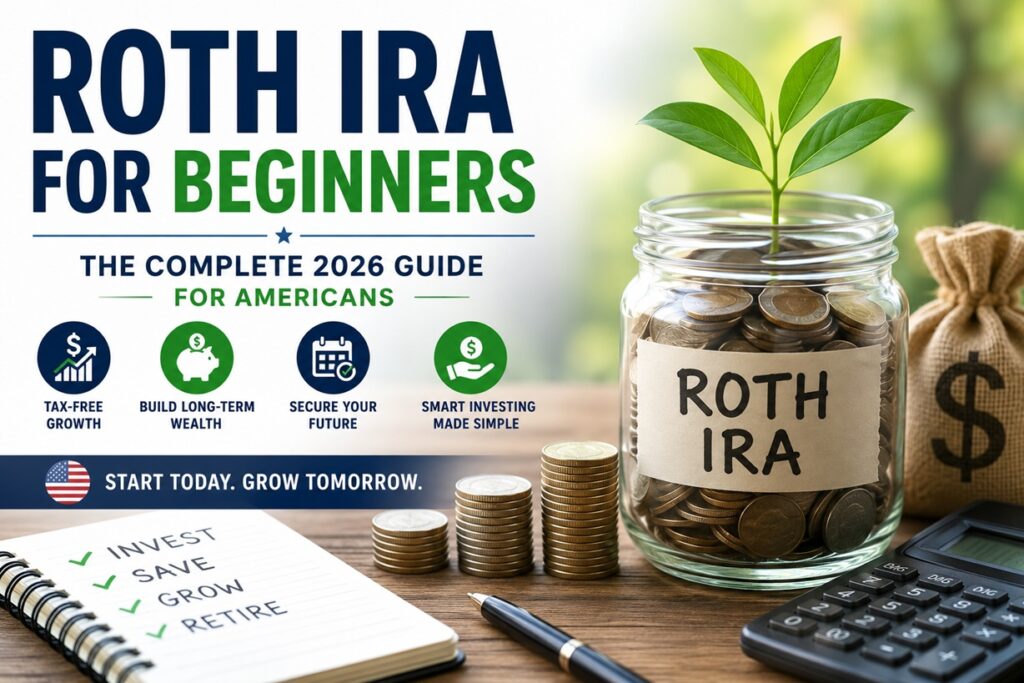
A Roth Individual Retirement Arrangement (Roth IRA) allows Americans to invest money after paying taxes and withdraw qualified earnings tax-free in retirement. Consequently, many financial experts consider it one of the most powerful wealth-building tools available to ordinary investors.
What Is a Roth IRA?
A Roth IRA is an individual retirement account that offers tax-free growth and tax-free withdrawals in retirement. Unlike traditional retirement accounts, you contribute money that you have already paid taxes on.
As a result, your investments can grow for decades, and qualified withdrawals in retirement generally remain free from federal income tax.
Many investors choose a Roth IRA because:
- Investment gains grow tax-free
- Qualified withdrawals remain tax-free
- No required minimum distributions apply during the original owner’s lifetime
- Contributions can often be withdrawn without taxes or penalties
How Does a Roth IRA Work?
You open a Roth IRA with a brokerage firm, contribute eligible income, and invest the money in assets such as index funds, ETFs, stocks, or bonds.
Popular providers include:
After you fund the account, your money can compound over time. Therefore, even modest contributions can grow significantly over several decades.
Why Roth IRAs Are So Popular
Many Americans choose Roth IRAs because they value tax-free retirement income. In addition, younger investors often expect their income to rise over time, which may place them in higher tax brackets later.
Furthermore, Roth IRAs provide flexibility because contributions can generally be withdrawn if needed, although investment earnings may be subject to rules and penalties if withdrawn early.
Who Can Open a Roth IRA?
Most Americans with earned income can open a Roth IRA, provided their income falls within annual eligibility limits set by the Internal Revenue Service.
Earned income includes:
- Wages and salaries
- Self-employment income
- Freelance income
- Bonuses and commissions
Income limits and contribution caps can change annually, so current IRS guidelines should be reviewed each year.
How Much Can You Contribute?
The IRS sets annual contribution limits for Roth IRAs. These limits often increase over time to reflect inflation.
Even if you cannot contribute the maximum amount, small monthly deposits can still produce meaningful long-term growth.
For example:
- $100 per month can grow substantially over several decades.
- $500 per month can build significant retirement savings.
Therefore, consistency matters far more than trying to time the market.
Best Investments for Beginners
Most beginners start with low-cost index funds that track the S&P 500.
Index funds are popular because they:
- Offer broad diversification
- Charge low fees
- Require little maintenance
- Perform competitively over long periods
As a result, many new investors prefer a simple buy-and-hold strategy.
Roth IRA vs Traditional IRA
Both accounts offer tax advantages, but they differ in timing.
Roth IRA
- Contributions use after-tax dollars
- Qualified withdrawals are tax-free
Traditional IRA
- Contributions may be tax-deductible
- Withdrawals are taxed in retirement
Therefore, investors who expect higher future tax rates often favor the Roth IRA.
When Should You Start?
The best time to start is usually as soon as possible. Because compound growth works over time, early contributions often produce the greatest benefit.
For example, an investor who starts at age 25 generally has a significant advantage over someone who waits until age 35, even if both contribute the same amount later.
Common Mistakes to Avoid
- Waiting too long to start investing
- Leaving contributions uninvested as cash
- Paying high fees
- Withdrawing earnings too early
- Ignoring diversification
Fortunately, these mistakes are easy to avoid with a simple long-term strategy.
Frequently Asked Questions
Yes. Many investors consider it one of the most effective retirement savings tools available.
Any consistent amount can help. Starting small is far better than delaying.
Popular choices include Vanguard, Fidelity, and Charles Schwab.
Yes. Investments can fluctuate in value, especially over short periods. However, long-term diversified investing has historically rewarded patient investors.
Absolutely. Most brokerage firms make the process straightforward.
Final Thoughts
A Roth IRA for beginners offers a straightforward and tax-efficient way to build long-term wealth. Moreover, it complements the financial habits you are already developing through budgeting, saving, and responsible credit management.
By starting early, investing consistently, and focusing on low-cost diversified funds, you can create a powerful source of tax-free retirement income.
At LearnWithVinod.com, our mission is simple: Learn, Earn, and Grow.