Table of Contents
- Quick Answer: Two Ways to Get an Adoption Tax Credit Refund
- What Changed: Why an Adoption Tax Credit Refund Is Now Possible
- The Automatic Adoption Tax Credit Refund for Carryforwards
- Do you need to do anything?
- How to know if your refund is real
- Who Qualifies for an Adoption Tax Credit Refund?
- Income limits
- Special needs adoptions
- What Expenses Count?
- How to Claim the Adoption Tax Credit Refund for a New Adoption
- Example: How the New Rules Help
- What to Do With Your Refund
- Final Thoughts
- Frequently Asked Questions
- Sources
For the first time, the federal adoption credit can put cash in your pocket even if you owe little or no income tax. Under the 2025 tax law, up to $5,000 per child of the credit is now refundable, and the IRS is already sending an automatic adoption tax credit refund to more than 50,000 families who had unused credits from earlier years. This guide explains the two ways to get the money, who qualifies, how much you can receive and exactly how to claim it.
Quick Answer: Two Ways to Get an Adoption Tax Credit Refund
| Automatic carryforward refund | Refundable credit for new adoptions | |
|---|---|---|
| Who it’s for | Families with unused adoption credit from 2020–2024 | Families who finalize (or pay expenses for) an adoption in 2025 or later |
| Amount | Up to $5,000 per child | Up to $5,000 per child for 2025; $5,120 for 2026 |
| Tax year | 2025 only | 2025 and later |
| Do you need to file? | No, if you filed your 2025 return by April 15, 2026 | Yes, claim it on Form 8839 with your return |
| Timing | Most refunds by December 31, 2026 | With your normal tax refund |
What Changed: Why an Adoption Tax Credit Refund Is Now Possible
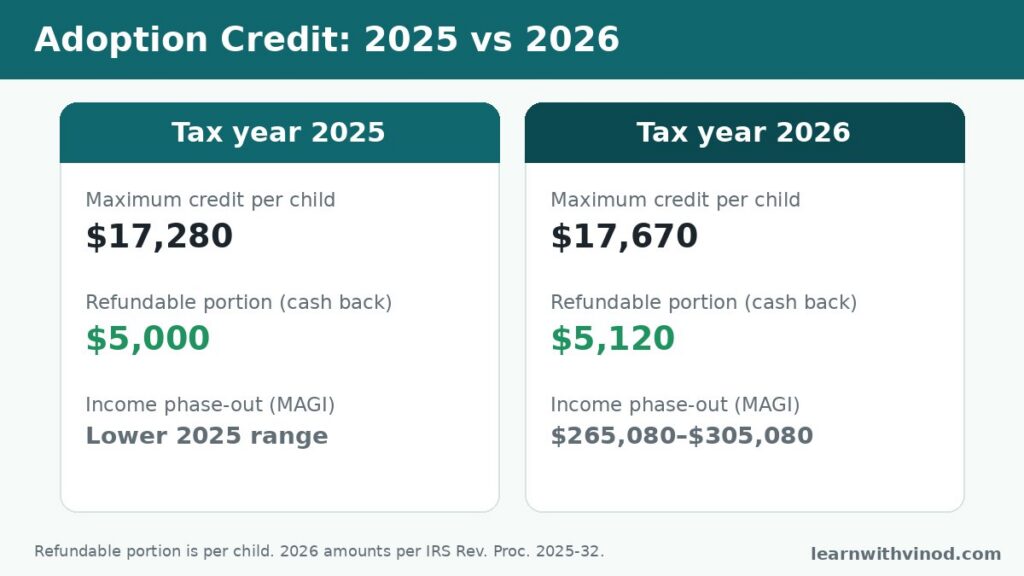
The adoption credit helps families pay for adoption costs. For 2025 the maximum credit is $17,280 per eligible child, and for 2026 it rises to $17,670.
Until 2025, the credit was fully nonrefundable. It could reduce your tax bill to zero, but any leftover amount did not come back to you as cash. Instead, it carried forward for up to five years. Many middle-income families never used all of it because their tax bills were too small.
The One Big Beautiful Bill Act changed that. Starting with tax year 2025, up to $5,000 of the credit per child is refundable, and that amount is adjusted for inflation ($5,120 for 2026). The rest of the credit is still nonrefundable and can still be carried forward.
The Automatic Adoption Tax Credit Refund for Carryforwards
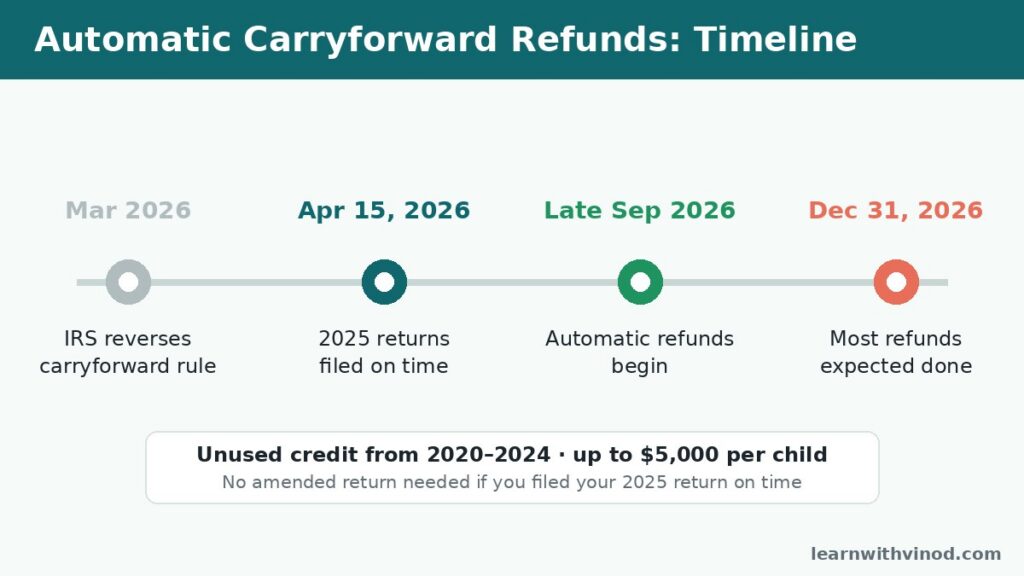
Here is the part many families do not know about. When the new rules took effect, IRS forms first said that credits carried forward from earlier years could not be used toward the refundable part. In March 2026, the IRS reversed that position.
For tax year 2025 only, unused adoption credit carried forward from 2020 through 2024 can count toward the refundable portion, up to $5,000 per qualifying child. Carryforwards from before 2020 have expired.
In October 2026, the IRS announced it had already sent this adoption tax credit refund to more than 50,000 taxpayers. Processing started in late September, and the IRS expects most eligible refunds to go out by the end of 2026.
Do you need to do anything?
- Filed your 2025 return by April 15, 2026? Generally no action is needed. The IRS adjusts your account automatically. Do not file an amended return just to ask for this.
- Filed on extension, or your account has an issue such as an identity theft flag or a dependency conflict? Your account will be reviewed later in 2026.
- Did not claim the credit in 2025 but have a carryforward on a 2020–2024 Form 8839? You may still qualify. If the IRS does not have enough information, you may need to file Form 1040-X with Form 8839.
- Did not file a 2025 return at all? You will not get the adjustment until you file.
How to know if your refund is real
The IRS usually mails a notice within 30 days of the adjustment. You can also see the change on your 2025 account transcript in your IRS online account. The “Where’s My Refund?” tool does not show this type of adjustment. If someone texts or emails you about an adoption credit refund and asks for bank details, it is a scam. Read the official IRS questions and answers on the carryforward for details.
One more thing: the IRS can apply the refund to other debts, such as past-due federal taxes or certain state debts. Your notice will tell you if that happened. If the debt belongs only to your spouse, Form 8379 (Injured Spouse Allocation) may help.
Who Qualifies for an Adoption Tax Credit Refund?
To get any adoption tax credit refund, you first need to qualify for the credit itself. You can generally claim it if you adopted, or tried to adopt, an eligible child:
- A child under 18, or
- A person of any age who is physically or mentally unable to care for themselves.
The credit covers domestic, international, private and foster care adoptions. Adopting your spouse’s child does not qualify.
Income limits
The credit starts to shrink once your modified adjusted gross income (MAGI) passes a set level and disappears completely $40,000 later. For 2026, the phase-out runs from about $265,080 to $305,080 of MAGI. The 2025 range is slightly lower. Most families fall well below these limits.
Special needs adoptions
If you adopt a U.S. child whom a state, or now a federally recognized tribal government, has determined to have special needs, you can claim the full credit even if you paid little or nothing in adoption expenses. This is especially valuable for families adopting from foster care, where costs are often low.
What Expenses Count?
The size of your adoption tax credit refund depends on your qualified expenses, unless the child has special needs. Qualified adoption expenses are reasonable and necessary costs directly related to a legal adoption, including:
- Adoption agency fees
- Court costs and attorney fees
- Home study fees, even if paid before a child is identified
- Travel costs, including meals and lodging while away from home
Costs paid by your employer through an adoption assistance program cannot also be counted for the credit, but those benefits may be tax-free up to a similar limit.
How to Claim the Adoption Tax Credit Refund for a New Adoption
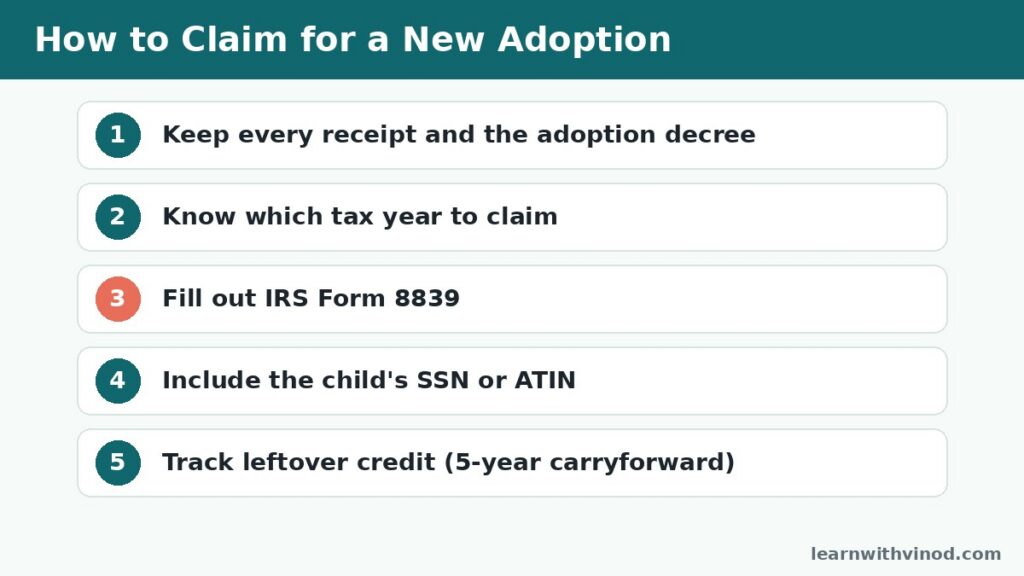
- Keep every receipt. Save agency invoices, court documents, travel receipts and the final adoption decree.
- Know which year to claim. For a domestic adoption, expenses paid before the year it is finalized are claimed the year after you pay them; expenses in the year of finalization or later are claimed that year. For a foreign adoption, you claim expenses only once the adoption is final.
- Fill out Form 8839. This form calculates your credit and splits it into the refundable and nonrefundable parts.
- Include the child’s information, including a Social Security number or adoption taxpayer identification number (ATIN).
- Track any leftover credit. The nonrefundable part you cannot use this year carries forward for up to five years.
Example: How the New Rules Help
Here is how an adoption tax credit refund can work in practice. Consider a family that finalized an adoption in 2023, qualified for the full credit, but owed only a few thousand dollars in federal tax each year. By 2025 they still had about $9,000 of unused credit carried forward.
Under the old rules, they might never have used it all before it expired. Under the 2025 special rule, up to $5,000 of that carryforward can be paid out as a refund. The remaining amount can still carry forward to future years, though it may be smaller after the adjustment. This is an illustration only; your actual amount depends on your tax situation.
What to Do With Your Refund
If an adoption tax credit refund lands in your account, consider putting part of it toward an emergency fund for your growing family. A high-yield account can help it grow; see our list of the best online banks in the USA for 2026. Adding a child is also a qualifying life event for health insurance. Our guide to ACA open enrollment 2027 explains your coverage options.
Final Thoughts
The adoption credit finally works for families with modest tax bills. If you had unused credit from 2020 to 2024, watch your mail and IRS account for an automatic adoption tax credit refund before the end of 2026. If you are adopting now, keep good records and claim the refundable portion on Form 8839. For more practical money guides, visit our Personal Finance section, and see the IRS’s official announcement.
Disclaimer: This article is for general information only and is not tax advice. Figures and IRS procedures are as of October 2026. Talk to a tax professional about your own situation.
Frequently Asked Questions
Is the adoption tax credit refundable now?
Partly. Starting with tax year 2025, up to $5,000 per child is refundable ($5,120 for 2026). The rest of the credit is nonrefundable and can be carried forward for up to five years.
What is the automatic adoption credit carryforward refund?
For tax year 2025 only, unused adoption credit carried forward from 2020–2024 can count toward the refundable portion, up to $5,000 per child. The IRS began sending these refunds automatically in late September 2026.
Do I need to file an amended return to get the carryforward refund?
Generally no, if you filed your 2025 return by April 15, 2026. The IRS adjusts your account and mails a notice. You may need Form 1040-X with Form 8839 if you never claimed the carryforward.
How much is the adoption credit for 2026?
Up to $17,670 per eligible child, with up to $5,120 refundable. It phases out for modified AGI between about $265,080 and $305,080.
Can I get the credit if I adopted from foster care with no expenses?
Yes, if the child is a U.S. child determined by a state or a federally recognized tribal government to have special needs. You can claim the full credit even with little or no expenses.
How do I check if I received an automatic adoption credit refund?
Watch for an IRS notice, usually mailed within 30 days of the adjustment, or check your 2025 account transcript in your IRS online account. ‘Where’s My Refund?’ does not show this adjustment.
Sources
- IRS – IRS has begun issuing automatic refunds for Adoption Tax Credit carryforward (IR-2026-123)
- IRS – Questions and answers about Adoption Tax Credit carryforward
- IRS – Improvements to the Adoption Tax Credit (Tax Tip 2025-71)
- IRS – Adoption credit carryforward may be refundable for tax year 2025
- US Tax Tools – Adoption Tax Credit 2026 amounts and phase-out
- Tom Talks Taxes – IRS mid-season adoption credit change (March 2026)
- IRS Problem Solvers – Is an automatic adoption credit refund real?