Table of Contents
- What the Fed Decided About Interest Rates in October
- Why Fed Interest Rates Are Staying High
- What High Fed Interest Rates Mean for Your Money
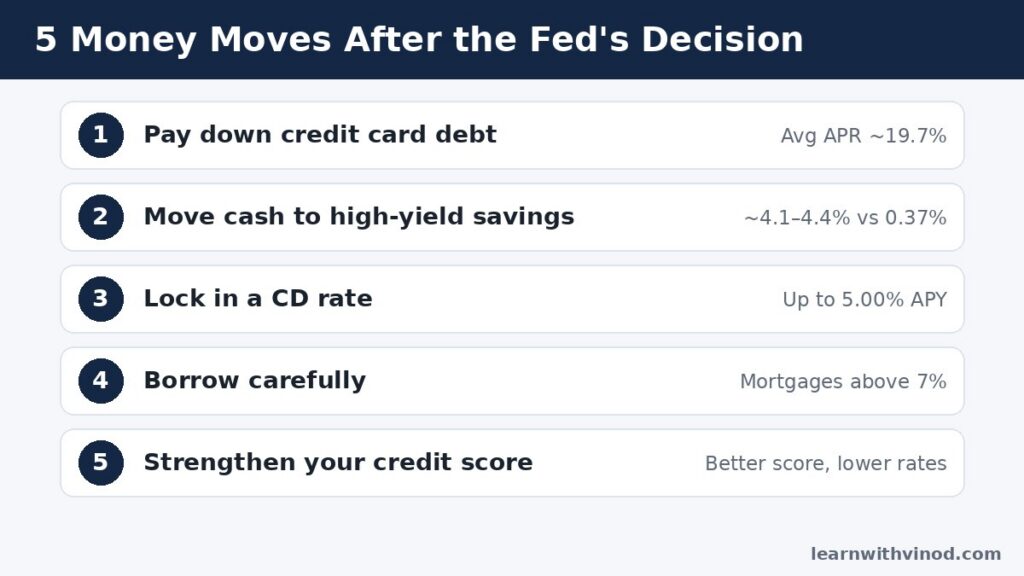
- 5 Money Moves to Make While Fed Interest Rates Stay High
- 1. Pay down high-interest credit card debt first
- 2. Move your cash to a high-yield savings account
- 3. Lock in a CD rate while it lasts
- 4. Be careful with big new loans and variable rates
- 5. Strengthen your credit score
- What to Watch Next for Fed Interest Rates
- Final Thoughts
- Frequently Asked Questions
- Sources
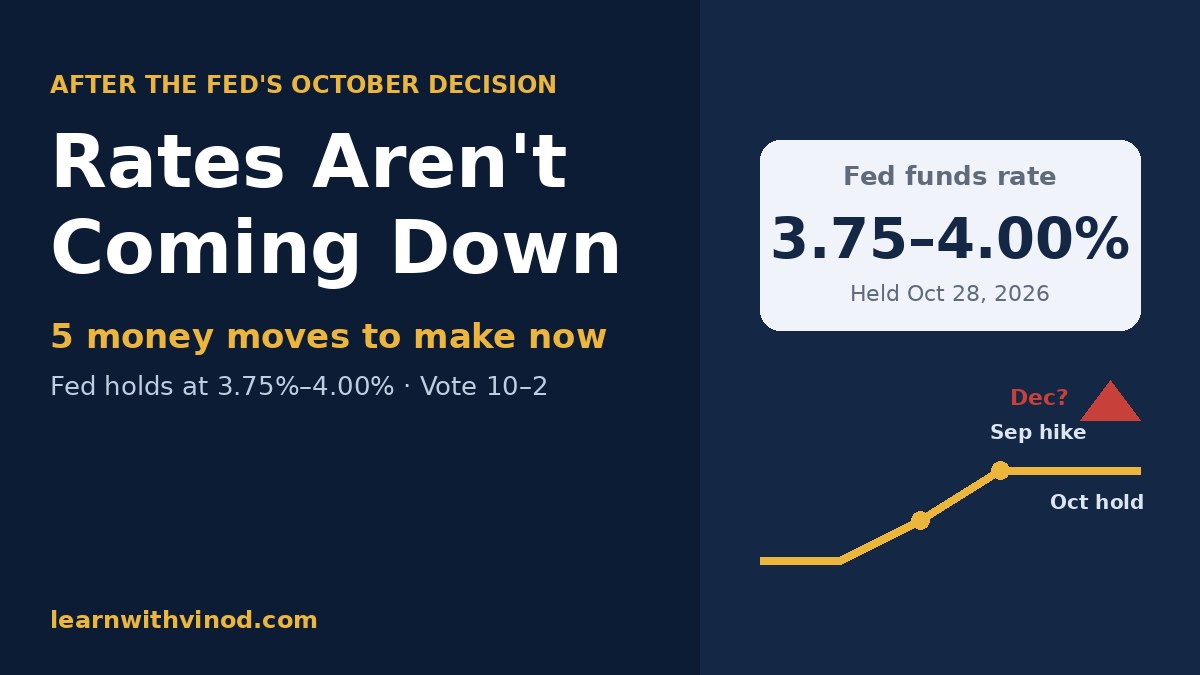
On October 28, 2026, the Federal Reserve held its benchmark rate at 3.75% to 4.00%, and two officials voted for another hike instead. The message for your wallet is clear: Fed interest rates are not coming down anytime soon. Inflation is still well above the Fed’s 2% target, and most officials expect at least one more hike before the year ends. That means credit cards, car loans and mortgages will stay expensive, while savers can keep earning solid returns. Here is what the Fed decided, what it means for you, and five money moves to make now.
What the Fed Decided About Interest Rates in October
The Fed’s policy committee voted 10 to 2 to keep the federal funds rate at 3.75% to 4.00%. The two dissenters, Governor Lisa Cook and Cleveland Fed President Beth Hammack, both wanted to raise rates by another quarter point. In its statement, the Fed said economic activity is “expanding strongly” and that “inflation remains elevated.” It gave no promise about what comes next, saying only that more information will help it decide.
At his press conference, Fed Chair Kevin Warsh said financial conditions have “tightened for some businesses and households” since September’s hike. But he added: “While overall financial conditions are tighter, I’m unwilling and unable to call them tight.” In other words, the Fed does not think it has done enough yet. Before the meeting, futures markets put the odds of a December hike at about 84%.
This follows the Fed’s September 16 meeting, when it raised rates by a quarter point for the first time since July 2023. At that meeting, 16 of 18 officials projected at least one more hike in 2026, and the median forecast showed rates around 4.1% at the end of both 2026 and 2027. In plain words: the Fed does not expect to cut rates for a long time.
Why Fed Interest Rates Are Staying High
The short answer is inflation. Consumer prices rose 3.7% in the 12 months to September, up from 3.4% in August and above what economists expected. Wholesale prices jumped 6.3%. Higher energy costs linked to the war with Iran, tariffs and strong demand from the AI boom have all pushed prices up.
“The plain fact is that inflation is too high, and has been for too long,” Fed Chair Kevin Warsh said in September. Some officials want to move faster. Dallas Fed President Lorie Logan has called for a larger half-point hike, while New York Fed President John Williams has said there is “no need for urgency.”
Fed interest rates are not the only thing pushing costs up. Long-term borrowing costs have climbed too. The 10-year Treasury yield, which strongly affects mortgage rates, touched 5.3% in September, its highest level in more than two decades.
What High Fed Interest Rates Mean for Your Money
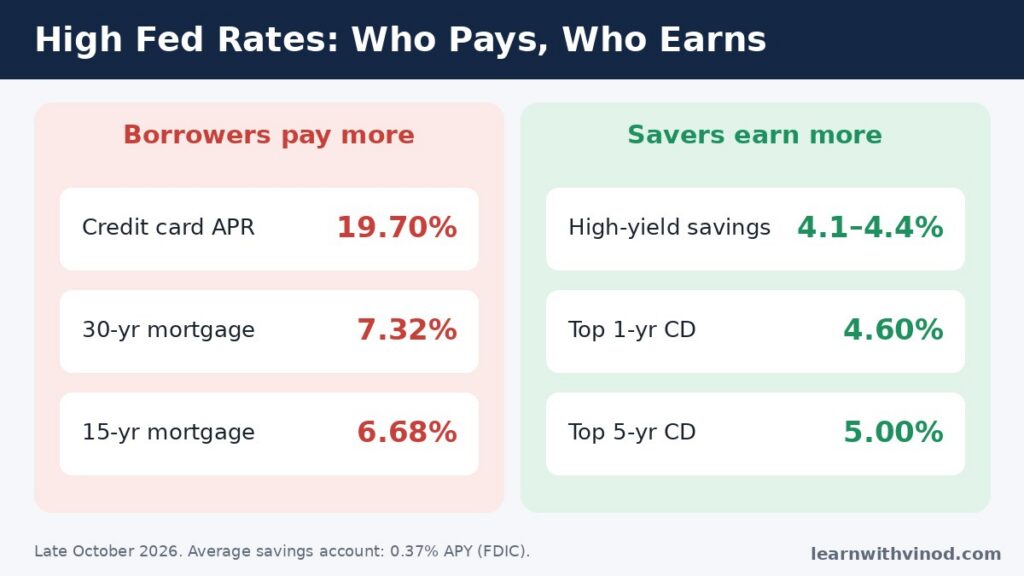
| Product | Typical rate now | What it means |
|---|---|---|
| Credit cards | 19.70% average APR | Carrying a balance is very costly |
| 30-year fixed mortgage | 7.32% | Home buying stays expensive; refinancing rarely pays |
| 15-year fixed mortgage | 6.68% | Lower rate, higher monthly payment |
| Top 1-year CD | up to 4.60% APY | Good chance to lock in a return |
| Top 5-year CD | up to 5.00% APY | Locks in today’s rate for longer |
| Top high-yield savings | about 4.1%–4.4% APY | Easy access and a strong return |
| Average savings account | 0.37% APY | Money in a regular account is losing ground |
Rates are as of late October 2026 and vary by lender and credit score.
5 Money Moves to Make While Fed Interest Rates Stay High
1. Pay down high-interest credit card debt first
Credit cards feel Fed interest rates faster than almost anything else. Most have variable rates tied to the prime rate, which moves with the Fed. After September’s hike, the average card rate rose within weeks. If the Fed hikes again in December, your rate will likely rise again.
- List your cards from highest to lowest interest rate and pay extra on the highest one first.
- Look at a 0% balance transfer card if your credit is good. Check the transfer fee (often 3%–5%) and how long the 0% rate lasts.
- Call your card company and ask for a lower rate. It does not always work, but it costs nothing to ask.
Example: a $5,000 balance at 19.70% costs about $985 a year in interest. Paying it off is like earning a guaranteed 19.70% return.
2. Move your cash to a high-yield savings account
Higher Fed interest rates are good news for savers, but only if your money is in the right place. Many people still keep their savings in a regular account at a big bank that pays almost nothing. The national average savings rate is just 0.37% APY, according to the FDIC. Meanwhile, the best online high-yield savings accounts pay around 4.1% to 4.4% APY.
That gap adds up fast. Here is what $10,000 would earn in one year:
| Where your $10,000 sits | APY | Interest in one year |
|---|---|---|
| Average savings account | 0.37% | about $37 |
| High-yield savings account | 4.20% | about $420 |
| Extra you could earn | about $383 |
Because the Fed is holding rates high and may raise them again, high-yield accounts are likely to keep paying well for now. Unlike a CD, your money is not locked up, so this is the best home for your emergency fund and short-term savings.
Why online banks pay more
Online banks do not run expensive branch networks, so they can pass more of their earnings to savers. Many big banks pay low rates simply because most customers never move their money.
How to switch in five steps
- Decide how much to move. Keep enough in checking for one month of bills, and move the rest of your emergency fund and short-term savings.
- Compare accounts. Look at the APY, minimum balance, monthly fees and how fast transfers arrive. See our list of the best online banks in the USA for 2026.
- Check deposit insurance. Choose an account insured by the FDIC (or NCUA for credit unions). Insurance covers up to $250,000 per depositor, per bank, per ownership category. You can confirm a bank with the FDIC BankFind tool.
- Open and link the account. Most online banks let you open an account in about 10 minutes and link it to your current checking account.
- Automate your saving. Set up an automatic transfer on payday so your savings grow without effort.
Things to watch out for
- Teaser rates: some banks offer a high rate for a few months, then lower it. Read the terms.
- Variable rates: savings rates can change at any time. If the Fed eventually cuts, your rate will fall too.
- Withdrawal timing: transfers to checking can take one to three business days, so keep some cash in checking for emergencies.
- Taxes: interest is taxable income, and you will get a Form 1099-INT if you earn $10 or more.
3. Lock in a CD rate while it lasts
CD yields follow Fed interest rates too. Top certificates of deposit pay up to 4.60% for one year and up to 5.00% for five years. If you have money you will not need for a while, a CD lets you lock in today’s rate even if Fed interest rates eventually fall.
A smart approach is a CD ladder: split your money across CDs that mature at different times, such as 1, 2 and 3 years. Each time one matures, you can reinvest or use the cash. Remember that cashing out a CD early usually means paying a penalty.
4. Be careful with big new loans and variable rates
With 30-year mortgage rates above 7%, think carefully before taking on a large new loan.
- Buying a home: get preapproved, compare at least three lenders, and make sure the payment fits your budget at today’s rate. Do not count on refinancing soon.
- Adjustable-rate loans and HELOCs: these rates move with Fed interest rates and can rise when the Fed hikes. If you have one, consider whether switching to a fixed rate makes sense.
- Car loans: a bigger down payment or a shorter loan term can cut the interest you pay. Check credit union rates too.
5. Strengthen your credit score
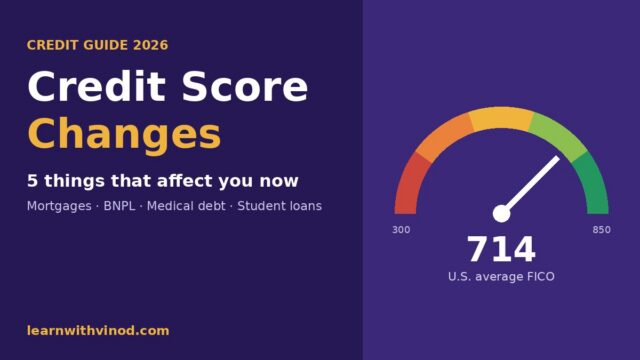
When Fed interest rates are high, a good credit score can save you thousands. Lenders give their best rates to people with strong scores. Pay every bill on time, keep your credit card balances low compared with your limits, and avoid opening many new accounts at once.
Learn how scoring works in our guide FICO Score Explained, and get practical steps in how to build credit fast.
What to Watch Next for Fed Interest Rates
- Next Fed meeting: December 8–9, 2026. Many economists expect another hike, and the Fed will publish new rate forecasts.
- Inflation reports: the next consumer price reports will show whether prices are cooling.
- Your own rates: check your card statements and any variable-rate loans after each Fed meeting.
You can read the full October 28 FOMC statement on the Federal Reserve website.
Final Thoughts
The Fed paused in October, but with two officials already pushing for a hike and inflation near 3.7%, Fed interest rates are likely to stay high well into 2027. Instead of waiting for relief, use this time to pay off costly debt, earn more on your savings, lock in good CD rates, borrow carefully and build your credit. For more practical guides, visit our Personal Finance section.
Disclaimer: This article is for general information only and is not financial advice. Rates mentioned are national averages or top rates as of late October 2026 and change often. Compare offers and consider speaking with a qualified financial professional before making decisions.
Frequently Asked Questions
What did the Fed decide in October 2026?
On October 28, 2026, the Fed held the federal funds rate at 3.75% to 4.00% in a 10–2 vote. Lisa Cook and Beth Hammack dissented in favor of a quarter-point hike.
Will the Fed raise rates in December 2026?
It is possible. Two officials already voted for a hike, inflation is about 3.7%, and before the October meeting markets put the odds of a December hike at about 84%. The next meeting is December 8–9.
When will Fed interest rates come down?
Not soon. In September, the median Fed official projected rates around 4.1% at the end of both 2026 and 2027.
How do Fed interest rates affect my credit card?
Most credit cards have variable rates tied to the prime rate, which moves with the Fed. When the Fed raises rates, card APRs usually rise within one or two billing cycles.
Is now a good time to open a high-yield savings account?
Yes, for emergency funds and short-term savings. Top online accounts pay around 4.1% to 4.4% APY, compared with a national average of 0.37%.
Should I lock in a CD now?
If you won’t need the money for a while, a CD locks in today’s rate, with top rates up to 4.60% for one year and 5.00% for five years. Early withdrawal usually means a penalty.
Sources
- Federal Reserve – FOMC statement, October 28, 2026
- American Banker – FOMC press conference live coverage, October 2026
- Yahoo Finance – Fed meeting live updates, October 2026
- Chase – Fed raises rates in September, officials signal one more hike in 2026
- US September 2026 CPI (investingLive)
- The Mortgage Reports – Freddie Mac rates, October 22, 2026
- Bankrate via WRDW – current credit card interest rates
- NerdWallet – best CD rates, October 2026
- SwitchWize – savings rate watch, October 2026