Table of Contents
- What Is a FICO Score?
- FICO Score Ranges and the National Average
- How Your FICO Score Is Calculated: The 5 Factors
- 1. Payment history (35%)
- 2. Amounts owed (30%)
- 3. Length of credit history (15%)
- 4. Credit mix (10%)
- 5. New credit (10%)
- You Have Many FICO Scores, Not Just One
- FICO Score vs. VantageScore
- How to Check Your FICO Score for Free
- A Realistic Plan to Raise Your FICO Score
- FICO Score Myths
- Final Thoughts
- Frequently Asked Questions
- Sources
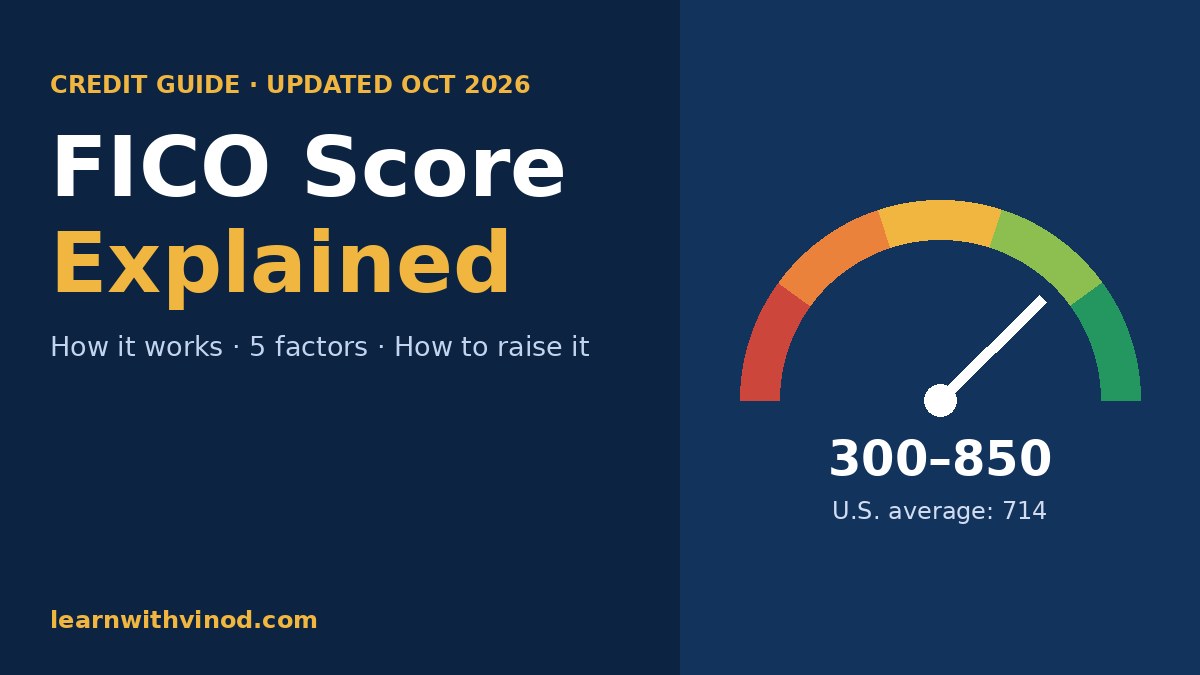
A FICO Score is a three-digit number, usually between 300 and 850, that lenders use to predict how likely you are to repay a loan. FICO says its scores are used by 90% of top U.S. lenders, so this one number can decide whether you are approved for a credit card, car loan or mortgage and how much interest you pay. This guide explains how your FICO Score is calculated, why you actually have dozens of different FICO Scores, how to check yours for free and a realistic plan to raise it.
What Is a FICO Score?
FICO (originally Fair Isaac Corporation) created the first widely used credit score in 1989. A FICO Score is calculated from the information in your credit report at one of the three national credit bureaus: Equifax, Experian or TransUnion. FICO does not collect your data. It provides the formula, and each bureau runs it on the file it holds about you.
Because the three bureaus may have slightly different information, your FICO Score can be a little different at each one. That is normal.
FICO Score Ranges and the National Average
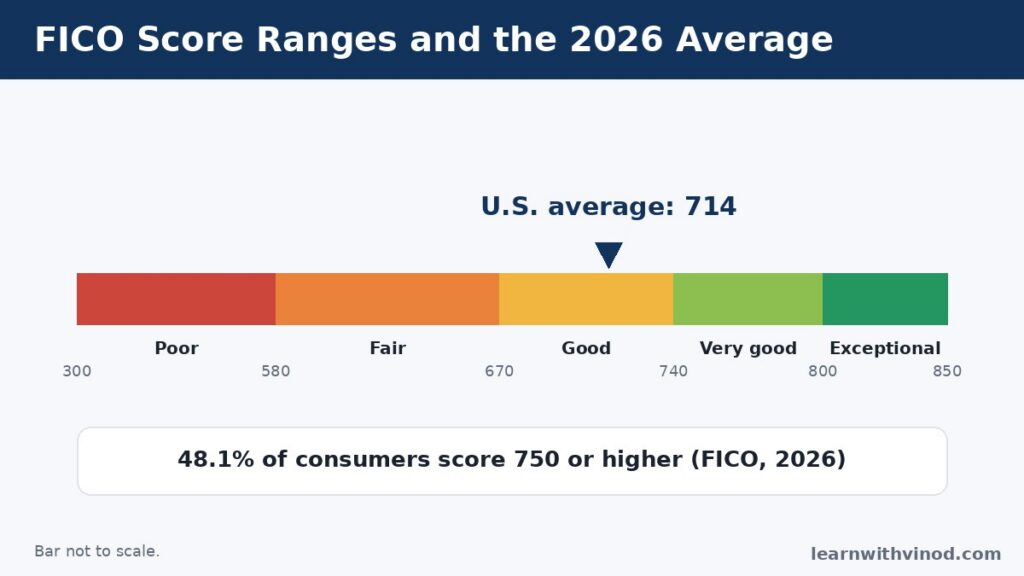
| FICO Score | Rating | What it usually means |
|---|---|---|
| 800–850 | Exceptional | The best rates and easiest approvals |
| 740–799 | Very good | Better-than-average rates |
| 670–739 | Good | Approved by most lenders |
| 580–669 | Fair | Approval possible, higher rates |
| 300–579 | Poor | Hard to get approved; may need secured products |
The U.S. average FICO Score is 714 in 2026, according to FICO’s Score Credit Insights reports, and 48.1% of consumers score 750 or higher. If you are near 714, you are in the “good” range, and moving into the 740s can unlock noticeably better loan rates.
How Your FICO Score Is Calculated: The 5 Factors
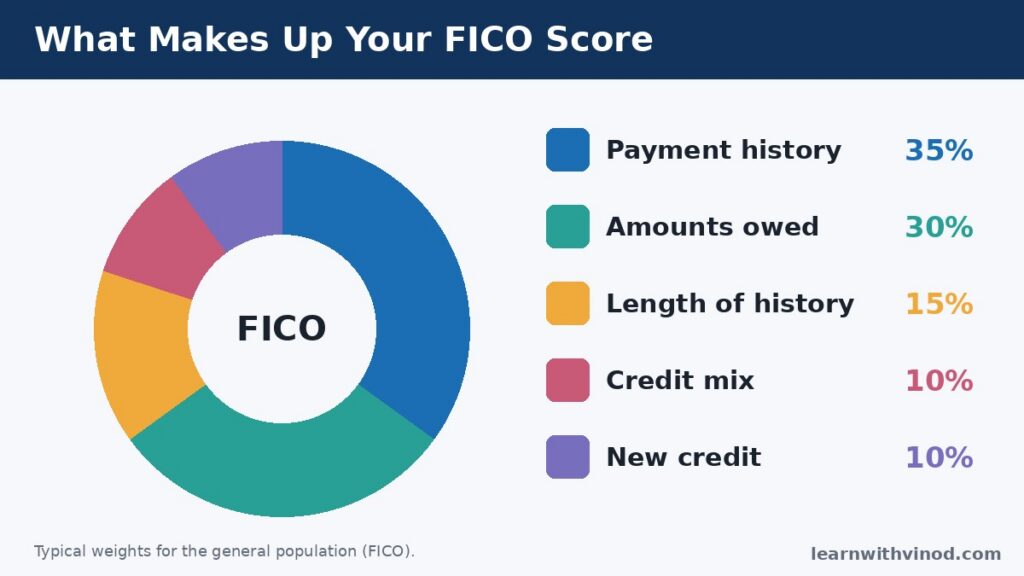
FICO groups the information in your credit report into five categories. The percentages show how much each one matters for most people. Your own mix can differ, especially if you have a short credit history.
1. Payment history (35%)
Do you pay on time? This is the single biggest factor. One payment that is 30 or more days late can drop a good score by dozens of points, and late payments can stay on your report for seven years. Collections, charge-offs and bankruptcies also fall here.
Example: missing one car payment by 45 days will usually hurt far more than carrying a high card balance for a month.
2. Amounts owed (30%)
This is mostly your credit utilization: how much of your available revolving credit you are using. If you have $10,000 in total card limits and owe $2,000, your utilization is 20%. Lower is better. Many experts suggest staying under 30%, and people with the highest scores often stay under 10%.
Tip: utilization is based on the balance your card issuer reports, usually your statement balance. Paying down the card before the statement closes can lower it, even if you pay in full every month.
3. Length of credit history (15%)
FICO looks at the age of your oldest account, your newest account and the average age of all accounts. This is why closing your oldest credit card can hurt over time.
4. Credit mix (10%)
Having both revolving credit (credit cards) and installment loans (car, student or mortgage loans) can help a little. You do not need to take on a loan just to improve your mix.
5. New credit (10%)
Opening several accounts in a short time can signal risk. Each hard inquiry from a credit application may lower your score a few points. Inquiries count toward your FICO Score for 12 months and stay on your report for two years. Rate shopping for a mortgage, car loan or student loan within a short window is usually counted as one inquiry.
You Have Many FICO Scores, Not Just One
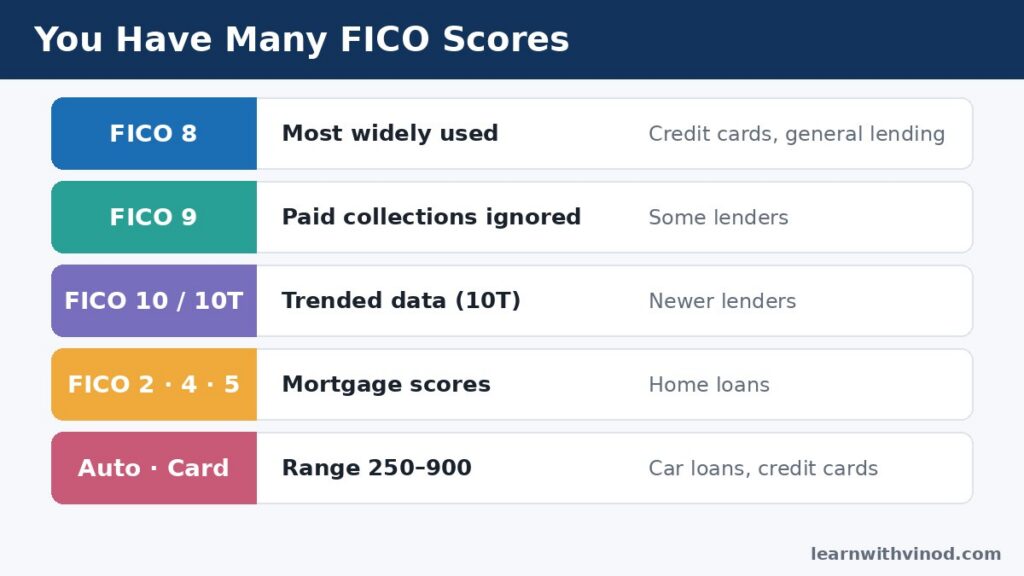
This is the part most guides skip. FICO has released many versions over the years, and different lenders use different ones:
| FICO version | Range | Where it is used |
|---|---|---|
| FICO Score 8 | 300–850 | The most widely used base score for credit cards and general lending |
| FICO Score 9 | 300–850 | Some lenders; ignores paid collections and treats medical collections more lightly |
| FICO Score 10 and 10T | 300–850 | Newer models; 10T uses “trended” data showing how your balances change over time |
| FICO Scores 2, 4 and 5 | 300–850 | Mortgage lending (Experian, TransUnion and Equifax versions) |
| FICO Auto and Bankcard Scores | 250–900 | Industry scores tuned for car loans and credit cards |
So the FICO Score you see in an app may not be the exact one a lender pulls. The good news: all versions reward the same habits, so improving one improves them all.
Mortgage lending is also changing. Lenders selling loans to Fannie Mae and Freddie Mac can now use VantageScore 4.0 instead of the older FICO mortgage scores. Read our guide to credit score changes in 2026 for what that means for home buyers.
FICO Score vs. VantageScore
VantageScore is a competing model created by the three credit bureaus. It uses the same 300–850 range and similar factors, but it weighs them differently and can score people with very little credit history. Many free apps show a VantageScore, not a FICO Score, which is why the numbers you see in different places can differ by 20 points or more.
How to Check Your FICO Score for Free
- Your credit card or bank: many issuers show a free FICO Score on your monthly statement or in their app. Check which version and bureau they use.
- Credit bureau accounts: Experian offers a free FICO Score 8 with a basic account.
- myFICO: FICO’s own site offers a limited free score and paid plans that show many versions, including mortgage and auto scores.
- Your credit reports: the score comes from your reports, so check them too. You can get free reports from all three bureaus at AnnualCreditReport.com.
Checking your own score is a soft inquiry and never lowers it.
A Realistic Plan to Raise Your FICO Score
How fast your score improves depends on what is holding it back. These are typical estimates, not guarantees.
| Timeframe | What to do | What can change |
|---|---|---|
| First 30 days | Pay card balances down before statements close; set up autopay for minimums; dispute any errors | Utilization drops can raise a score quickly, often within one or two billing cycles |
| 30–90 days | Bring any past-due accounts current; ask for credit limit increases (without a hard pull if possible) | Stops new damage and keeps utilization low |
| 6–12 months | Build a streak of on-time payments; avoid new applications | Older late payments slowly matter less |
| 12+ months | Keep old accounts open; add a credit-builder loan if your file is thin | Longer history and a steadier profile |
If you are starting from scratch, see our guides on how to build credit fast and credit builder loans.
FICO Score Myths
- “Checking my score lowers it.” False. Checking your own score is a soft inquiry.
- “Carrying a balance helps my score.” False. Paying in full each month is best; interest does not help.
- “Income affects my score.” False. Income is not in your credit report, though lenders consider it separately.
- “Closing old cards helps.” Usually false. It can raise utilization and shorten your history.
Final Thoughts
Your FICO Score comes down to a few habits: pay every bill on time, keep balances low, keep old accounts open and apply for new credit only when you need it. You have many FICO versions, but the same habits raise all of them. Check your reports, track one score consistently and give improvements time to show. For more practical guides, visit our Personal Finance section, or learn more from FICO’s own credit education pages.
Disclaimer: This article is for general information only and is not financial advice. Score effects and timelines are typical estimates; your results depend on your credit report. Figures are as of October 2026.
Frequently Asked Questions
What is a good FICO Score?
A FICO Score of 670–739 is considered good, 740–799 very good and 800–850 exceptional. The U.S. average is 714 in 2026.
How is a FICO Score calculated?
From five categories in your credit report: payment history (35%), amounts owed (30%), length of credit history (15%), credit mix (10%) and new credit (10%).
Why do I have different FICO Scores?
Each credit bureau has slightly different data, and lenders use different FICO versions, such as FICO 8 for cards, FICO 2, 4 and 5 for mortgages, and industry scores for auto loans.
Does checking my FICO Score lower it?
No. Checking your own score is a soft inquiry and does not affect it. Only hard inquiries from credit applications can lower it.
How fast can I raise my FICO Score?
Lowering credit card balances can help within one or two billing cycles. Recovering from late payments takes many months of on-time payments. Results vary by credit report.
Is FICO the same as VantageScore?
No. Both use a 300–850 range, but they weigh factors differently. Many free apps show VantageScore, while most lenders use a FICO Score.