Table of Contents
- Social Security Tax Cap 2027: The Key Numbers
- Who Pays More Under the New Social Security Tax Cap?
- Self-employed? Your extra cost doubles
- How the Social Security Tax Cap Has Grown
- What it means for employers
- When Does Social Security Tax Stop on Your Paycheck?
- Two Jobs? You May Pay Over the Social Security Tax Cap
- What You Get Back: A Bigger Future Benefit
- Working While Collecting? The Earnings Test Also Rises
- Could the Social Security Tax Cap Be Removed?
- What to Do Now
- Final Thoughts
- Frequently Asked Questions
- Sources
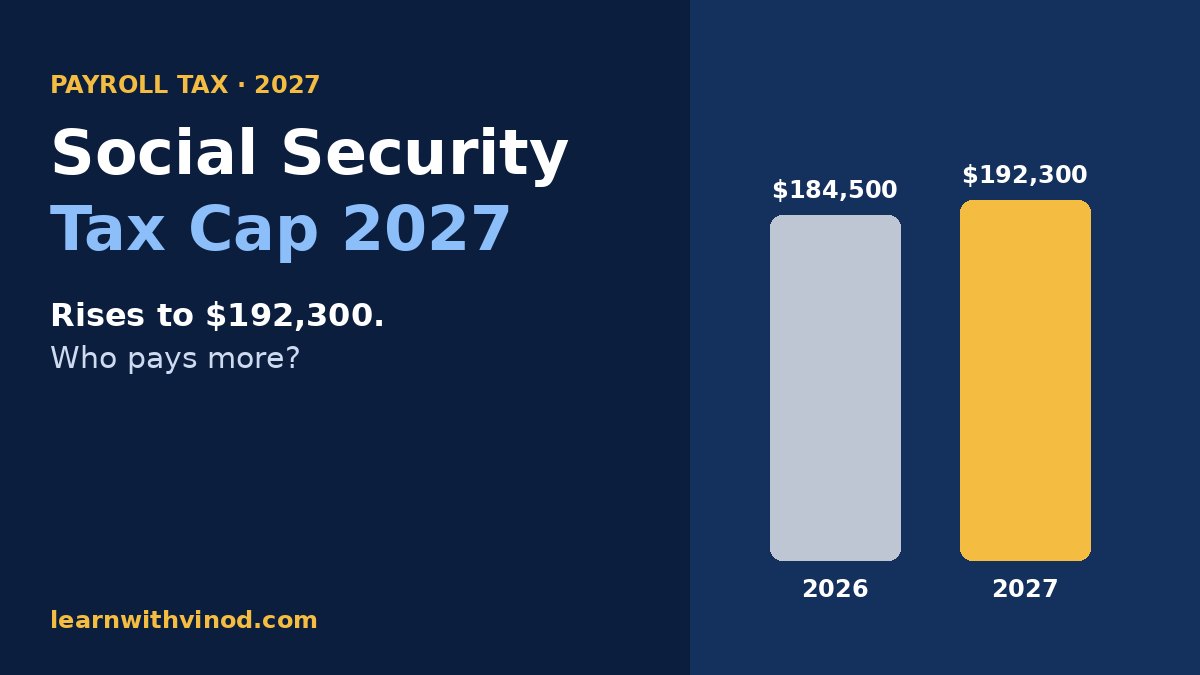
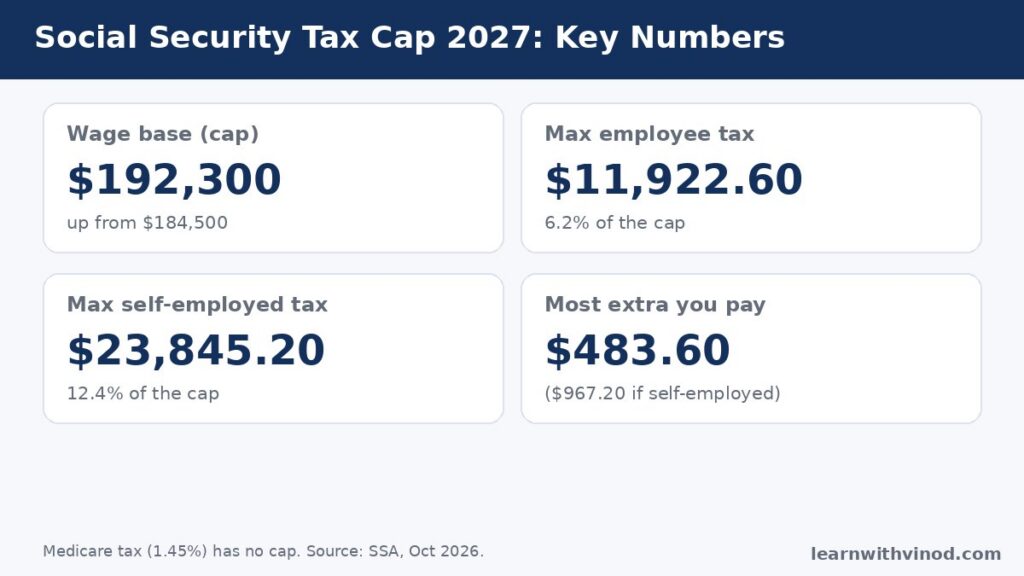
The Social Security tax cap is going up. In 2027, the 6.2% Social Security payroll tax will apply to the first $192,300 of wages, up from $184,500 in 2026, according to the Social Security Administration. But most workers won’t pay a penny more because of it. The change only affects people who earn above $184,500, and the extra cost tops out at $483.60 for employees and $967.20 for the self-employed. This guide shows exactly who pays more, how much, when the tax stops appearing on your paycheck, and the one benefit you get in return.
Social Security Tax Cap 2027: The Key Numbers
| Item | 2026 | 2027 |
|---|---|---|
| Social Security wage base (tax cap) | $184,500 | $192,300 |
| Employee tax rate | 6.2% | 6.2% |
| Maximum employee Social Security tax | $11,439.00 | $11,922.60 |
| Maximum employer match (per worker) | $11,439.00 | $11,922.60 |
| Maximum self-employed Social Security tax (12.4%) | $22,878.00 | $23,845.20 |
| Medicare tax (1.45% each) | No cap | No cap |
The cap is often called the “taxable maximum” or “wage base.” It rises most years based on the growth in average U.S. wages. That is separate from the 3.6% cost-of-living adjustment for benefits, which we cover in our guide to the Social Security COLA 2027.
Who Pays More Under the New Social Security Tax Cap?
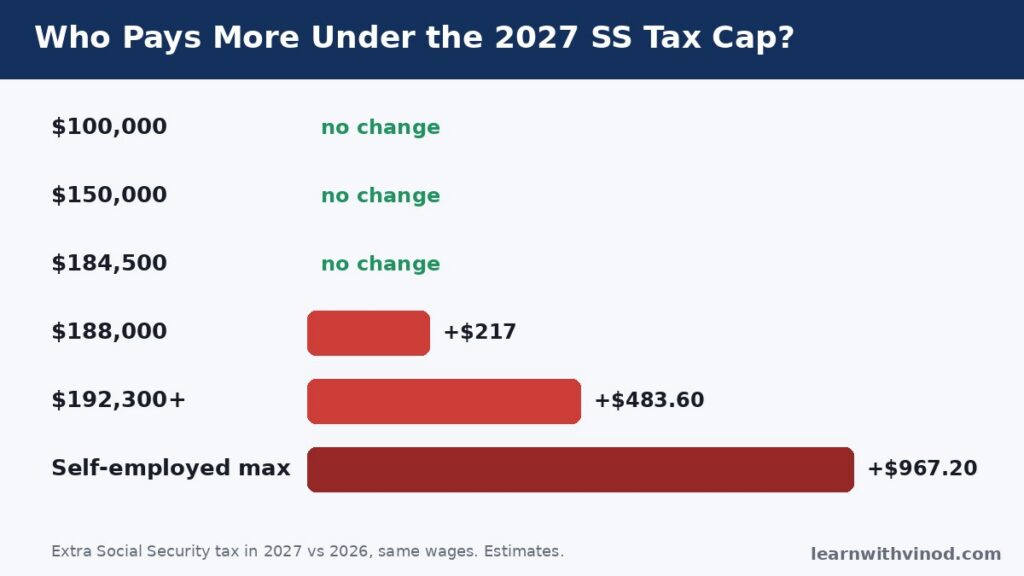
Only people with earnings above the old cap pay more. If you earn $184,500 or less, your Social Security tax doesn’t change at all; it stays at 6.2% of your pay, as it always was.
| Yearly wages | 2026 Social Security tax | 2027 Social Security tax | Change |
|---|---|---|---|
| $100,000 | $6,200 | $6,200 | $0 |
| $150,000 | $9,300 | $9,300 | $0 |
| $184,500 | $11,439 | $11,439 | $0 |
| $188,000 | $11,439 | $11,656 | +$217 |
| $192,300 or more | $11,439 | $11,922.60 | +$483.60 |
Assumes the same wages in both years. In practice, many workers get raises, so their tax also rises because they earn more, not because of the cap.
In past years, SSA has estimated that only about 6% of workers earn more than the taxable maximum. So the Social Security tax cap increase mostly affects higher earners, along with their employers, who pay a matching 6.2%.
Self-employed? Your extra cost doubles
If you work for yourself, you pay both halves of the tax, 12.4% in total, through self-employment tax. That means a maximum increase of $967.20 in 2027. There’s a twist many freelancers miss: self-employment tax applies to 92.35% of your net earnings. So you only reach the $192,300 cap when your net self-employment income is about $208,230. Plan your quarterly estimated payments with this in mind.
How the Social Security Tax Cap Has Grown
The Social Security tax cap has climbed quickly in recent years as wages rose:
| Year | Social Security tax cap | Increase |
|---|---|---|
| 2024 | $168,600 | — |
| 2025 | $176,100 | +$7,500 |
| 2026 | $184,500 | +$8,400 |
| 2027 | $192,300 | +$7,800 |
That is an increase of about 14% in three years. A worker earning at or above the cap now pays roughly $1,470 more a year in Social Security tax than in 2024.
What it means for employers
Employers match the 6.2% on every worker’s wages up to the Social Security tax cap. A business with ten employees earning above $192,300 will pay up to $4,836 more in 2027. Payroll teams should update the new wage base in their systems before the first paycheck of January.
When Does Social Security Tax Stop on Your Paycheck?
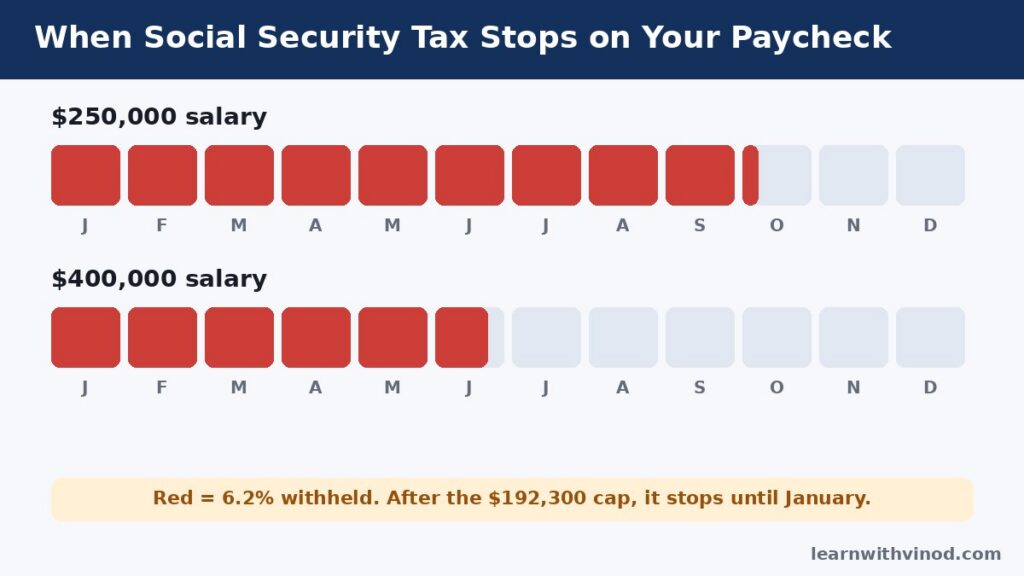
Once your year-to-date wages hit the cap, your employer stops withholding the 6.2% Social Security tax for the rest of the year. Your take-home pay jumps, then drops back in January when the count restarts.
- $250,000 salary, paid evenly: you hit the 2027 cap after about 9.2 months, so the tax stops in October.
- $400,000 salary: you hit it after about 5.8 months, in mid-June.
- Bonuses count too. A big bonus early in the year can push you to the cap sooner.
Because the cap is higher in 2027, those paychecks without the tax will arrive a little later in the year than in 2026. If you budget around that “raise,” adjust your plan. Medicare tax never stops: the 1.45% applies to all wages, plus an extra 0.9% on wages over $200,000 ($250,000 for married couples filing jointly).
Two Jobs? You May Pay Over the Social Security Tax Cap
Each employer withholds Social Security tax separately, up to the Social Security tax cap. If you work two jobs and your combined wages exceed $192,300, you can end up paying more than the $11,922.60 maximum.
The good news: you get the extra back. When you file your tax return, the excess Social Security tax is claimed as a credit on Schedule 3 of Form 1040. Your employers don’t get a refund of their share, but you do. Check your W-2 forms each year if you change jobs mid-year or hold more than one job.
What You Get Back: A Bigger Future Benefit
Paying more Social Security tax isn’t money lost. Earnings up to the cap count toward your benefit, so the higher cap slightly raises the most you can receive later. Social Security benefits are based on your highest 35 years of earnings, adjusted for wage growth, and earnings above the cap are not counted.
The trade-off is modest. Benefits replace a smaller share of income for high earners, so the extra $483.60 a year adds only a little to future checks. Still, it’s not a pure tax increase.
Working While Collecting? The Earnings Test Also Rises
If you claim Social Security before full retirement age and keep working, the earnings test limits go up in 2027 too:
- Under full retirement age all year: $25,560. SSA withholds $1 for every $2 you earn above this.
- The year you reach full retirement age: $67,920, counting only earnings before the month you reach it. SSA withholds $1 for every $3 above this.
Benefits withheld under the earnings test are not lost; your benefit is recalculated at full retirement age. If you’re also planning retirement withdrawals, read our 401(k) withdrawal strategy guide.
Could the Social Security Tax Cap Be Removed?
The cap is part of a bigger debate about Social Security’s finances. The 2026 Trustees Report projects the combined trust funds will run short in 2034, after which incoming taxes would cover about 83% of scheduled benefits unless Congress acts.
- Supporters of raising or removing the cap say high earners should pay on more of their income, and that this would close much of the funding gap.
- Opponents say it would be a large tax increase on high earners and small businesses, and that benefit changes or other reforms should be part of any fix.
As of November 2026, no law has changed how the cap works. For 2027, the rule is simple: 6.2% up to $192,300.
What to Do Now
- Estimate your 2027 wages. If they will top the old Social Security tax cap of $184,500, budget for up to $483.60 more in Social Security tax.
- Self-employed: update your 2027 estimated tax payments.
- Two jobs: track total withholding and claim any excess on your return.
- Check your earnings record in your my Social Security account, so every year of taxed earnings counts toward your benefit.
Final Thoughts
The 2027 Social Security tax cap increase to $192,300 is real, but it only affects people earning more than $184,500, and it adds no more than $483.60 for employees or $967.20 for the self-employed. In return, those earnings count toward a slightly larger future benefit. For more help with benefits and payroll taxes, visit our Social Security section.
Disclaimer: This article is for general information only and is not tax advice. Figures are from SSA’s 2027 announcement and IRS rules as of November 2026. Examples are estimates. Consult a tax professional about your situation.
Frequently Asked Questions
What is the Social Security tax cap for 2027?
The Social Security taxable maximum is $192,300 in 2027, up from $184,500 in 2026. The 6.2% employee Social Security tax applies only to wages up to that amount.
What is the maximum Social Security tax in 2027?
Employees pay up to $11,922.60 (6.2% of $192,300), and employers match it. Self-employed people pay up to $23,845.20 (12.4%).
Will I pay more Social Security tax in 2027?
Only if you earn more than $184,500. Workers earning $192,300 or more pay $483.60 more than in 2026; self-employed people at the cap pay $967.20 more.
Is there a cap on Medicare tax?
No. The 1.45% Medicare tax applies to all wages, plus an extra 0.9% on wages above $200,000 for single filers or $250,000 for married couples filing jointly.
What if I paid too much Social Security tax with two jobs?
If combined wages from more than one employer exceed the cap, claim the excess Social Security tax as a credit on Schedule 3 of Form 1040 when you file.
What is the 2027 Social Security earnings test limit?
For people under full retirement age all year, the limit is $25,560. In the year you reach full retirement age, it is $67,920 for earnings before the month you reach it.
Sources
- SSA – Social Security Announces 3.6 Percent Benefit Increase for 2027 (Oct 14, 2026)
- EY Tax News – Social Security taxable wage base to increase in 2027
- Taxpayers.net – 2027 Social Security wage base and earnings test tracker
- CRS – Social Security: Selected Findings of the 2026 Annual Report
- SSA – my Social Security account