Table of Contents
- SpaceX Stock at a Glance
- The SpaceX IPO in Plain English
- Why SpaceX Stock Fell From Its Peak
- 1. The first-week rally was driven by scarcity
- 2. More shares became available to sell
- 3. The valuation was hard to justify
- 4. Debt and heavy spending
- 5. SpaceX now trades like an AI stock
- What You Actually Own When You Buy SpaceX Stock
- Who Is Making Money on SpaceX Stock
- Should You Buy SpaceX Stock Now? A Checklist
- What to Watch Next for SpaceX Stock
- Final Thoughts
- Frequently Asked Questions
- Sources
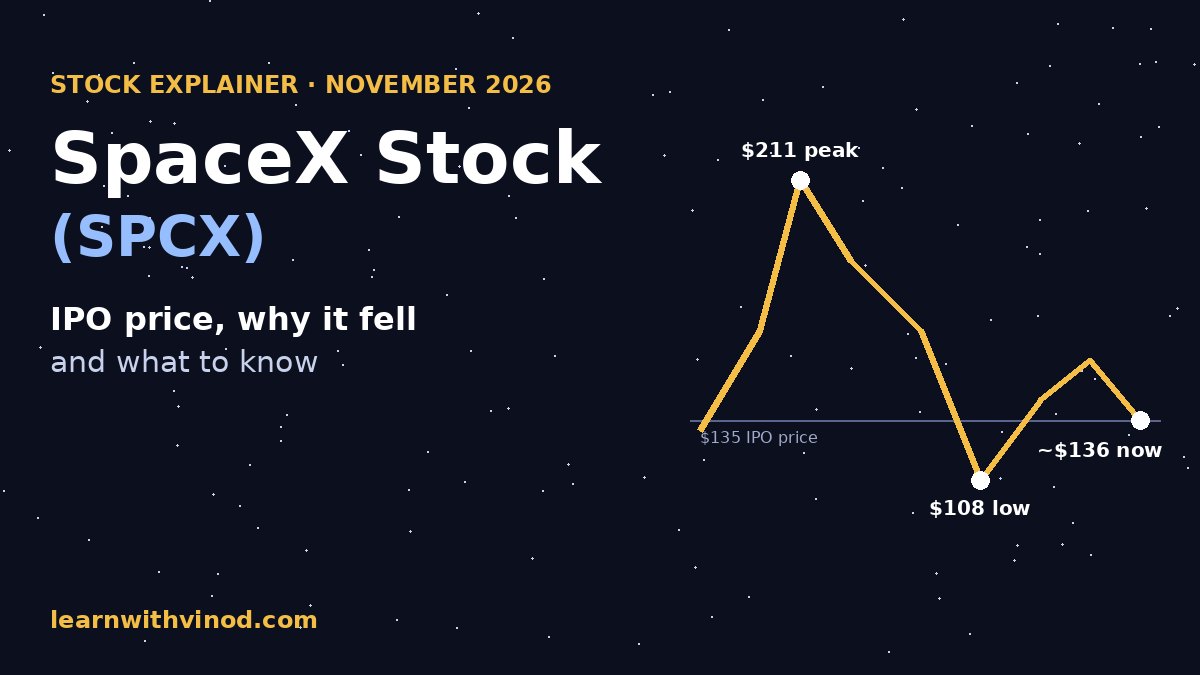
SpaceX stock (Nasdaq: SPCX) went public on June 12, 2026, at $135 a share in the largest IPO in history. Within three trading days it hit a record close of $211.39. By October 30 it had fallen back to $134.72, just under the price IPO buyers paid, and it was trading around $136 on November 2. That is roughly 35% below its peak. This guide explains what happened, why the price fell, what you actually own when you buy SpaceX stock, and a simple checklist to use before you invest.
SpaceX Stock at a Glance
| Item | Detail |
|---|---|
| Ticker | SPCX (Nasdaq) |
| IPO date and price | June 12, 2026, at $135 per share |
| Valuation at IPO | About $1.77 trillion |
| First-day close | $160.95 (up about 19%) |
| Record close | $211.39 on June 16, 2026 (intraday high $225.64) |
| Lowest close | $108.27 on August 5, 2026 |
| Recent price | About $136 (November 2, 2026) |
| Voting control | Elon Musk holds roughly 82% of the votes through 10-vote Class B shares |
Prices change every day, so check a live quote before acting. The figures above come from SpaceX’s offering documents and market reports cited at the end of this post.

The SpaceX IPO in Plain English
SpaceX sold about 556 million new Class A shares at $135 each, raising roughly $75 billion, or more including extra shares sold to meet demand. About 30% of the offering went to individual investors through retail brokerages, which is unusually high for a big IPO.
The key detail most new investors missed: only about 5% of the company was available to trade at first. Founders, employees and early investors were locked up. When a very popular company has very few shares for sale, the price can jump far above what the business is worth on paper. That is exactly what happened in the first week.
Why SpaceX Stock Fell From Its Peak
There was no single bad headline. Instead, several pressures arrived one after another.
1. The first-week rally was driven by scarcity
With a tiny float and huge demand, SpaceX stock climbed about 57% above its IPO price in three trading days. At its peak it was briefly worth more than Amazon and Microsoft. Gains that fast are often followed by a pullback once excitement cools.
2. More shares became available to sell
IPO “lock-ups” stop insiders from selling for a set time. SpaceX used staggered releases, so the float kept growing through the summer and fall. One large release freed about 1.3 billion shares on October 22, and the stock slid in the days that followed. More supply with the same demand usually means a lower price. Musk and other top insiders are locked up for 366 days, until June 2027.
3. The valuation was hard to justify
At its July price, SpaceX traded at about 88 times sales, more than any stock in the S&P 500. Even after strong growth, investors are paying for success many years into the future. Morningstar’s analyst puts fair value at $70 a share, about half the current price, while most Wall Street analysts rate it a buy. That wide gap shows how uncertain the outlook is.
4. Debt and heavy spending
Days after the IPO, SpaceX announced its first bond sale, reported at around $20 billion, to repay a bridge loan. It also expects to spend $35 billion to $40 billion on capital projects in the fourth quarter alone, after $19.6 billion in the third quarter. Big spending can pay off, but it also raises risk.
5. SpaceX now trades like an AI stock
After merging with Elon Musk’s AI company xAI in early 2026, SpaceX’s largest business segment is now artificial intelligence, not rockets. When AI and chip stocks sold off on October 30, SpaceX stock fell 6.4% the same day, even without company-specific news. One AI company customer reportedly made up about a third of third-quarter revenue, which adds concentration risk.

What You Actually Own When You Buy SpaceX Stock
Many buyers of SpaceX stock think they are investing in a rocket company. Today SpaceX is closer to three businesses in one:
- AI (“Super Intelligence” segment): about $7.6 billion of third-quarter revenue, from the xAI business and AI computing.
- Connectivity (mainly Starlink): about $5.2 billion, the satellite internet service that has been SpaceX’s steadiest moneymaker.
- Launch and space: rockets, NASA and defense contracts, and the Starship program.
In the third quarter, total revenue reached about $14.6 billion, up 161% from a year earlier, and the company reported a profit of about $4.4 billion after losses earlier in the year. Management has guided for $33 billion to $37 billion of revenue in the first quarter of 2027. Those are big numbers, but so is the roughly $1.8 trillion market value.
You also have very little say in how the company is run. Class A shares carry one vote each, while Musk’s Class B shares carry ten. That is common for founder-led companies, but it means outside shareholders cannot easily change direction.
Who Is Making Money on SpaceX Stock
| If you bought at… | Approximate result at $136 |
|---|---|
| $135 IPO price | About +1% |
| $160.95 first-day close | About −15% |
| $211.39 record close | About −36% |
| $108.27 August low | About +26% |
These are price changes only and ignore any trading costs. The lesson: chasing a hot IPO in its first week has been the worst entry point so far.
Should You Buy SpaceX Stock Now? A Checklist
This is not a recommendation to buy or sell. Instead, ask yourself these questions first:
- Is your foundation in place? Pay off high-interest debt and keep an emergency fund in a high-yield savings account before buying any single stock.
- How much would you put in? Many planners suggest keeping any single stock to a small slice of your portfolio, often 5% or less.
- Can you handle a 40% drop? SpaceX stock has already swung from $225 to $105 and back in under five months.
- Do you already own it? SpaceX joined the Nasdaq-100 and Russell 1000 shortly after listing, so many index funds and ETFs now hold a small amount.
- Which account? Long-term growth stocks can work well in a Roth IRA, where future gains can be tax-free. See our Roth IRA for beginners guide.
- Will you buy in steps? Buying a fixed amount each month instead of all at once reduces the risk of buying at another peak.

What to Watch Next for SpaceX Stock
- More lock-up releases. Additional insider shares can come to market, with the biggest group (Musk and top insiders) unlocking in June 2027.
- Quarterly results. Watch AI revenue growth, Starlink subscribers, profit and capital spending.
- Starship tests and launches. Big test flights can move the stock either way.
- Interest rates. High-valuation growth stocks are sensitive to rates. Our guide Fed Interest Rates Aren’t Coming Down explains why rates matter.
- Merger talk. Reports of a possible SpaceX-Tesla combination could bring regulatory questions.
Before investing in any newly public company, read its filings. You can search SpaceX’s prospectus and quarterly reports on the SEC’s EDGAR database. Like gold earlier this year, SpaceX shows that a fast rise can reverse quickly; see our post on whether to buy the dip in gold for how to think about buying after a fall.
Final Thoughts
SpaceX stock is a real, fast-growing business wrapped in an extremely high valuation and a story that now depends heavily on AI. The fall from its peak came from scarcity fading, new shares unlocking, heavy spending and a tech selloff, not from one disaster. If you want to own it, keep the position small, buy gradually and be ready for big swings. For more practical money guides, visit our Personal Finance section.
Disclaimer: This article is for general information only and is not investment advice. Stock prices are as of early November 2026 and change daily. Investing involves risk, including loss of principal.
Frequently Asked Questions
What was the SpaceX IPO price?
SpaceX priced its IPO at $135 per share. Trading began on the Nasdaq under the ticker SPCX on June 12, 2026, at a valuation of about $1.77 trillion.
What is SpaceX stock's all-time high?
SpaceX stock’s record close was $211.39 on June 16, 2026, with an intraday high of $225.64 the same day.
Why did SpaceX stock fall?
There was no single cause. The early rally was fueled by a tiny float, then lock-up releases added shares (about 1.3 billion on October 22), the valuation was very high, the company took on debt and heavy spending, and it fell with AI and tech stocks.
Is SpaceX stock below its IPO price?
It has moved around the $135 IPO price. It closed at $134.72 on October 30, 2026 and traded around $136 on November 2. Check a live quote for today’s price.
Can I buy SpaceX stock in a Roth IRA?
Yes. SPCX trades on the Nasdaq, so you can buy it in most brokerage accounts, including a Roth IRA. Many Nasdaq-100 and total-market index funds also hold a small amount.
Who controls SpaceX?
Elon Musk holds about 42% of the shares but roughly 82% of the voting power through 10-vote Class B shares. Public Class A shares carry one vote each.
Sources
- Wikipedia – Initial public offering of SpaceX (IPO terms, structure, index inclusion, financials)
- SpaceX Share Price History – daily closes, record high and low
- FourWeekMBA – SpaceX shares close below $135 IPO price, 36% off peak (Nov 2, 2026)
- Gotrade – SpaceX (SPCX) falls 6.4% as tech stocks slide (Q3 10-Q figures)
- FinanceFeeds – SpaceX stock climbs above $135 IPO price (Nov 2, 2026)
- Motley Fool – SpaceX stock is 25% below its all-time high (Oct 30, 2026)
- Motley Fool via Yahoo Finance – SpaceX stock is down 36% from its post-IPO peak (Jul 22, 2026)
- Yahoo Finance – SpaceX stock tumbles 16.4% (Jun 23, 2026)
- SEC EDGAR full-text search