Table of Contents
- First, Check Your RMD Age: 73 or 75?
- Why Some Retirees Want an Early 401(k) Withdrawal Plan
- Taxes and Penalties on a 401(k) Withdrawal
- Two traps that surprise people
- How Much Tax Would You Actually Pay? A 2026 Example
- A Smarter 401(k) Withdrawal Order
- When Draining Your 401(k) Is a Bad Idea
- Quick Checklist Before Any 401(k) Withdrawal
- Final Thoughts
- Frequently Asked Questions
- Sources
A popular idea in retirement circles right now is to drain your 401(k) before the IRS forces you to take money out. The thinking: take a smart 401(k) withdrawal in your 60s, at low tax rates, instead of being pushed into higher brackets later by required minimum distributions (RMDs) on top of Social Security. It can work very well, but there’s a catch most articles skip. For many of today’s retirees, the forced withdrawals start at 73, not 75. This guide explains the real rules, the taxes and penalties, and a smarter order for pulling money out.
First, Check Your RMD Age: 73 or 75?
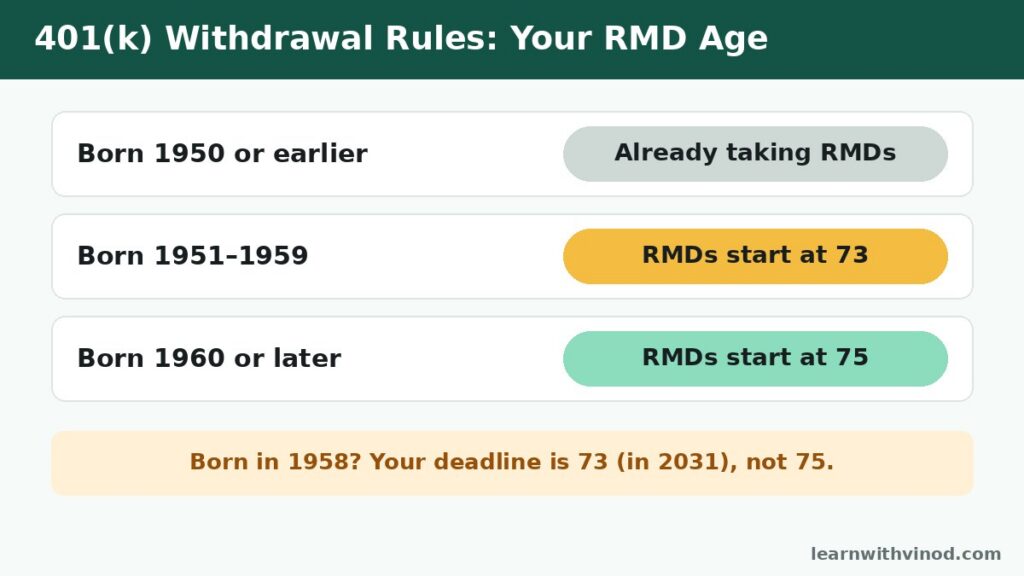
The SECURE 2.0 Act raised the age when RMDs begin, but the change depends on your birth year:
| Year you were born | RMDs start at | First RMD year |
|---|---|---|
| 1950 or earlier | 72 or earlier (already started) | Already taking them |
| 1951–1959 | 73 | 2024–2032 |
| 1960 or later | 75 | 2035 or later |
So if you were born in 1958, your deadline is age 73, in 2031, not 75. Planning around the wrong age can leave you two fewer low-tax years than you think. You can delay your very first RMD until April 1 of the following year, but then you take two RMDs in one year, which can raise your tax bill. Roth 401(k) accounts no longer have RMDs while the owner is alive. The IRS RMD FAQs have the full rules.
Why Some Retirees Want an Early 401(k) Withdrawal Plan
Every dollar in a traditional 401(k) will be taxed as ordinary income someday. The question is when, and at what rate. Many people retire in their early 60s, delay Social Security to get a bigger check, and have a few “gap years” with very little taxable income. Those years can be the cheapest time in your life for a 401(k) withdrawal.
Wait too long, and three things can stack up at once:
- RMDs grow. A $900,000 401(k) earning 5% a year could grow to about $1.7 million by 75 if untouched. The first RMD at 75 would then be about $69,000, and the required share rises every year after that. These are estimates.
- Social Security becomes taxable. Once your income passes set levels, up to 85% of your benefits can be taxed. Extra RMD dollars can make more of your Social Security taxable, so the real tax rate on that money can be much higher than your bracket.
- Medicare premiums rise. Higher income can trigger IRMAA, extra charges on Medicare Part B and Part D. In 2026 these start at about $109,000 of income for single filers and $218,000 for couples, based on your income from two years earlier.
Taxes and Penalties on a 401(k) Withdrawal
| Situation | Income tax? | 10% penalty? |
|---|---|---|
| Under 59½, no exception | Yes | Yes |
| Left your job in or after the year you turned 55 (“rule of 55”) | Yes | No, from that employer’s 401(k) |
| Age 59½ or older | Yes | No |
| Qualified Roth 401(k) withdrawal (59½+ and 5 years) | No | No |
| Missed RMD | Yes, when taken | 25% excise tax (10% if fixed within two years) |
Other exceptions to the 10% penalty include disability and a series of equal yearly payments (sometimes called 72(t) payments). See the IRS list of exceptions to the early-withdrawal tax.
Two traps that surprise people
- 20% withholding. When you take cash directly from a 401(k), the plan must usually withhold 20% for federal tax. That is a prepayment, not the final bill. You may owe more or get some back. A direct rollover to an IRA avoids this.
- State taxes. Most states tax 401(k) withdrawals too. A few have no income tax, and some exempt part of retirement income.
How Much Tax Would You Actually Pay? A 2026 Example
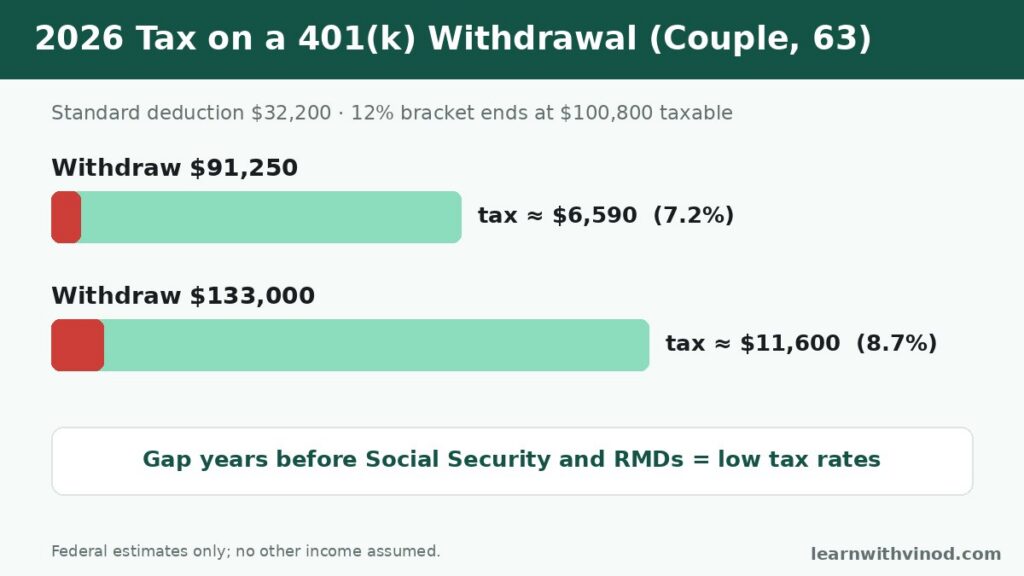
Take a married couple, both 63, who are retired and have not yet claimed Social Security. Their only income is a 401(k) withdrawal. In 2026, the standard deduction for a married couple is $32,200, and the 12% bracket ends at $100,800 of taxable income.
| Yearly withdrawal | Taxable income | Federal tax (est.) | Effective rate |
|---|---|---|---|
| $91,250 | $59,050 | about $6,590 | about 7.2% |
| $133,000 | $100,800 | about $11,600 | about 8.7% |
That is a low rate for a six-figure 401(k) withdrawal. Once the same couple is collecting Social Security and taking RMDs, extra withdrawals could land in the 22% bracket, plus the extra tax on Social Security. Couples 65 and older get an additional standard deduction, and through 2028 a new “senior deduction” of up to $6,000 each, which shrinks at higher incomes. These figures are federal estimates only.
A Smarter 401(k) Withdrawal Order
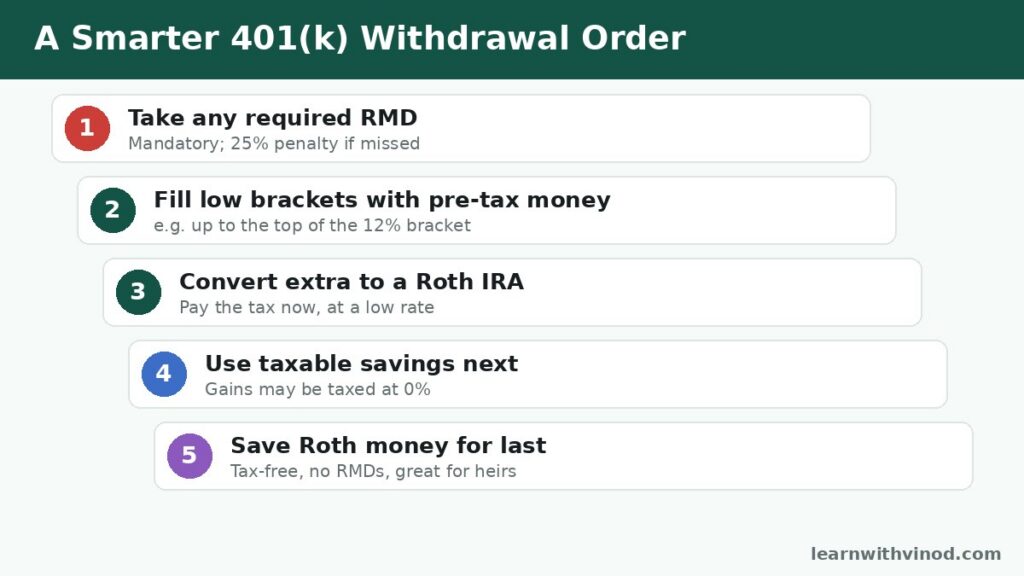
The old rule was simple: spend taxable savings first, then pre-tax accounts, then Roth. A better approach for many people is to fill the low tax brackets every year with pre-tax money, and use other accounts for the rest. Here is a practical order:
- Take any required RMD first. It is not optional, and the penalty is steep.
- Fill your low brackets with a 401(k) withdrawal (or IRA money). Decide on a target, such as “the top of the 12% bracket,” and withdraw pre-tax money up to that line.
- Convert instead of spending, if you don’t need the cash. Moving that same amount into a Roth IRA (a Roth conversion) means you pay the tax now, at a low rate, and future growth is tax-free with no RMDs. Pay the tax from savings, not from the conversion.
- Use taxable brokerage and cash savings next. Long-term capital gains can be taxed at 0% for couples with modest taxable income.
- Save Roth money for last, for big one-time costs or high-income years, and as a tax-free gift to heirs.
When Draining Your 401(k) Is a Bad Idea
- You rely on ACA health insurance before 65. Large withdrawals raise your income and can shrink or wipe out premium subsidies. Check our guide to ACA open enrollment 2027 before you plan big withdrawals.
- You would push into high brackets anyway. A huge 401(k) withdrawal, or emptying a large account in a few years can cost more tax than steady RMDs would.
- The market drops early in retirement. Selling a lot during a downturn locks in losses. Keep one to two years of spending in cash.
- You are 63 or older and near IRMAA lines. Medicare looks back two years, so big withdrawals at 63 can raise premiums at 65.
- You have no plan for the money. Withdrawing just to sit in a bank account means paying tax early for no reason. A Roth conversion usually makes more sense.
Quick Checklist Before Any 401(k) Withdrawal
- Confirm your RMD age from your birth year: 73 or 75.
- Estimate your income for the year, including pensions and any Social Security.
- Pick a bracket target and stop withdrawals there.
- Check ACA subsidy and Medicare IRMAA limits.
- Decide between spending the money and converting it to a Roth.
- Set withholding or estimated payments so you don’t owe a penalty in April.
Social Security timing is a big part of this plan. Read our guide to the Social Security COLA 2027, and our best investment strategies for 2026 for how to invest what you keep.
Final Thoughts
Drawing down your 401(k) early can be a smart tax move, but “drain it before 75” is the wrong target for many people. If you were born before 1960, your deadline is 73. The real goal is not an empty account. It is paying the lowest total tax over your lifetime. Fill low brackets in your gap years, consider Roth conversions, watch Medicare and ACA income limits, and save Roth money for last. Because the right 401(k) withdrawal plan depends on your full picture, consider running the numbers with a tax professional or fee-only financial planner.
Disclaimer: This article is for general information only and is not tax, legal or investment advice. Tax figures are for 2026 and federal only; examples are estimates. Rules can change. Speak with a qualified professional about your own situation.
Frequently Asked Questions
At what age do I have to start taking money from my 401(k)?
Required minimum distributions start at 73 if you were born from 1951 through 1959, and at 75 if you were born in 1960 or later. Roth 401(k) accounts no longer have RMDs while the owner is alive.
Is it smart to drain my 401(k) before RMDs start?
Withdrawing or converting some pre-tax money in low-income years before Social Security and RMDs can reduce lifetime taxes. Emptying the account completely can backfire if it pushes you into high brackets, raises Medicare premiums or cuts ACA subsidies.
What is the penalty for early 401(k) withdrawal?
Withdrawals before age 59½ are generally taxed as income plus a 10% penalty. Exceptions include the rule of 55 for people who leave their job in or after the year they turn 55, disability and equal periodic payments.
What happens if I miss an RMD?
You may owe a 25% excise tax on the amount you should have withdrawn, reduced to 10% if you correct it within two years. You report it on IRS Form 5329.
How much tax will I pay on a 401(k) withdrawal in 2026?
It depends on your total income. For example, a married couple under 65 with no other income who withdraws $91,250 would owe about $6,590 in federal tax, roughly 7.2%, after the $32,200 standard deduction. State taxes may also apply.
Why is 20% withheld from my 401(k) withdrawal?
Plans must generally withhold 20% for federal tax on cash distributions that could have been rolled over. It is a prepayment; your actual tax is settled when you file. A direct rollover to an IRA avoids the withholding.
Sources
- IRS – Retirement plan and IRA required minimum distributions FAQs
- IRS – Exceptions to tax on early distributions
- Motley Fool – 3 RMD rule changes retirees must know in 2026
- CPA Practice Advisor – IRS adjusts tax brackets, standard deduction for 2026
- 24/7 Wall St. – At 75, the IRS will set the withdrawal amount on a $900,000 401(k) (Nov 1, 2026; topic background)