Table of Contents
- Chase vs Capital One vs Wells Fargo at a Glance
- Chase vs Capital One vs Wells Fargo: What Each Costs You in a Year
- The savings gap is even bigger
- Chase vs Capital One vs Wells Fargo: Which Fits Your Money?
- 1. You live close to paycheck to paycheck
- 2. You deposit cash often or want a nearby branch
- 3. You want your savings to grow
- 4. You want a sign-up bonus
- 5. You’re a student or young adult
- 6. You want everything in one place
- Chase vs Capital One vs Wells Fargo: Pros and Cons
- Chase
- Capital One
- Wells Fargo
- Are Chase, Capital One and Wells Fargo Safe?
- How to Decide Between Chase vs Capital One vs Wells Fargo in 5 Minutes
- Final Thoughts
- Frequently Asked Questions
- Sources
Choosing between Chase vs Capital One vs Wells Fargo isn’t about which bank is “best.” It’s about which one costs you the least and fits how you actually use money. All three are huge, FDIC-insured national banks, but they work very differently. Chase and Wells Fargo charge a $15 monthly fee on their basic checking unless you qualify for a waiver, and they pay almost nothing on savings. Capital One has no monthly fee, no overdraft fees and a savings rate around 3.2%. This guide compares the real costs in 2026, then matches each bank to six common money profiles so you can decide in a few minutes.
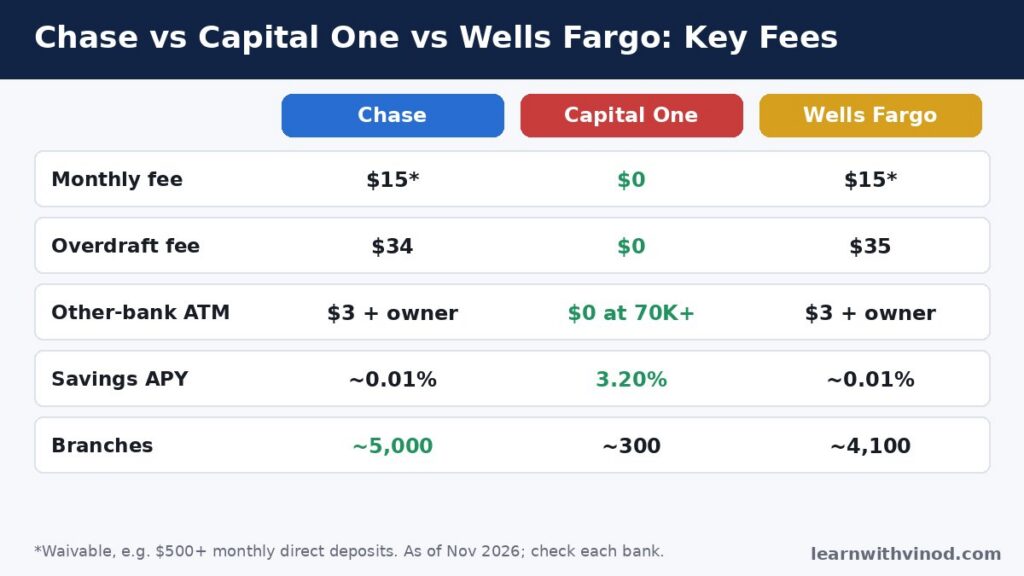
Chase vs Capital One vs Wells Fargo at a Glance
| Chase Total Checking | Capital One 360 Checking | Wells Fargo Everyday Checking | |
|---|---|---|---|
| Monthly fee | $15 | $0 | $15 |
| Easiest way to waive it | $500+ in monthly direct deposits or $1,500 daily balance | No fee to waive | $500+ in monthly direct deposits, $1,500 daily balance, or age 17–24 |
| Overdraft fee | $34 (none if overdrawn by $50 or less; max 3 a day) | $0 | $35 (none on items of $10 or less; max 3 a day) |
| Out-of-network ATM fee | $3 plus the ATM owner’s fee | $0 at 70,000+ partner ATMs | $3 plus the ATM owner’s fee |
| Main savings rate (APY) | About 0.01% (standard savings) | 3.20% (360 Performance Savings) | About 0.01% (standard savings) |
| Branches | About 5,000 in 48 states | About 300, plus cafés in big cities | About 4,100 |
| New-customer bonus | $400 with $1,000 in direct deposits (through Jan. 27, 2027) | Varies | Varies |
Fees, rates and bonuses as published or reported in late October and early November 2026. Savings rates are variable and bonuses change often, so confirm on each bank’s website before opening an account.
Chase vs Capital One vs Wells Fargo: What Each Costs You in a Year
The biggest difference in Chase vs Capital One vs Wells Fargo is fees. Monthly fees look small, but they add up. A $15 fee you fail to waive costs $180 a year. Here is what the same habits cost at each bank:
| Your habits | Chase | Capital One | Wells Fargo |
|---|---|---|---|
| Paycheck by direct deposit, no overdrafts | $0 | $0 | $0 |
| No direct deposit, balance under $1,500 | $180 | $0 | $180 |
| Two overdrafts a year | About $68 | $0 | About $70 |
| Two out-of-network ATM withdrawals a month | $72 plus owner fees | $0 at partner ATMs | $72 plus owner fees |
In a Chase vs Capital One vs Wells Fargo cost comparison, the pattern is clear: Capital One costs nothing for most habits, while the other two are free only if you meet a waiver. These are estimates based on the fee schedules above. Your actual cost depends on your account and how you use it.
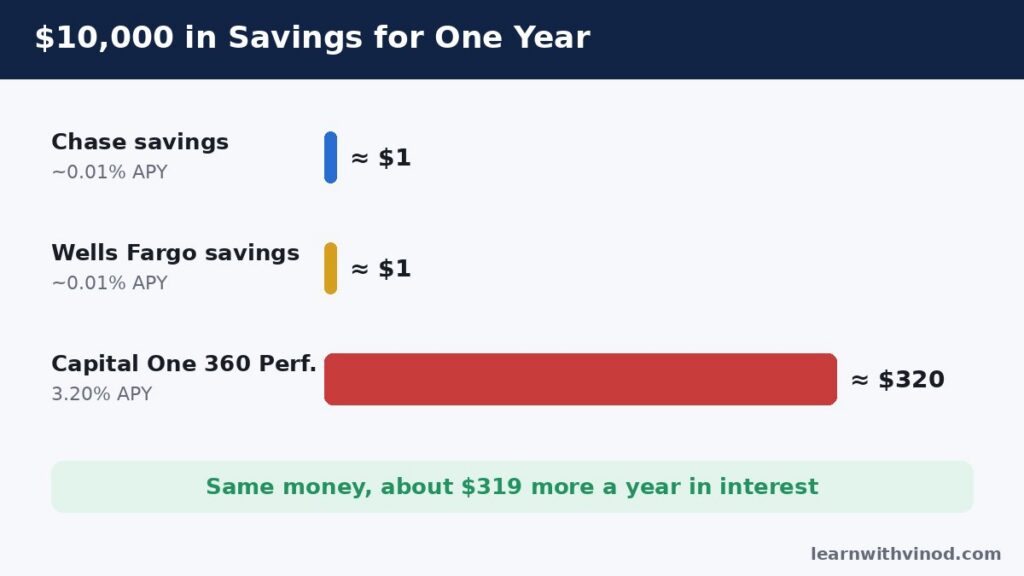
The savings gap is even bigger
If you keep a $10,000 emergency fund in a standard savings account at Chase or Wells Fargo at about 0.01%, it earns roughly $1 a year. At Capital One’s 3.20% rate, it would earn about $320. Both Chase and Wells Fargo offer higher “relationship” or promotional savings rates for some customers, but you often need large balances or other accounts to get them.
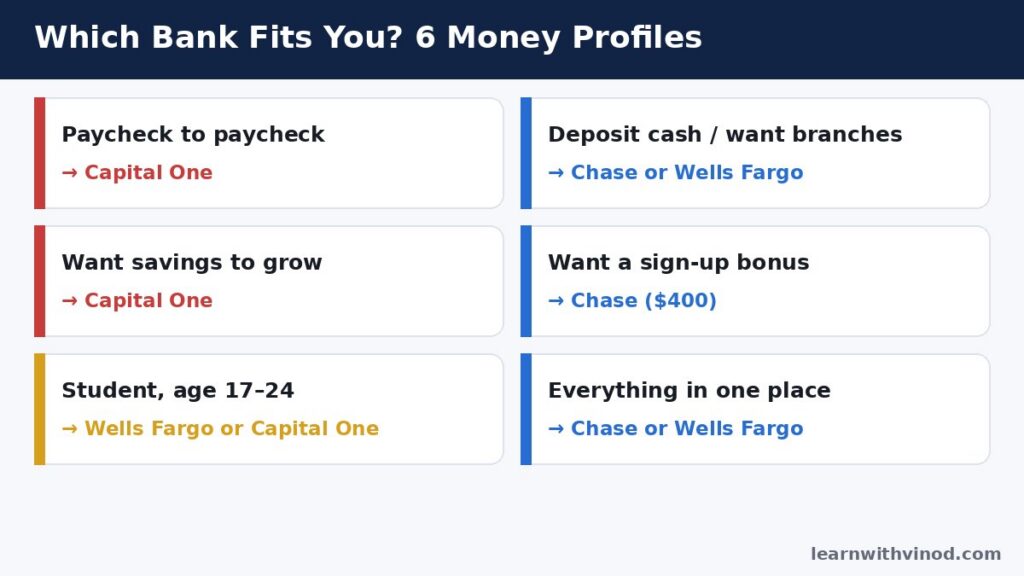
Chase vs Capital One vs Wells Fargo: Which Fits Your Money?
1. You live close to paycheck to paycheck
Best fit: Capital One. No monthly fee and no overdraft fees means a tight month doesn’t turn into $35 penalties. If you prefer Wells Fargo, its Clear Access Banking account has no overdraft fees and a $5 monthly fee that can be waived.
2. You deposit cash often or want a nearby branch
Best fit: Chase or Wells Fargo, whichever has more branches near you. Both have thousands of locations. Capital One lets you deposit cash at many of its own ATMs and some retail stores, but it has far fewer branches.
3. You want your savings to grow
Best fit: Capital One, or keep checking at a big bank and move savings to a high-yield account elsewhere. See our list of the best online banks in the USA for 2026 for rates around 4%.
4. You want a sign-up bonus
Best fit: Chase, if you can set up at least $1,000 in direct deposits within 90 days to earn the $400 Total Checking bonus. Make sure you can also waive the $15 monthly fee, or the fees will eat into the bonus. Bonus money is usually taxable as interest income.
5. You’re a student or young adult
Best fit: Wells Fargo or Capital One. Wells Fargo waives the Everyday Checking fee for primary account owners aged 17 to 24. Capital One has no fee at any age. Chase offers separate student and teen accounts with their own rules.
6. You want everything in one place
Best fit: Chase or Wells Fargo. If you want checking, a credit card, a mortgage, investing and in-person help at one bank, the two biggest branch networks are the most convenient. Capital One is strong on credit cards and online banking but offers fewer in-person services.
Chase vs Capital One vs Wells Fargo: Pros and Cons
Chase
- Pros: largest branch network of the three, strong mobile app, frequent sign-up bonuses, and a $50 overdraft buffer.
- Cons: $15 monthly fee unless waived, $34 overdraft fee, and near-zero interest on standard savings.
Capital One
- Pros: no monthly fees, no overdraft fees, no minimum balance, a competitive savings rate and a large fee-free ATM network.
- Cons: few branches outside major cities, and the savings rate can fall if the Federal Reserve cuts rates. Former Discover savings customers are being moved into Capital One accounts after the 2025 merger.
Wells Fargo
- Pros: about 4,100 branches, several ways to waive the monthly fee (including age 17 to 24), and no fee on overdrafts of $10 or less.
- Cons: $15 monthly fee unless waived, a $35 overdraft fee and near-zero interest on standard savings.
Are Chase, Capital One and Wells Fargo Safe?
Yes. All three are FDIC-insured banks. Deposits are protected up to $250,000 per depositor, per insured bank, for each ownership category. If you had money at both Discover and Capital One, check whether your balances now count as one bank for insurance purposes. You can confirm any bank’s insurance with the FDIC BankFind tool.
How to Decide Between Chase vs Capital One vs Wells Fargo in 5 Minutes
- Check your last three bank statements. Add up any monthly fees, overdraft fees and ATM fees you paid.
- Decide if you need a branch. If you rarely visit one, Capital One’s no-fee model is hard to beat.
- Make sure you can waive the fee at Chase or Wells Fargo. If you can’t, they will cost you $180 a year.
- Move savings to a high-yield account, wherever you keep checking.
- Read the bonus terms before chasing a bonus: deposit amounts, deadlines and how long you must keep the account open.
Many people end up with a mix: checking at the bank with the most convenient branches and savings at a higher-yield online bank. For more checking options, see our guide to the best checking accounts in the USA for 2026.
Final Thoughts
In the Chase vs Capital One vs Wells Fargo decision, the winner depends on your habits. Capital One is the cheapest for most everyday users and savers. Chase is the best choice if you want branches everywhere and a $400 bonus. Wells Fargo makes sense for young adults and people with a branch nearby who can easily waive the fee. Pick the one that matches how you bank, then make sure your savings earn more than 0.01%. For more practical guides, visit our Personal Finance section.
Disclaimer: This article is for general information only and is not financial advice. We are not paid by the banks mentioned. Fees, rates and offers are as of early November 2026 and can change at any time; confirm details with each bank before opening an account.
Frequently Asked Questions
Which is better: Chase, Capital One or Wells Fargo?
It depends on your habits. Capital One is cheapest for most people because it has no monthly or overdraft fees and pays about 3.20% on savings. Chase and Wells Fargo are better if you need many branches and can waive the $15 monthly fee.
How do I avoid the Chase Total Checking monthly fee?
Chase waives the $15 fee if you have $500 or more in monthly electronic deposits, a $1,500 beginning-of-day balance, or a $5,000 average balance across linked Chase accounts.
How do I avoid the Wells Fargo Everyday Checking fee?
Wells Fargo waives the $15 fee with $500+ in qualifying electronic deposits, a $1,500 minimum daily balance, $5,000 in combined balances, if the primary owner is 17 to 24, or with qualifying military direct deposit.
Does Capital One charge overdraft fees?
No. Capital One 360 Checking has no overdraft fees and no monthly fee. Transactions may be declined or covered under free overdraft options you choose.
What is the Chase checking bonus right now?
Chase offers $400 for new Total Checking customers who set up $1,000 or more in direct deposits within 90 days, with the offer listed through January 27, 2027. Terms can change.
Are Chase, Capital One and Wells Fargo FDIC insured?
Yes. All three are FDIC-insured banks, covering deposits up to $250,000 per depositor, per insured bank, for each account ownership category.
Sources
- NerdWallet – Chase checking accounts review (overdraft, ATM fees, branches)
- Money's My Life – Chase Total Checking bonus ($400; $15 fee effective Aug 24, 2025)
- Wells Fargo – Everyday Checking account fees summary
- Bankrate – Wells Fargo checking accounts review
- Bankrate – Capital One savings account rates (360 Performance Savings 3.20%)
- Freenance – Capital One 360 Performance Savings review (ATM network, branches)
- FDIC BankFind Suite