Table of Contents
- How Credit Builder Loans Work
- What Credit Builder Loans Really Cost in 2026
- The real cost, in dollars
- Do Credit Builder Loans Actually Work?
- How fast will your score change?
- Who Should Get a Credit Builder Loan?
- How to Choose the Right Credit Builder Loan
- Credit Builder Loans vs. Secured Credit Cards
- Mistakes to Avoid
- Final Thoughts
- Frequently Asked Questions
- Sources
Credit builder loans are one of the simplest ways to build a credit history from scratch: you make small monthly payments, the lender reports them to the credit bureaus, and you get the money back at the end. But they are not free, and they do not help everyone. This 2026 guide shows how credit builder loans work, what they really cost with today’s lenders, research on who they help most, and a simple test to decide whether one is right for you.
How Credit Builder Loans Work
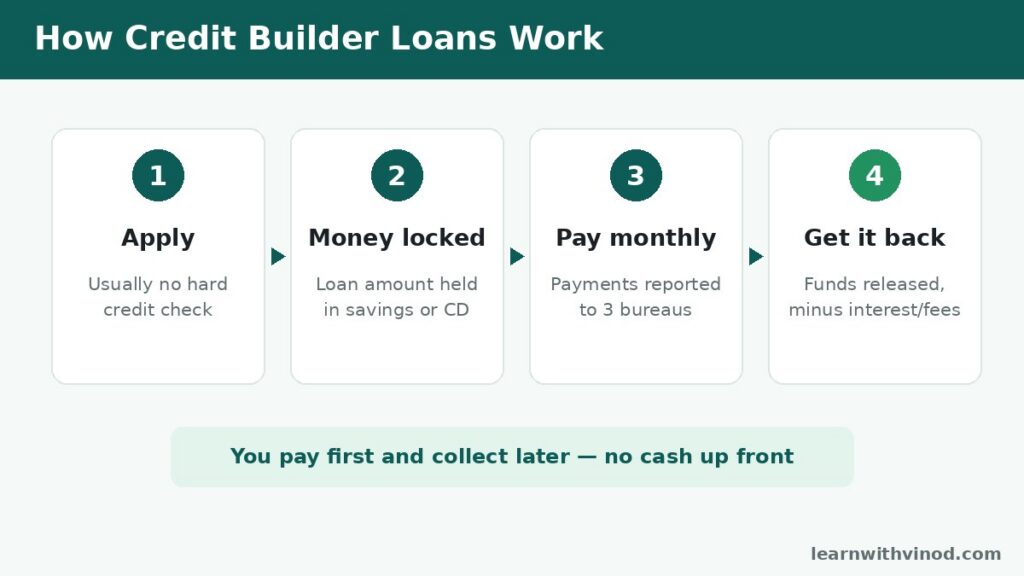
A credit builder loan works in reverse compared with a normal loan. Instead of getting cash up front, you pay first and collect later:
- You apply. Most lenders do not run a hard credit check, so a thin or damaged credit file is usually fine.
- The lender locks the loan amount in a savings account or certificate of deposit (CD) in your name.
- You make fixed monthly payments, usually for 12 to 24 months. Each on-time payment is reported to Equifax, Experian and TransUnion.
- At the end, you get the money back, minus interest and fees.
Because the lender already holds the money, the risk to the lender is low. That is why these loans are easy to get. What you are really buying is a record of on-time payments on an installment loan.
What Credit Builder Loans Really Cost in 2026
Many guides skip the price. Here is what popular options charge, based on published terms in mid to late 2026:
| Provider | Monthly payment | Term | APR* | Fees |
|---|---|---|---|---|
| Self | $25, $35, $48 or $150 | 24 months | about 15.5%–15.9% | Possible admin fee; fee for debit card payments |
| Credit Strong Instal | $28 | Varies | about 15.6% | One-time admin fee (typically $15–$25) |
| MoneyLion Credit Builder Plus | Varies (loans up to $1,000) | 12 months | 5.99%–29.99% | $19.99/month membership |
| Credit unions (example: DCU) | Varies (loans up to $3,000) | 12–24 months | often around 5% | Membership required |
*Rates and fees change often. Always check the loan agreement before you sign.
The real cost, in dollars
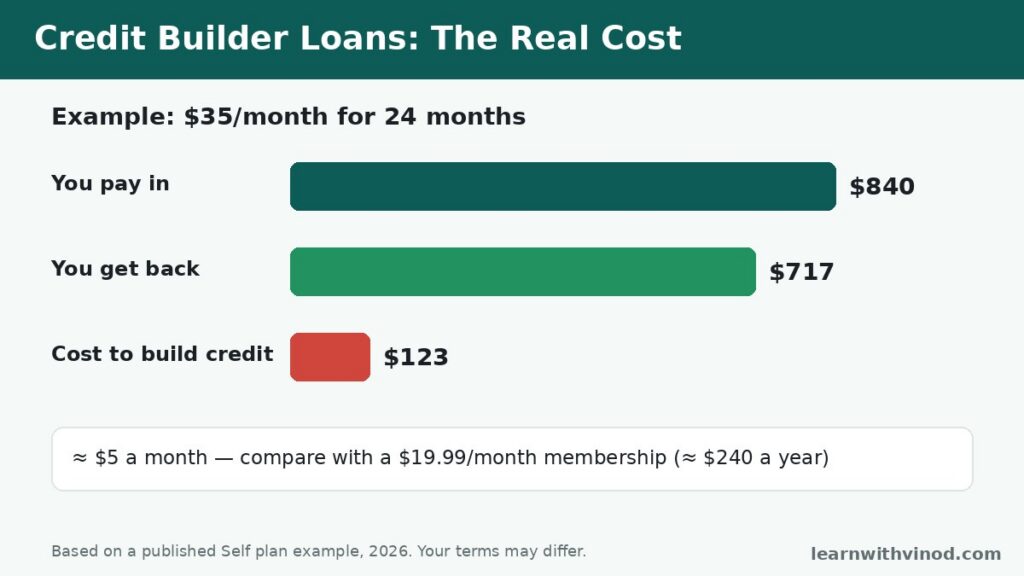
APR is hard to picture, so look at what you pay in and what you get back. On Self’s $35-a-month plan, you pay $840 over 24 months and get back about $717 if you never miss a payment. The cost of building credit is about $123, or roughly $5 a month.
MoneyLion works differently. Its loan rate can be low, but the $19.99 monthly membership adds about $240 over a 12-month loan. For most people, that makes it one of the more expensive ways to build credit.
A local credit union is often the cheapest option. Many offer “share-secured” or credit builder loans at single-digit rates, and some pay dividends on the money while it is locked.
Do Credit Builder Loans Actually Work?
Yes, for the right person. The Consumer Financial Protection Bureau (CFPB) studied credit builder loans with a credit union and found two very different results. You can read the CFPB’s research report for the details.
- People with no existing debt were more likely to get a credit score and saw their scores improve.
- People who already had debt saw little benefit. Some fell behind on their other loans, because the new monthly payment stretched their budget.
The lesson is simple. Credit builder loans help most when you are building credit from zero and can easily afford the payment. If money is already tight, an extra bill can hurt more than it helps, because payment history makes up 35% of your FICO Score. Learn how the other factors work in our guide FICO Score explained.
How fast will your score change?
Lenders usually start reporting after your first payment. Most credit scoring models need at least one account that is six months old to create a FICO Score, so people with no history often see a first score after about six months of on-time payments. If you already have a score, the gain depends on what else is in your report. Results vary, and no lender can promise a number.
Who Should Get a Credit Builder Loan?
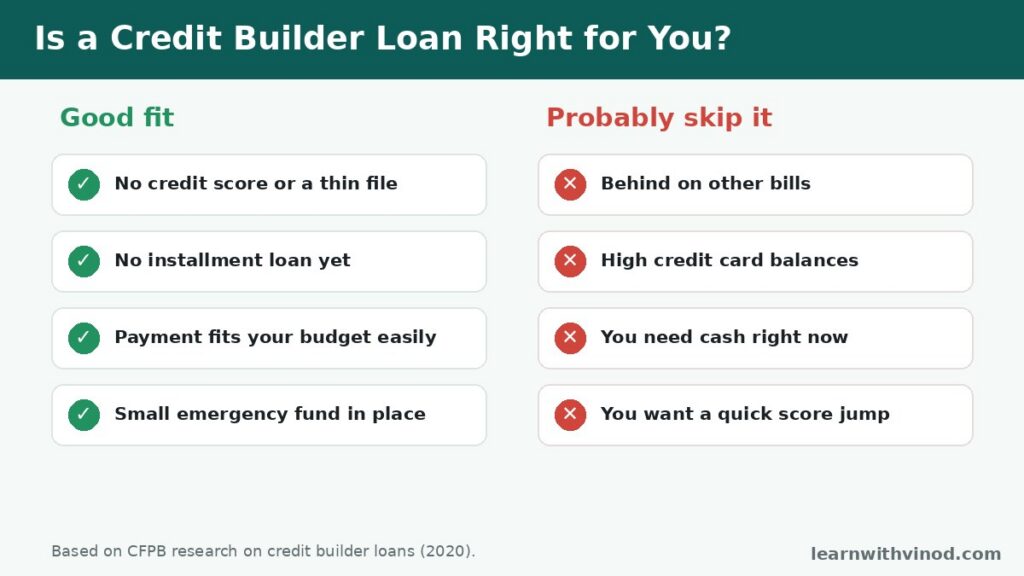
Use this quick test. A credit builder loan is a good fit if most of these are true:
- You have no credit score, or a very thin file with one or two accounts.
- You have no installment loan (car, student or personal loan) on your report.
- You can pay the monthly amount for the full term without stress.
- You have a small emergency fund, so a surprise bill won’t make you miss a payment.
- You are not planning to apply for a mortgage or car loan in the next few months and need a fast fix.
It is probably not a good fit if you are behind on other bills, carry high credit card balances, or need cash now. Credit builder loans do not give you money up front.
How to Choose the Right Credit Builder Loan
- Check credit unions first. They often have the lowest rates. Many are open to anyone who joins a partner organization.
- Compare total cost, not just APR. Add up every payment and fee, then subtract what you get back.
- Confirm all three bureaus. The loan should report to Equifax, Experian and TransUnion.
- Pick the smallest payment that works. A $25 payment you never miss beats a $150 payment you struggle with.
- Read the rules on late and early closing. Know the late fee, the grace period and what happens if you cancel early.
- Turn on autopay from your bank account. Some lenders charge extra for debit card payments.
Credit Builder Loans vs. Secured Credit Cards
| Credit builder loan | Secured credit card | |
|---|---|---|
| Upfront money | None; you pay over time | Security deposit, often $200 or more |
| Type of credit | Installment | Revolving |
| Helps with | Payment history and credit mix | Payment history and credit utilization |
| Main risk | Missed payments; interest and fees | High balances; overspending |
| Money back | At the end of the term | Deposit returned when you close or upgrade |
Many people use both: a credit builder loan for an installment account and a secured card, kept at a low balance and paid in full, for a revolving account. Some providers, including Self, let you unlock a secured card after a few on-time payments. For more options, see our guide on how to build credit fast.
Mistakes to Avoid
- Missing a payment. A payment 30 or more days late is reported and can stay on your report for seven years. That defeats the purpose of the loan.
- Taking more than one at a time. One loan is enough to show installment history.
- Treating it as savings. You lose money on interest and fees. For real savings, a high-yield account pays you instead. See the best online banks in the USA for 2026.
- Never checking your reports. Get free reports at AnnualCreditReport.com and make sure every payment shows as on time.
Final Thoughts
Credit builder loans are a low-risk way to start a credit history if you have little or no credit and can easily afford the payment. Expect to pay roughly $5 a month in interest and fees with a typical online lender, and less at a credit union. Compare the total cost, confirm reporting to all three bureaus, set up autopay and never miss a payment. For the bigger picture, read about the credit score changes in 2026.
Disclaimer: This article is for general information only and is not financial advice. Rates, fees and terms are based on published information as of October 2026 and change often. We are not paid by the companies mentioned. Check each lender’s current terms before applying.
Frequently Asked Questions
Do credit builder loans really work?
Yes, for people with little or no credit who can easily afford the payment. CFPB research found they worked best for borrowers with no existing debt; people already carrying debt saw little benefit and some fell behind on other loans.
How much does a credit builder loan cost?
With a typical online lender, expect roughly $5 a month in interest and fees. For example, on a $35-a-month, 24-month plan you pay $840 and get about $717 back. Credit unions are often cheaper.
Can I get a credit builder loan with bad credit?
Usually yes. Most lenders do not run a hard credit check because the loan money is held in a locked account until you finish paying.
How long does it take a credit builder loan to raise my score?
If you have no credit history, a FICO Score usually appears after about six months of reported payments. If you already have a score, the change depends on the rest of your credit report.
Is a credit builder loan better than a secured credit card?
They build different things. A credit builder loan adds installment history; a secured card adds revolving credit and needs a deposit. Many people use both.
What happens if I miss a payment on a credit builder loan?
A payment 30 or more days late can be reported to the credit bureaus and hurt your score for up to seven years, and you may owe a late fee. Set up autopay to avoid it.
Sources
- CFPB – Targeting credit builder loans (research report, 2020)
- LendingTree – Best credit-builder loans in 2026 (updated Aug 7, 2026)
- Credit Karma – Best credit-builder loans of 2026 (updated Oct 22, 2026)
- Crediful – Self Credit Builder review 2026 (Sep 20, 2026)
- Finder – Credit Strong review (May 8, 2026)
- LendEDU – MoneyLion Credit Builder review (May 1, 2026)
- AnnualCreditReport.com