
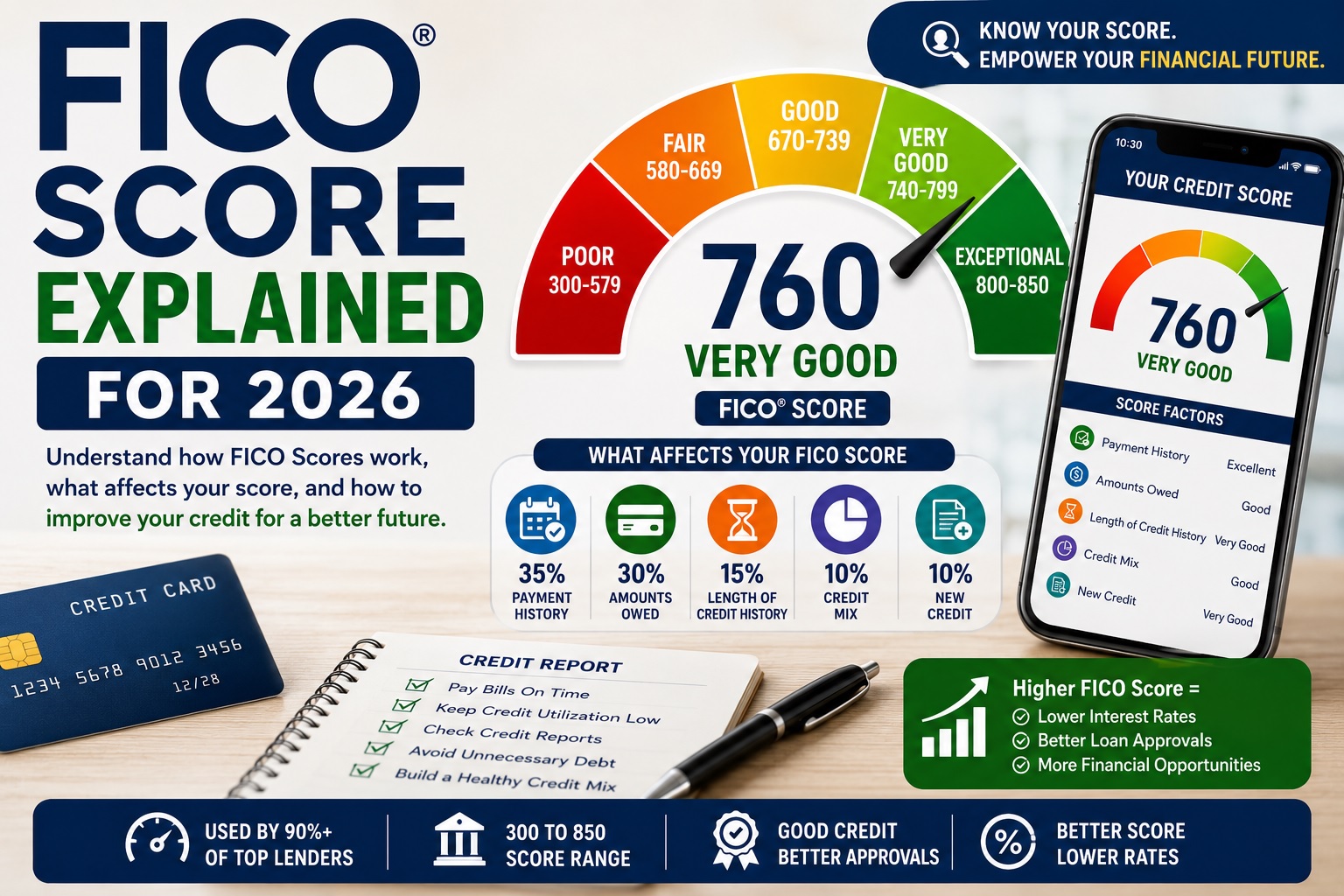
FICO Score Explained is one of the most important topics in personal finance because your FICO score influences many major financial decisions. Whether you plan to apply for a credit card, mortgage, auto loan, personal loan, or apartment rental, lenders often review your FICO score before approving your application. Therefore, understanding how FICO scores work can help you make smarter financial decisions and improve your financial future.
Moreover, millions of Americans monitor their FICO scores regularly because a higher score can lead to lower interest rates and better borrowing opportunities. Consequently, learning how your score is calculated can help you focus on the factors that matter most.
Whether you are building credit, repairing credit, or preparing for a major loan application, this guide explains everything you need to know about FICO scores in 2026.
What Is a FICO Score?
A FICO score is a three-digit number that predicts how likely you are to repay borrowed money responsibly. The score generally ranges from: 300 to 850
Most lenders use FICO scores because they provide a standardized way to evaluate credit risk. The scoring model was developed by Fair Isaac Corporation, commonly known as FICO. Today, lenders across the United States rely on FICO scores when making credit decisions.
Why FICO Scores Matter
Your FICO score can affect:
- Mortgage approvals
- Auto loan rates
- Personal loan eligibility
- Credit card approvals
- Insurance pricing
- Apartment applications
Therefore, maintaining a strong score can save thousands of dollars over time. For example, borrowers with excellent credit often qualify for lower interest rates than borrowers with poor credit.
FICO Score Ranges
Most FICO scores fall into the following categories:
| Score Range | Rating |
|---|---|
| 300–579 | Poor |
| 580–669 | Fair |
| 670–739 | Good |
| 740–799 | Very Good |
| 800–850 | Exceptional |
Generally, higher scores provide greater financial advantages.
How FICO Scores Are Calculated
FICO evaluates several factors when calculating scores.
Payment History (35%)
Payment history carries the largest influence. Lenders want evidence that borrowers pay obligations on time. Important factors include:
- On-time payments
- Late payments
- Collections
- Bankruptcies
Consequently, making every payment on time should remain your highest priority.
Amounts Owed (30%)
This category focuses heavily on credit utilization.
Example:
Credit limit: $10,000
Balance: $2,000
Utilization:
(2000/10000)x100=20%
Many experts recommend staying below 30%. However, utilization below 10% may provide stronger scoring benefits.
Length of Credit History (15%)
Older accounts often help your score. Therefore:
- Keep older accounts open
- Avoid unnecessary closures
- Maintain long-term credit relationships
Credit Mix (10%)
FICO considers different account types. Examples include:
- Credit cards
- Auto loans
- Mortgages
- Student loans
- Personal loans
A healthy mix can strengthen your profile.
New Credit (10%)
Opening several accounts quickly may temporarily reduce scores. Therefore, apply for credit strategically.
FICO Score vs Credit Score
Many people use the terms interchangeably. However, not all credit scores are FICO scores. Other scoring models include:
- VantageScore
- Proprietary lender scores
Nevertheless, FICO remains the most widely used scoring system in the United States.
What Is a Good FICO Score?
Most lenders consider scores above 670 to be good. General guidelines:
- 670+ Good
- 740+ Very Good
- 800+ Exceptional
Although perfection is unnecessary, higher scores often improve approval odds.
How to Improve Your FICO Score
Pay Every Bill On Time
Payment history remains the most important factor. Consider:
- Automatic payments
- Calendar reminders
- Payment alerts
Lower Credit Utilization: Reducing balances often improves scores quickly.
Check Credit Reports: Review reports regularly for errors.
Access free reports at: Annual Credit Report
Avoid Excessive Applications: Too many hard inquiries may temporarily lower scores.
Keep Older Accounts Open: Long account history generally supports higher scores.
Common FICO Score Myths
Checking Your Own Score Hurts Credit: False. Personal credit checks create soft inquiries.
Carrying Credit Card Debt Improves Scores: False. Paying balances responsibly remains the better strategy.
Income Affects FICO Scores: False. FICO does not directly consider income.
Closing Old Accounts Always Helps: False. Closures can reduce account age and increase utilization.
How Long Does It Take to Improve a FICO Score?
Improvement timelines vary. Some consumers see progress within:
- 30 days
- 90 days
- 6 months
However, significant improvements often require consistent financial habits over longer periods.
Best Tools for Monitoring FICO Scores
These services provide credit monitoring and educational resources.
Common Mistakes That Hurt FICO Scores
Avoid:
- Late payments
- High utilization
- Collections accounts
- Excessive inquiries
- Defaulted loans
- Identity theft issues
Therefore, regular monitoring remains important.
Frequently Asked Questions
Most FICO models use 850 as the highest possible score.
Yes. A 700 score generally falls within the good range.
Lowering utilization and correcting errors may produce faster improvements.
Scores often update when lenders report new account information.
Yes. Most mortgage lenders rely heavily on FICO scoring models.
Helpful Resources
Learn more through trusted resources:
These resources provide educational materials and credit management tools.
Final Thoughts
FICO Score Explained remains one of the most valuable personal finance topics because FICO scores influence nearly every major borrowing decision. Moreover, understanding the factors behind your score allows you to take practical steps toward financial improvement.
Fortunately, improving a FICO score often comes down to consistent habits such as paying bills on time, maintaining low credit utilization, monitoring reports, and managing accounts responsibly. Over time, these actions can strengthen your credit profile and unlock better financial opportunities.
At LearnWithVinod.com, our mission is simple: Learn, Earn, and Grow.