
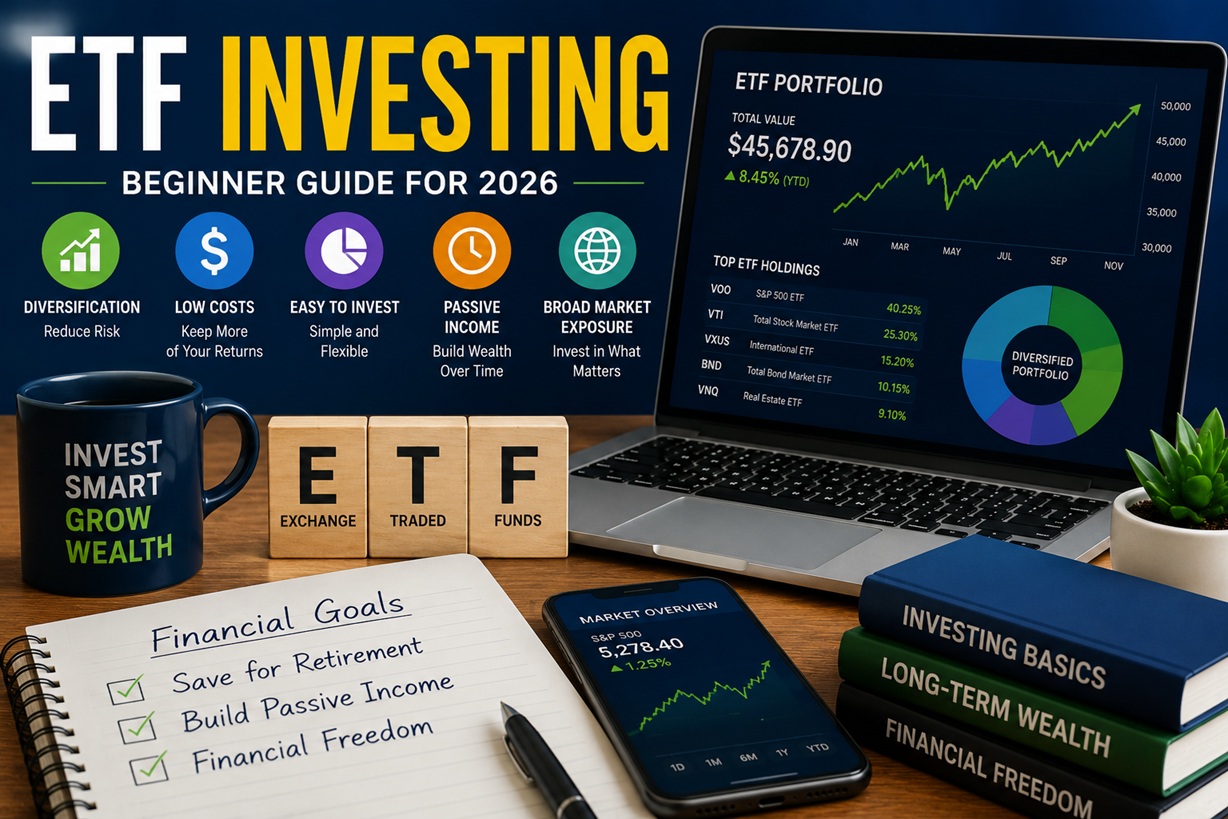
ETF Investing has become one of the most popular ways for Americans to build wealth, diversify portfolios, and invest for long-term financial goals. Instead of purchasing individual stocks one by one, many investors now choose exchange-traded funds because they provide broad market exposure, lower costs, and greater convenience. As a result, ETF Investing continues to attract beginners and experienced investors alike.

Moreover, exchange-traded funds have transformed modern investing by making diversification simpler and more affordable. Investors can gain exposure to hundreds of companies, industries, or even entire global markets through a single investment. Consequently, ETFs help reduce risk while supporting long-term growth strategies.
In addition, ETF Investing remains highly relevant because millions of Americans want practical ways to save for retirement, generate passive income, and grow wealth without spending hours researching stocks. Since investing-related topics attract strong advertiser competition, ETF content also performs well in high-RPM finance niches.
Whether you are opening your first brokerage account or refining an existing portfolio, this guide explains how ETFs work, why they matter, and how beginners can use them to invest smarter in 2026.
What Is an ETF?
An ETF, or exchange-traded fund, is an investment fund that trades on stock exchanges similarly to individual stocks. Instead of buying one company, investors buy shares of a fund that holds multiple investments.
ETFs may include:
- Stocks
- Bonds
- Commodities
- Real estate assets
- International investments
Because ETFs contain many holdings, they provide instant diversification.
How ETF Investing Works
When you purchase an ETF, you buy a small portion of all the investments inside the fund. Therefore, your portfolio becomes more balanced compared to owning only one or two stocks.
For example, an S&P 500 ETF includes shares from hundreds of major American companies such as:
- Technology firms
- Healthcare companies
- Financial institutions
- Consumer brands
- Industrial businesses
As these companies grow and generate profits, the ETF’s value can increase over time.
Why ETFs Are Popular
Diversification
ETFs spread investments across multiple companies or sectors. As a result, investors reduce the risk associated with individual stocks.
Lower Costs
Most ETFs charge lower fees than actively managed mutual funds. Consequently, investors keep more of their long-term returns.
Easy Trading
Unlike traditional mutual funds, ETFs trade throughout the day on stock exchanges.
Beginner-Friendly Investing
ETFs simplify investing because they provide exposure to large sections of the market through a single purchase.
Tax Efficiency
Many ETFs create fewer taxable events compared to some mutual funds.
ETFs vs Mutual Funds
Many beginners compare ETFs with mutual funds before investing.
ETFs
- Trade like stocks
- Usually have lower fees
- Allow intraday trading
- Often require lower minimum investments
Mutual Funds
- Trade after market close
- May have higher management fees
- Sometimes require larger minimum deposits
Although both options can work well, many investors prefer ETFs because of flexibility and lower costs.
Types of ETFs
Stock ETFs
These ETFs track groups of stocks such as the S&P 500 or Nasdaq-100.
Bond ETFs
Bond ETFs focus on government or corporate bonds and may provide more stability.
Dividend ETFs
Dividend ETFs invest in companies that regularly pay dividends.
Sector ETFs
Sector funds focus on industries such as technology, healthcare, or energy.
International ETFs
International ETFs provide exposure to markets outside the United States.
Real Estate ETFs
These ETFs invest in real estate companies and REITs.
Best ETF Strategies for Beginners
Start with Broad Market ETFs
Many beginners start with:
- S&P 500 ETFs
- Total stock market ETFs
- International index ETFs
These funds provide strong diversification.
Invest Consistently
Regular monthly investing often produces better long-term results than trying to time the market.
Focus on Low Fees
Expense ratios significantly affect long-term investment growth.
Stay Invested Long-Term
Markets naturally rise and fall. However, long-term investing historically rewards patience.
Popular ETF Providers
Several companies dominate the ETF industry because of low costs and broad fund selections.
Popular ETF providers include:
These platforms offer beginner-friendly investing tools and educational resources.
How to Start ETF Investing
Step 1: Open a Brokerage Account
You can open:
Step 2: Choose Your ETFs
Look for:
- Low expense ratios
- Broad diversification
- Strong long-term history
Step 3: Decide How Much to Invest
Many platforms now support fractional investing, allowing beginners to start with small amounts.
Step 4: Invest Consistently
Automatic investing can help build wealth steadily over time.
The Power of Compound Growth
Compound growth remains one of the biggest advantages of long-term ETF Investing. Over decades, investment returns can generate additional returns. Therefore, early investing often creates significantly larger long-term portfolios.
Example of Long-Term ETF Investing
Suppose you invest:
- $400 every month
- For 30 years
- With an average annual return of 8%
Consistent investing could potentially grow into hundreds of thousands of dollars over time.
Consequently, time in the market often matters more than perfect timing.
Common ETF Investing Mistakes
Chasing Short-Term Trends
Some investors constantly switch funds based on recent performance. However, this strategy often creates inconsistent results.
Ignoring Fees
Even small fee differences can reduce long-term returns significantly.
Overtrading
Frequent buying and selling may increase taxes and emotional decision-making.
Panic Selling
Market declines are normal. Long-term investors usually benefit from remaining invested.
ETF Investing and Retirement
ETFs work especially well for retirement accounts because they provide:
- Diversification
- Long-term growth potential
- Lower costs
- Passive investing simplicity
As a result, many Americans use ETFs inside:
- Roth IRAs
- 401(k) plans
- Traditional IRAs
Are ETFs Safe?
No investment is completely risk-free. ETF values can decline during market downturns.
However, diversified ETFs generally reduce company-specific risk because they hold many investments instead of relying on a single business.
Long-term investors often recover from short-term market volatility more effectively.
Helpful Investment Resources
Readers who want additional guidance can explore trusted investing resources such as:
These resources explain investing basics, market risks, and retirement planning strategies.
Frequently Asked Questions
Yes. ETFs provide diversification, lower costs, and beginner-friendly investing.
Yes. ETF values can rise and fall with market conditions.
Stocks represent ownership in a single company, while ETFs contain multiple investments.
Many brokers allow investors to begin with very small amounts.
Many investors prefer ETFs because of lower fees and trading flexibility.
Final Thoughts
ETF Investing continues to grow because it offers a practical and affordable way to build long-term wealth. Instead of constantly researching individual stocks, investors can use ETFs to gain broad market exposure with lower costs and reduced complexity.
Moreover, ETFs support many financial goals, including retirement planning, passive income generation, and long-term investing.
Whether you are starting your first portfolio or improving an existing investment strategy, ETFs can provide a strong foundation for financial growth in 2026 and beyond.
At LearnWithVinod.com, our mission is simple: Learn, Earn, and Grow.