The Debt Snowball method helps thousands of Americans pay off credit cards, personal loans, and other debts faster by focusing on small wins first. Instead of trying to tackle the highest interest rate immediately, you pay off your smallest balance as quickly as possible while making minimum payments on all other debts. As a result, you build momentum, stay motivated, and gain confidence with every balance you eliminate.
Moreover, debt has become a major financial challenge for many households in the United States. Credit cards, car loans, and personal loans can quickly become overwhelming when several payments are due each month. Fortunately, the Debt Snowball offers a simple and highly effective system that turns a stressful situation into a step-by-step plan.
Whether you want to improve your credit score, reduce financial stress, or free up more money for saving and investing, this guide explains exactly how the Debt Snowball works and how you can use it to become debt-free in 2026.
What Is the Debt Snowball Method?
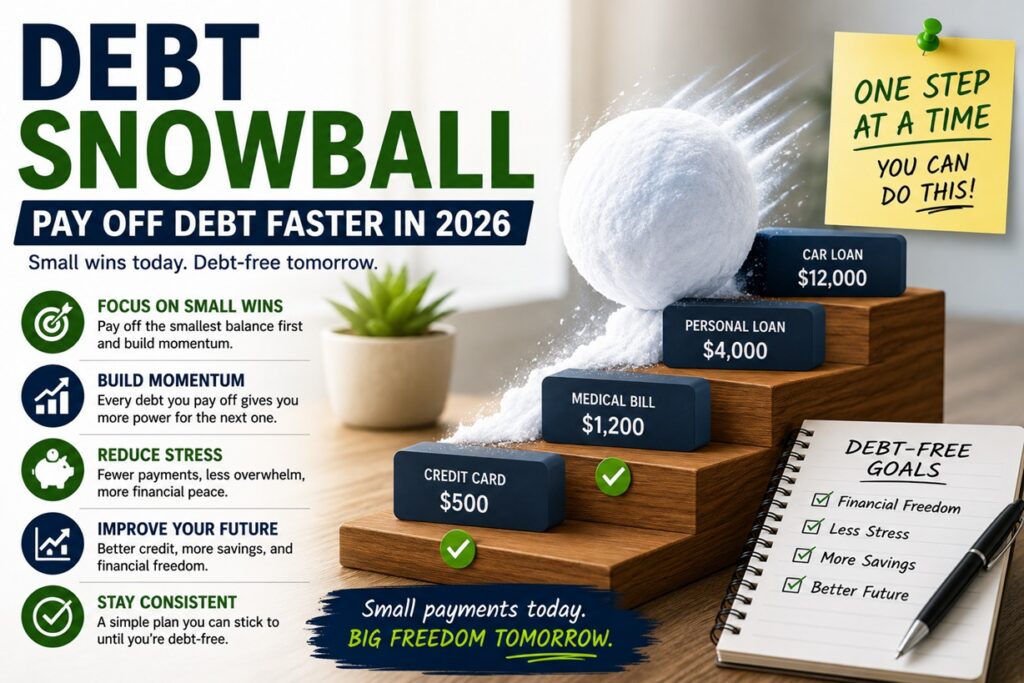
The Debt Snowball is a debt payoff strategy popularized by Dave Ramsey. The idea is straightforward: list all of your debts from the smallest balance to the largest balance, regardless of interest rate.
Next, make minimum payments on every debt except the smallest one. Then, direct every extra dollar toward that smallest balance until you pay it off completely.
Once you eliminate that first debt, roll the entire payment amount into the next-smallest debt. Consequently, your payment power grows like a snowball rolling downhill.
How the Debt Snowball Works
The process is simple but powerful.
- List all debts from smallest to largest.
- Make minimum payments on all accounts.
- Put all extra money toward the smallest balance.
- Pay off the smallest debt.
- Roll that payment into the next debt.
- Repeat until every debt is gone.
Because each paid-off balance creates a visible win, motivation tends to increase as the process continues.
Why the Debt Snowball Works So Well
Mathematically, the Debt Snowball may not always minimize interest costs. However, personal finance is often driven by behavior rather than pure math.
Quick Wins Build Confidence
Paying off a small balance early gives you immediate progress. As a result, you are more likely to stay committed.
Fewer Monthly Payments Reduce Stress
Each eliminated debt simplifies your finances and improves cash flow.
Momentum Increases Over Time
Every payoff adds more money to the next debt, accelerating your progress.
Motivation Stays High
Visible results make it easier to remain disciplined for months or years.
Debt Snowball Example
Suppose you have the following debts:
| Debt | Balance | Minimum Payment |
|---|---|---|
| Credit Card A | $500 | $25 |
| Medical Bill | $1,200 | $50 |
| Personal Loan | $4,000 | $150 |
| Car Loan | $12,000 | $300 |
Assume you can put an extra $300 toward debt each month.
Step 1
Pay $325 ($25 minimum + $300 extra) to Credit Card A.
Step 2
After Credit Card A is paid off, apply its $25 payment plus your extra $300 to the Medical Bill, for a total of $375.
Step 3
Once the Medical Bill is gone, roll $375 plus the $150 minimum payment into the Personal Loan.
Step 4
Continue until every debt is eliminated.
As you can see, the amount available for each subsequent debt grows larger and larger.
Debt Snowball vs Debt Avalanche
Many readers compare the Debt Snowball to the Debt Avalanche method.
Debt Snowball
- Prioritizes the smallest balance first
- Builds motivation quickly
- Creates early wins
Debt Avalanche
- Prioritizes the highest interest rate first
- Minimizes total interest costs
- Appeals to mathematically focused savers
Which Method Is Better?
If motivation is your biggest challenge, the Debt Snowball often works better. If you are highly disciplined and want to minimize interest, the Avalanche method may save more money.
However, the best strategy is the one you will actually follow consistently.
How to Find Extra Money for Debt Payments
The faster you increase your payments, the sooner you become debt-free.
Consider these strategies:
- Cancel unused subscriptions
- Reduce dining out
- Sell unused items
- Take on freelance work
- Use tax refunds
- Apply bonuses to debt
- Lower insurance costs
Even small changes can significantly shorten your payoff timeline.
Benefits of the Debt Snowball
Easy to Understand
The system is simple and straightforward.
Highly Motivating
Quick wins reinforce positive habits.
Improves Cash Flow
Each paid-off account frees money for other goals.
Supports Credit Improvement
Lower balances can help reduce credit utilization.
Builds Financial Discipline
Consistent payments strengthen money habits.
Potential Drawbacks
The Debt Snowball has one primary disadvantage: you may pay more interest compared with the Debt Avalanche.
Nevertheless, many people find that the psychological benefits outweigh the additional cost.
Common Mistakes to Avoid
- Paying only minimum balances
- Ignoring a written budget
- Continuing to use credit cards
- Skipping emergency savings
- Losing focus after early progress
By avoiding these mistakes, you increase your chances of long-term success.
How the Debt Snowball Improves Your Credit Score
The Debt Snowball can support a stronger credit profile in several ways:
- Credit card balances decrease
- Credit utilization improves
- On-time payments continue
- Debt-to-income ratio may improve
Consequently, your credit score may rise as you eliminate debt.
What to Do After Becoming Debt-Free
Once you pay off all consumer debt, you can redirect those payments toward other goals.
For example, you may:
- Build a larger emergency fund
- Max out a Roth IRA
- Increase 401(k) contributions
- Invest in index funds
- Save for a home down payment
As a result, the same discipline that eliminated debt can accelerate wealth building.
Before choosing a debt payoff strategy, it can be helpful to review trusted resources that explain credit, budgeting, and debt management in greater detail. The Consumer Financial Protection Bureau offers practical guidance on creating a repayment plan and managing money more effectively. In addition, you can obtain your free annual credit reports through AnnualCreditReport.com to review balances and identify potential issues. Furthermore, MyMoney.gov provides educational tools on budgeting, saving, and reducing debt, while the Federal Trade Commission explains how to recognize and avoid debt relief scams. Together, these resources can help you make more informed decisions and stay on track throughout your debt-free journey.
Frequently Asked Questions
Yes. Millions of people have used this method successfully because it emphasizes behavioral momentum.
It depends on your personality and priorities. Many people prefer the motivation of quick wins.
Yes. Any debt you want to eliminate can be included.
The timeline depends on your balances, income, and monthly payments.
Yes. Lower balances and consistent payments often benefit credit scores over time.
Final Thoughts
The Debt Snowball method offers a practical and motivating way to eliminate debt and regain financial control. By paying off your smallest balance first and rolling each payment into the next debt, you create powerful momentum that can transform your finances.
Most importantly, you do not need a perfect income or a complicated system to succeed. You simply need a clear plan, consistent payments, and the determination to keep going.
Once your debt is gone, you can redirect that same money toward saving, investing, and building long-term wealth.
At LearnWithVinod.com, our mission is simple: Learn, Earn, and Grow.