
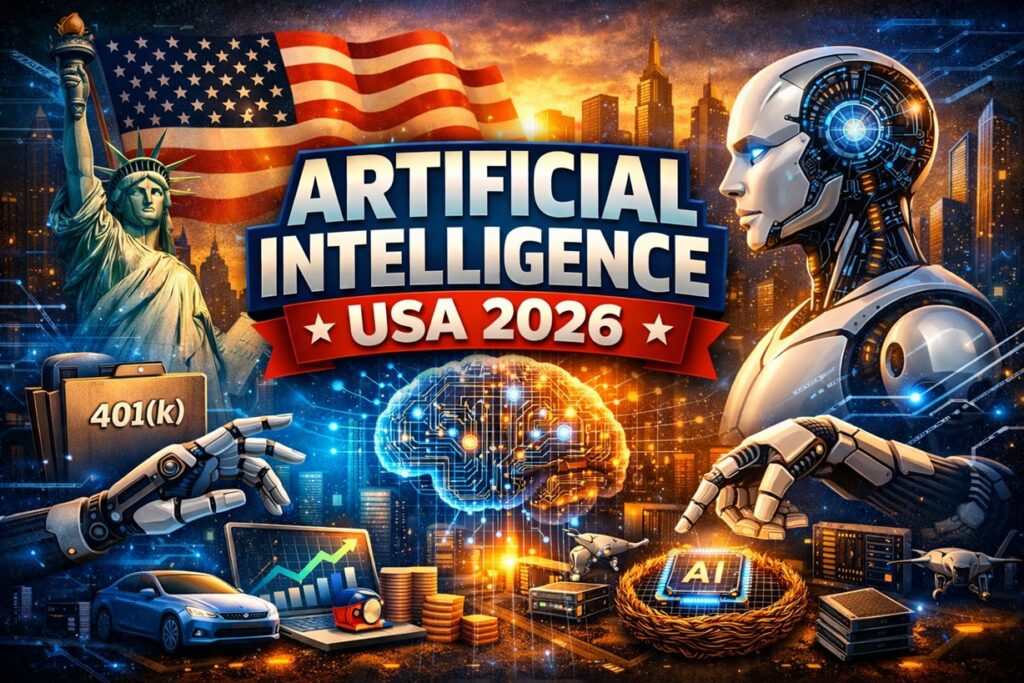
In 2026, artificial intelligence USA has become more than a buzzword — it’s a driving force behind innovation, productivity, and economic growth. From finance to healthcare, AI is reshaping how Americans work, invest, and live. Understanding these changes helps you stay ahead, adapt faster, and benefit from the AI revolution.
Why Artificial Intelligence Matters in 2026
AI is no longer futuristic — it’s practical, accessible, and profitable. Transitioning from manual processes to AI‑powered automation saves time and boosts efficiency. Businesses across the USA are using AI to analyze data, predict trends, and personalize customer experiences.
👉 Outbound resource: U.S. Department of Commerce – AI Policy and Innovation (commerce.gov in Bing) (bing.com in Bing)
AI in Business and Finance
Artificial intelligence is transforming how companies operate and how Americans manage money.
1. AI‑Driven Investing
AI algorithms now analyze market data faster than any human. Transitioning to robo‑advisors and AI‑powered trading platforms helps investors make smarter decisions. 👉 Outbound resource: Betterment Robo‑Advisor
2. AI in Banking
Banks use AI to detect fraud, automate customer service, and personalize financial advice. Transitioning to AI‑enabled apps ensures faster transactions and better security. 👉 Outbound resource: JPMorgan AI Innovation (jpmorgan.com in Bing) (bing.com in Bing)
3. AI for Credit Scoring
AI models assess creditworthiness more accurately by analyzing spending patterns and social data. Transitioning to AI‑based scoring helps lenders reduce risk and borrowers access fairer rates.
AI in Everyday Life
Artificial intelligence is now part of daily routines — from smart homes to healthcare.
4. Smart Home Automation
Americans are using AI‑powered devices like Alexa, Google Home, and smart thermostats to simplify life. Transitioning to connected homes saves energy and enhances comfort. 👉 Outbound resource: Energy.gov Smart Home Guide
5. AI in Healthcare
Hospitals use AI for diagnostics, patient monitoring, and drug discovery. Transitioning to AI‑assisted healthcare improves accuracy and reduces costs. 👉 Outbound resource: Mayo Clinic AI Research (mayoclinic.org in Bing) (bing.com in Bing)
6. AI in Education
AI tutors and adaptive learning platforms personalize education for students. Transitioning to AI‑based learning tools helps Americans upskill faster and more effectively.
7. AI in Transportation
Self‑driving cars and traffic prediction systems are becoming mainstream. Transitioning to AI‑powered mobility reduces accidents and travel time. 👉 Outbound resource: Tesla Autopilot Overview (tesla.com in Bing) (bing.com in Bing)
Artificial Intelligence in USA and Job Opportunities
While automation replaces some roles, it also creates new ones. Transitioning into AI‑related careers — data science, machine learning, and prompt engineering — ensures future job security.
| AI Career Path | Average Salary (2026) | Growth Rate |
|---|---|---|
| Data Scientist | $130,000 | 35% |
| Machine Learning Engineer | $145,000 | 40% |
| AI Product Manager | $120,000 | 30% |
| Prompt Engineer | $110,000 | 50% |
| AI Ethics Specialist | $100,000 | 25% |
👉 Outbound resource: U.S. Bureau of Labor Statistics – Tech Jobs Outlook (bls.gov in Bing) (bing.com in Bing)
AI and Privacy Concerns
With great power comes responsibility. Transitioning into AI‑driven systems requires strong data protection. Americans are increasingly aware of privacy laws like the AI Bill of Rights and GDPR‑inspired frameworks. 👉 Outbound resource: White House Blueprint for AI Bill of Rights (whitehouse.gov in Bing) (bing.com in Bing)
Future of Artificial Intelligence in the USA
By 2026, AI will continue to expand into sustainability, cybersecurity, and creative industries. Transitioning into AI‑powered tools helps individuals and businesses stay competitive. The USA remains a global leader in AI innovation, driving progress through ethical development and public‑private partnerships.
Final Thoughts
The artificial intelligence USA revolution is here to stay. Transitioning into AI‑driven tools, careers, and investments ensures you stay ahead in a rapidly changing world. Whether you’re optimizing finances, learning new skills, or automating daily tasks, embracing AI today means thriving tomorrow.
FAQ Section
Finance, healthcare, education, and transportation are leading sectors for AI adoption.
Some roles are automated, but new opportunities in AI development and ethics are growing rapidly.
Enroll in online courses from platforms like Coursera, Udemy, or Microsoft Learn.
Yes, when regulated properly. Always use trusted platforms with strong encryption and privacy policies.
AI will drive innovation in sustainability, finance, and healthcare, making life more efficient and connected.