Table of Contents
- Credit Card Debt in 2026: Where Things Stand
- How Consolidating Credit Card Debt With a Personal Loan Works
- The 3-Number Test: Will a Consolidation Loan Save You Money?
- A real dollar example
- When Consolidating Credit Card Debt Makes Sense
- When It’s a Bad Idea
- Other Ways to Tackle Credit Card Debt
- How to Consolidate Credit Card Debt the Right Way
- Timing Matters Before the Holidays
- Final Thoughts
- Frequently Asked Questions
- Sources
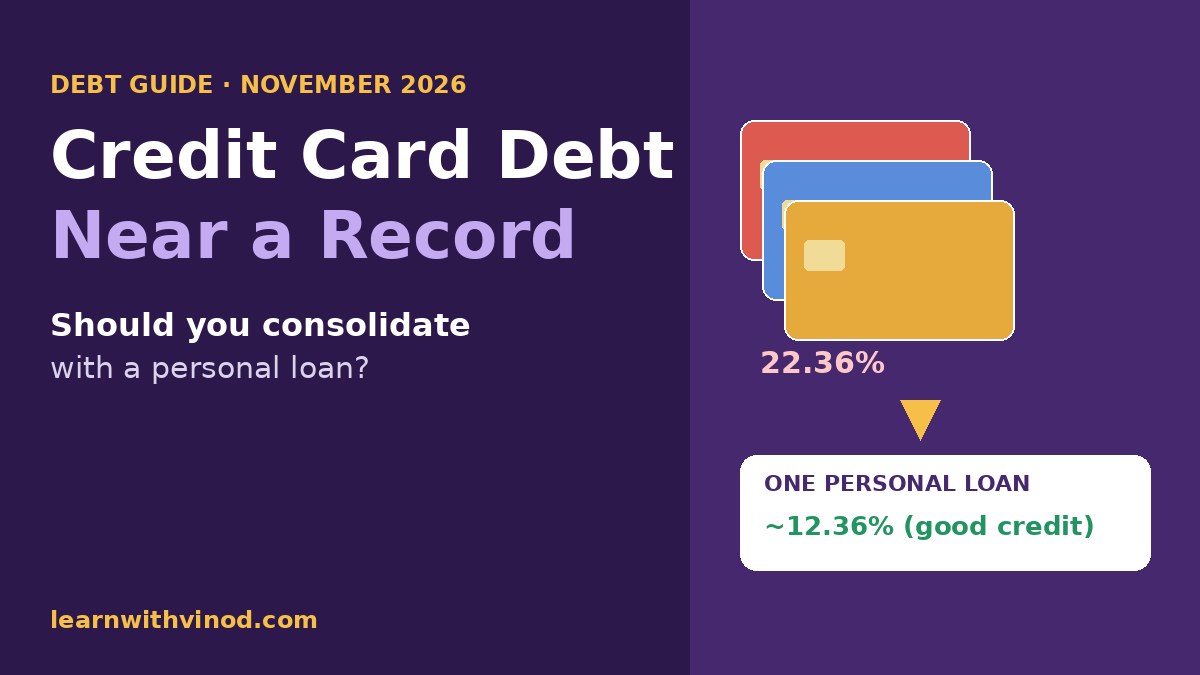
Americans owe $1.26 trillion in credit card debt, according to the Federal Reserve Bank of New York, just below the record $1.28 trillion set at the end of 2025. With the average card charging more than 22% interest, many people are asking whether to roll their balances into a personal loan. Sometimes that saves well over $1,000. Sometimes it costs more. This guide gives you a simple three-number test, a real dollar example and the warning signs that a consolidation loan will backfire.
Credit Card Debt in 2026: Where Things Stand
| Measure | Latest figure |
|---|---|
| Total U.S. credit card balances (Q2 2026) | $1.26 trillion |
| All-time high (Q4 2025) | $1.28 trillion |
| Average rate on cards charged interest (August 2026) | 22.36% |
| Average personal loan rate (700 FICO, 3 years, October 2026) | 12.36% |
| Share of card balances moving into serious delinquency (annualized) | 6.97% |
Sources: Federal Reserve Bank of New York Household Debt and Credit Report, Federal Reserve data reported by Forbes Advisor, and Bankrate. The New York Fed’s next quarterly report, for the third quarter, is expected in early November.
The gap between the two rates is the reason consolidating credit card debt is so popular. A borrower with good credit may cut their rate roughly in half. But the average hides a wide range: personal loan rates run from about 6% for excellent credit to 36% for poor credit, and many online lenders charge an upfront origination fee.
How Consolidating Credit Card Debt With a Personal Loan Works
- You take out a fixed-rate personal loan, usually for two to five years.
- You use the money to pay off your credit card debt, or the lender pays the cards directly.
- You make one fixed monthly payment until the loan is gone.
The benefits are a lower rate (if you qualify), a fixed end date and one payment instead of several. Your credit score can also improve, because paying off the cards lowers your credit utilization, which is a big part of your score. Our guide FICO Score explained covers how utilization works.
The 3-Number Test: Will a Consolidation Loan Save You Money?
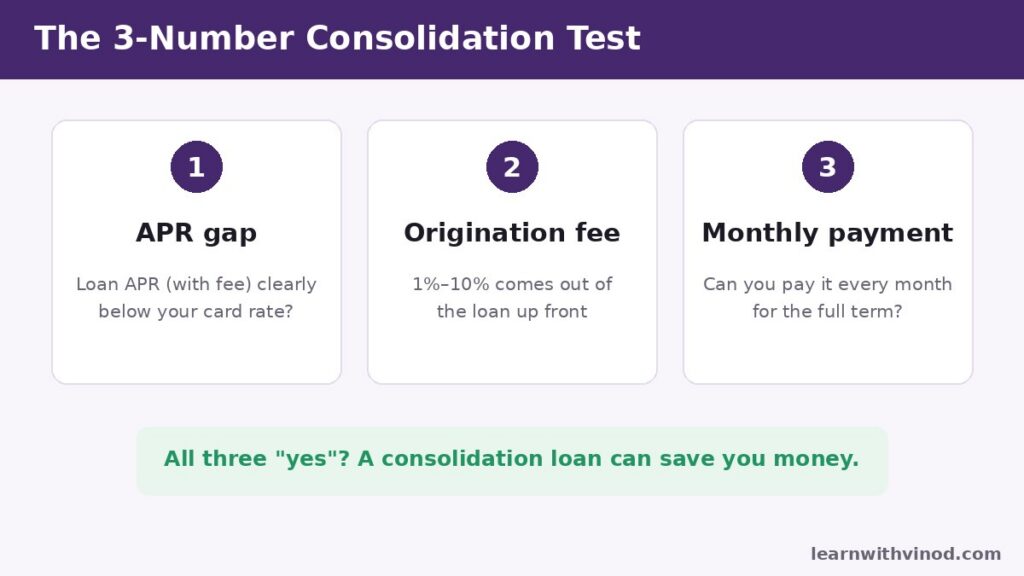
Before you apply, check these three numbers:
- The APR gap. Compare the loan’s APR, which includes the origination fee, with the interest rate on your cards. If the loan’s APR is not clearly lower, stop here.
- The origination fee. Fees of 1% to 10% are taken out of the loan before you get it. Borrow enough to cover your balances after the fee.
- The monthly payment. A fixed payment is only helpful if you can pay it every month. If it is higher than what you pay on your cards today, make sure your budget can handle it.
A real dollar example
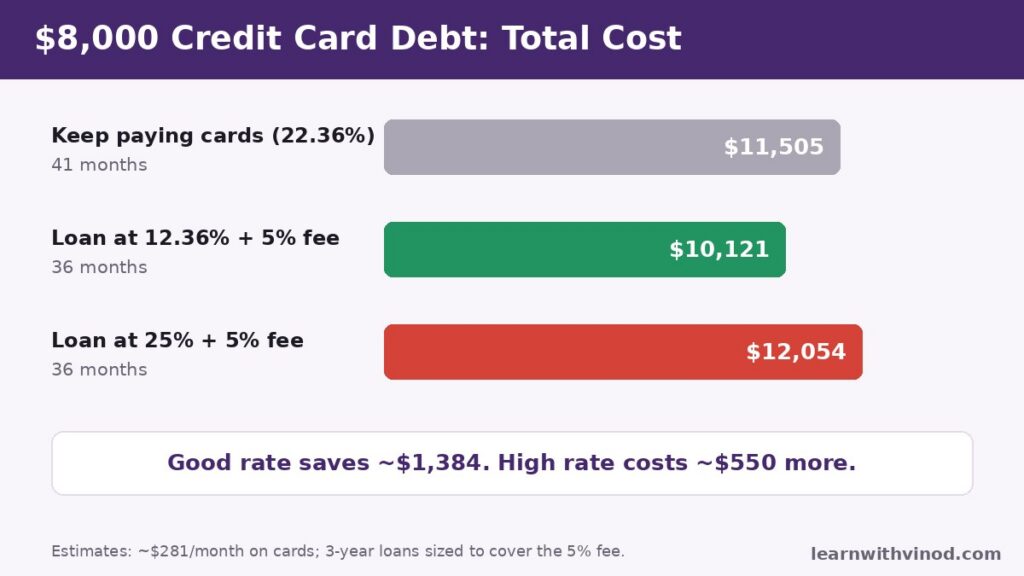
Say you have $8,000 in credit card debt at 22.36% and can pay about $281 a month.
| Option | Monthly payment | Time to pay off | Total paid |
|---|---|---|---|
| Keep paying the cards | $281 | 41 months | about $11,505 |
| Personal loan at 12.36% (5% fee, 3 years) | $281 | 36 months | about $10,121 |
| Personal loan at 25% (5% fee, 3 years) | $335 | 36 months | about $12,054 |
With good credit, the loan saves about $1,384 and five months for the same monthly payment. With a high loan rate, it costs about $550 more than keeping the cards. These are estimates based on fixed monthly payments; your numbers will depend on the offer you get.
To borrow enough to clear $8,000 after a 5% fee, you would need a loan of about $8,421. That is why the fee matters so much.
When Consolidating Credit Card Debt Makes Sense
- Your credit score is good enough (often 670 or higher) to get a rate well below your card rate.
- You owe enough credit card debt that the savings matter, usually a few thousand dollars or more.
- You can afford the fixed payment for the full term.
- You have stopped adding new charges and know what caused the debt in the first place.
When It’s a Bad Idea
- The loan rate is close to or above your card rate. With fair or poor credit, offers of 25% to 36% are common, and you would only be swapping one expensive debt for another.
- You plan to keep using the cards. This is the biggest risk. If the paid-off cards fill up again, you end up with the loan and new card balances.
- You could pay the credit card debt off within a year by cutting spending. A fee may cost more than the interest you save.
- You are already missing payments. A new loan may not fix a budget that doesn’t balance. Credit counseling is often a better first step.
Other Ways to Tackle Credit Card Debt
| Option | Best for | Watch out for |
|---|---|---|
| 0% balance transfer card | Good credit; can repay within the promo period (often 12–21 months) | Transfer fee (often 3%–5%); high rate after the promo ends |
| Personal loan | Larger balances that need 2–5 years | Origination fees; rates depend on credit |
| Nonprofit debt management plan | People struggling to keep up | Cards usually closed; small monthly fee |
| Avalanche or snowball payoff | Anyone with extra monthly cash | Needs discipline; no rate cut |
| Home equity loan or HELOC | Homeowners with equity | Your home is collateral |
For a debt management plan, look for a nonprofit agency that belongs to the National Foundation for Credit Counseling (NFCC). Be careful with “debt settlement” companies that ask you to stop paying your cards. That can seriously damage your credit and often comes with large fees.
How to Consolidate Credit Card Debt the Right Way
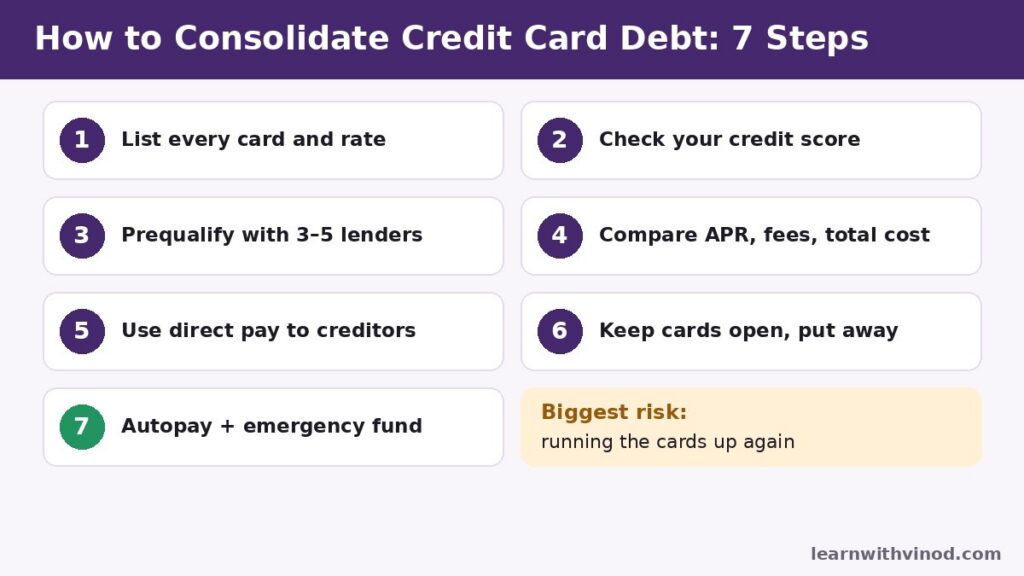
- List every card with its balance, interest rate and minimum payment.
- Check your credit report and score so you know which rates to expect.
- Prequalify with three to five lenders, including a credit union. Prequalification uses a soft credit check and won’t hurt your score.
- Compare APRs, fees and total cost, not just the monthly payment. A longer term lowers the payment but can raise the total interest.
- Choose direct payment to creditors if the lender offers it, so the money goes straight to your cards.
- Keep the cards open but put them away. Closing old cards can raise your utilization and shorten your credit history.
- Set up autopay and build a small emergency fund, so a surprise bill doesn’t turn into new credit card debt.
Timing Matters Before the Holidays
Holiday shopping is when many card balances grow. If you consolidate now, set a firm holiday budget so you don’t refill the cards in December. Our $500 holiday gift budget plan can help. Also, interest rates are not expected to drop quickly. The Federal Reserve held its benchmark rate at 3.75%–4.00% in October, so card rates are likely to stay high. Our guide Fed Interest Rates Aren’t Coming Down explains why.
Final Thoughts
Credit card debt is close to a record high, and card rates above 22% make it expensive to carry. A personal loan can be a smart way out, but only if the APR is clearly lower, the fee is small and you stop adding new charges. Run the three-number test, compare several offers and pick the option you can stick with until the balance is zero. For more practical money guides, visit our Personal Finance section.
Disclaimer: This article is for general information only and is not financial advice. Rates and figures are as of late October 2026 and change often. Examples are estimates; your loan offer and savings will depend on your credit and the lender.
Frequently Asked Questions
Is credit card debt at a record high?
Close to it. Americans owed $1.26 trillion on credit cards in the second quarter of 2026, according to the New York Fed, just below the record $1.28 trillion set at the end of 2025.
Is it smart to use a personal loan to pay off credit card debt?
It can be, if the loan’s APR (including fees) is clearly lower than your card rate, you can afford the fixed payment and you stop adding new charges. With fair or poor credit, loan rates may be too high to save money.
Will a debt consolidation loan hurt my credit score?
Applying causes a small, temporary dip from the hard inquiry. Paying off your cards usually lowers your credit utilization, which can help your score over time if you keep the cards paid down and make every loan payment on time.
Is a balance transfer card better than a personal loan?
A 0% balance transfer card is often cheaper if you have good credit and can repay the balance before the promo period ends. A personal loan is usually better for larger balances that need two to five years to pay off.
What is the average personal loan rate right now?
Bankrate reported an average of 12.36% in October 2026 for a borrower with a 700 FICO Score, a $5,000 loan and a three-year term. Rates range from about 6% for excellent credit to 36% for poor credit.
What if I can't qualify for a good consolidation loan?
Consider a debt management plan through a nonprofit credit counseling agency, such as one affiliated with the NFCC, or focus extra payments on your highest-rate card first. Be cautious with debt settlement companies.
Sources
- Federal Reserve Bank of New York – Household Debt and Credit, Q2 2026 (Aug 11, 2026)
- Yahoo Finance – U.S. credit card debt hits $1.26 trillion in Q2 2026, near record
- Forbes Advisor – Average credit card interest rate (Oct 26, 2026; Fed rate for accounts assessed interest)
- Bankrate – Average personal loan interest rates, October 2026
- National Foundation for Credit Counseling (NFCC)