Medicare open enrollment ends on Monday, December 7, 2026, and the choice you make now sets your costs for all of 2027. The trouble is that most people pick a Medicare plan by looking at one number, the monthly premium, and that’s exactly how they end up overpaying. This guide shows you how to pick a Medicare plan by its total yearly cost: premium, deductible, drug copays and your worst-case medical bills. It takes about 30 minutes with the free tools on Medicare.gov.
Why the Lowest Premium Is Often Not the Cheapest Plan
When you pick a Medicare plan, the monthly premium is only part of what you pay. Your real cost for the year is:
Total cost = (premium × 12) + deductible + copays and coinsurance for your drugs and care
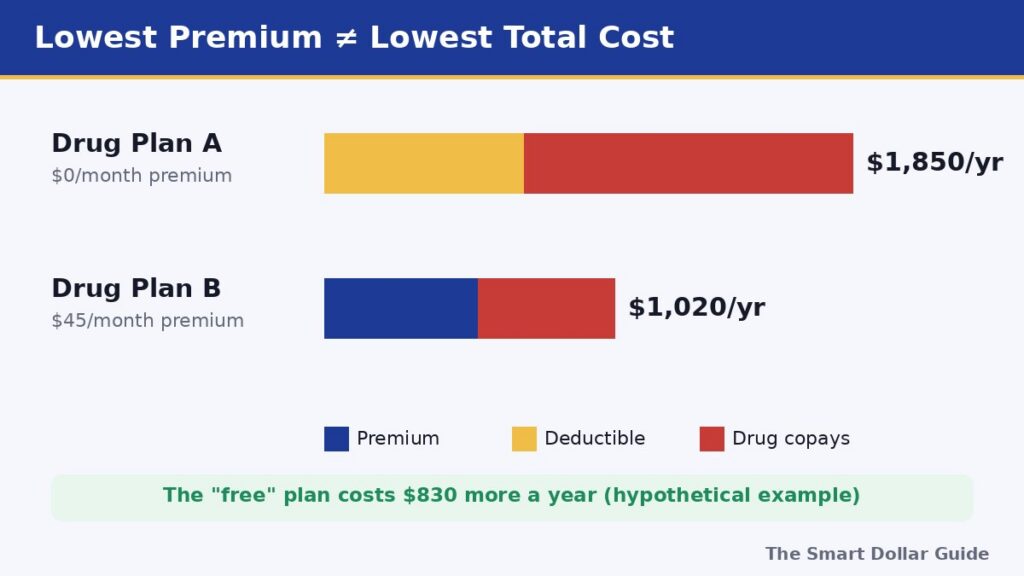
Here’s a simple example for someone taking three regular prescriptions. The plans and numbers are hypothetical, but this pattern shows up in Plan Finder all the time:
| Drug Plan A | Drug Plan B | |
|---|---|---|
| Monthly premium | $0 | $45 |
| Yearly premium | $0 | $540 |
| Deductible | $700 | $0 |
| Drug copays for the year | $1,150 | $480 |
| Total yearly cost | $1,850 | $1,020 |
The “free” plan costs $830 more over the year. That’s why the single most useful step is to enter your actual drugs into Medicare’s Plan Finder and sort by total cost, not premium.
How to Pick a Medicare Plan in 7 Steps
Follow these steps in order. Each one narrows your options, so by the end you’ll have one or two plans that fit your health and budget.
1. Read your Annual Notice of Change
Your current plan mailed an Annual Notice of Change (ANOC) in late September. It lists what changes on January 1: premium, deductible, drug coverage, pharmacy network and doctors. If your plan is leaving your area, you’ll get a separate notice and must pick a new one. Don’t assume “no news is good news.” Many plans changed a lot for 2027.
2. Make your list
Before you pick a Medicare plan, write down:
- Every prescription, with the exact dose and how often you take it
- Your preferred pharmacy, and whether you’d use mail order
- Your doctors, specialists and hospitals
- Any planned surgery, therapy or regular treatments next year
3. Compare total drug costs in Plan Finder
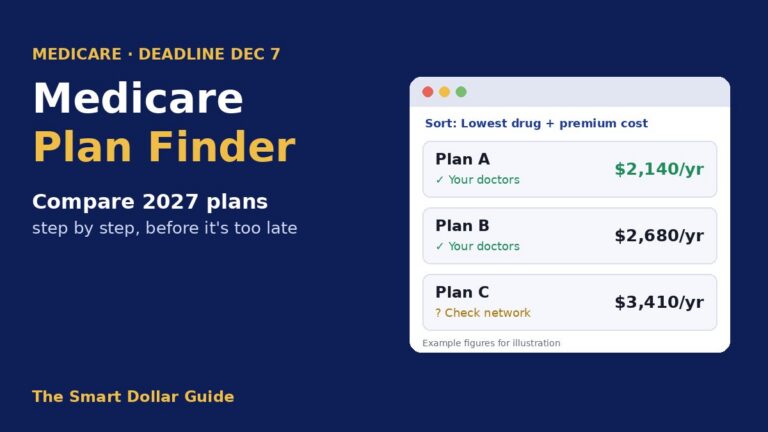
Go to Medicare Plan Finder, log in or continue as a guest, enter your drugs and pharmacy, then sort by “lowest drug + premium cost.” Check the top three plans. Look at which tier each drug is on and whether it needs prior authorization or has quantity limits. Two plans with the same premium can differ by hundreds of dollars a year.
If your drugs are expensive, remember that the Part D out-of-pocket cap rises to $2,400 in 2027. Once you hit it, covered drugs cost $0 for the rest of the year. For you, the premium may matter more than copays, because you’ll reach the cap in any plan.
4. Price your worst-case year
If you need to pick a Medicare plan type, Original Medicare or Medicare Advantage, compare what a bad health year would cost:
- Medicare Advantage plans must cap your in-network costs. The legal maximum for 2027 is $9,850 ($14,800 combined in and out of network for PPOs). Many plans set a lower cap; the average was about $5,400 in 2026.
- Original Medicare has no yearly cap. Most people pair it with a Medigap policy, which can cover nearly all costs after the Part B deductible, but adds a monthly premium.
A $0-premium Advantage plan with a $9,000 cap and a Medigap plan with a $250 monthly premium can end up costing about the same in a bad year. The Advantage plan is far cheaper in a healthy year. Pick a Medicare plan type based on your health, budget and appetite for risk.
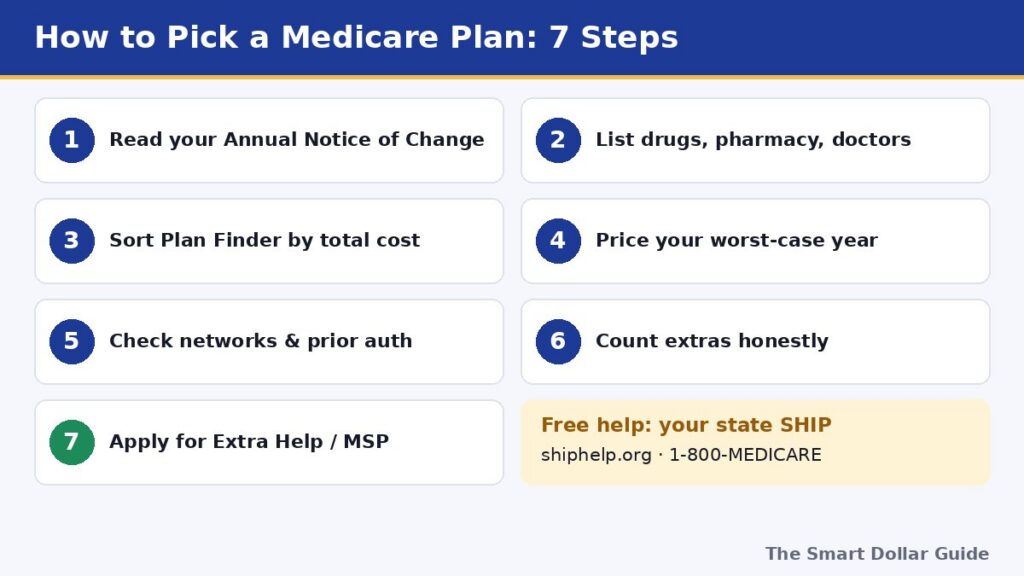
5. Check networks and prior authorization
A plan is only cheap if you can use it. For Medicare Advantage, confirm every doctor and hospital is in network for 2027, not just 2026. Ask whether your regular treatments need prior authorization. If you travel or spend winters in another state, an HMO with a local-only network may not work for you.
6. Count the extras honestly
Dental, vision, hearing and grocery allowances look appealing, but only count them if you’ll really use them, and check the limits. A $1,000 dental allowance helps if you need a crown; it doesn’t help if you only get a yearly cleaning. Don’t pay higher medical costs for perks you won’t use.
7. Check if you qualify for help
If your income is limited, you may qualify for Extra Help with drug costs or a Medicare Savings Program that pays your Part B premium. These can save thousands of dollars a year, and many eligible people never apply. Our guide to the $90 Medicare Part B payment explains one type of premium help.
7 Ways People Overpay for Medicare
- Staying put without checking. Your plan can raise premiums, drop a drug or change its pharmacy network every year.
- Choosing by premium alone. See the table above.
- Using a non-preferred pharmacy. The same drug can cost much more at a standard pharmacy than at a preferred or mail-order one.
- Ignoring the Medigap trap. If you leave Original Medicare for Medicare Advantage and later want to switch back, in most states a Medigap insurer can turn you down or charge more because of your health.
- Skipping the late enrollment penalty check. Going without creditable drug coverage can add a permanent penalty to your Part D premium.
- Not spreading out big drug costs. The Medicare Prescription Payment Plan lets you pay out-of-pocket drug costs in monthly installments instead of all at once.
- Waiting until December 7 to pick a Medicare plan. Plan Finder and help lines get busy in the last week. Enroll early so a problem can be fixed in time.
What If You Miss December 7?
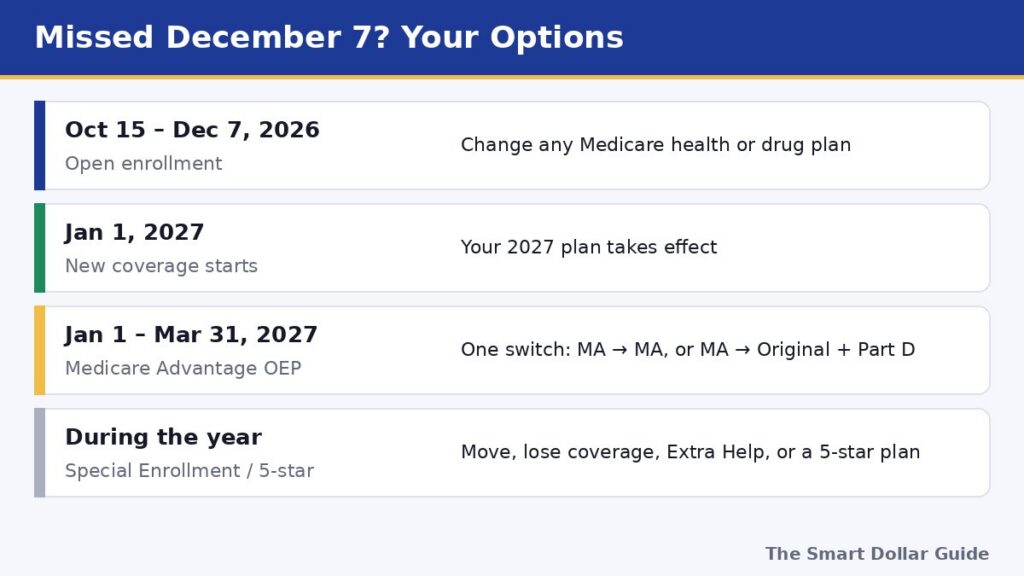
If you miss the deadline, your current coverage usually continues into 2027. You still have limited options:
- January 1 to March 31, 2027: if you’re in a Medicare Advantage plan, you can switch to another Advantage plan or to Original Medicare (and join a drug plan) once.
- Special Enrollment Periods: moving, losing other coverage or qualifying for Extra Help can let you change plans at other times.
- 5-star plans: you can switch to a plan rated 5 stars once during the year, if one is available in your area.
Where to Get Free, Unbiased Help
If you’re still unsure how to pick a Medicare plan, every state has a State Health Insurance Assistance Program (SHIP) with trained counselors who give free, one-on-one advice and don’t sell insurance. You can find yours at shiphelp.org, or call Medicare at 1-800-MEDICARE (1-800-633-4227). Be careful with TV ads and callers promising “extra benefits.” Only use licensed agents or official sources, and never give your Medicare number to an unsolicited caller.
For the full list of 2027 dates and cost changes, read our Medicare Open Enrollment 2027 guide. Your Social Security check will also change in January; see what the 3.6% COLA for 2027 means after Part B premiums.
Final Thoughts
To pick a Medicare plan without overpaying, compare the total yearly cost, not the premium. Enter your exact drugs in Plan Finder, check your worst-case year, confirm your doctors and pharmacy, and apply for any help you qualify for. Do it well before December 7, and use a free SHIP counselor if you’re unsure. For more guides, visit our Medicare section.
Disclaimer: This article is for general information only and is not insurance or medical advice. Plan examples are hypothetical. Figures are as of November 2026; costs vary by plan and location. Confirm details on Medicare.gov or with a licensed counselor.
Frequently Asked Questions
When does Medicare open enrollment end?
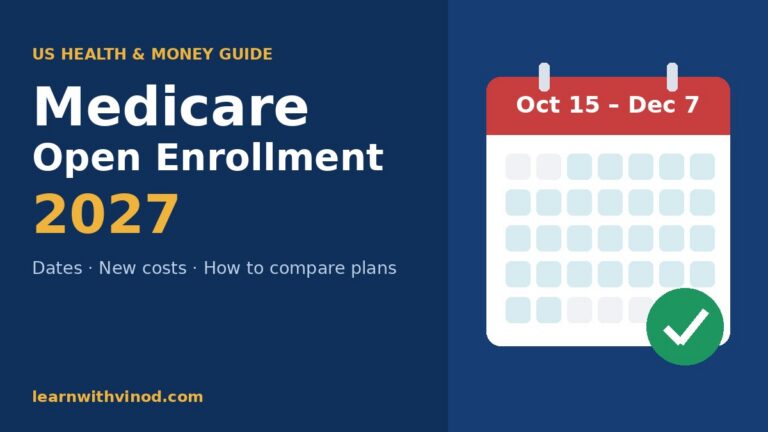
Medicare open enrollment runs from October 15 to December 7, 2026. Changes you make take effect January 1, 2027.
How do I compare Medicare plans by cost?
Enter your exact drugs and pharmacy in Medicare Plan Finder on Medicare.gov and sort by lowest drug plus premium cost. Then add the deductible, copays and the plan’s out-of-pocket maximum to see your total yearly cost.
What is the Medicare Advantage out-of-pocket maximum for 2027?
Plans can set in-network limits up to $9,850 in 2027, or $14,800 combined for in- and out-of-network care in PPO plans. Many plans set lower limits.
What is the Part D out-of-pocket cap for 2027?
$2,400. After you reach it, you pay nothing more for covered Part D drugs for the rest of 2027.
What if I miss the December 7 deadline?
Your current coverage usually continues. If you’re in Medicare Advantage, you can switch once between January 1 and March 31, 2027. Special Enrollment Periods and 5-star plans also allow some changes.
Where can I get free help choosing a Medicare plan?
Your State Health Insurance Assistance Program (SHIP) offers free, unbiased counseling; find it at shiphelp.org. You can also call 1-800-MEDICARE.
Sources
- Medicare.gov – Medicare Plan Finder
- BenefitsUSA – Medicare Advantage out-of-pocket maximum 2027 (CMS CY 2027 standards)
- SmartQuotes – 2027 Medicare Part B premium: what CMS has confirmed
- CMS – 2026 Medicare Parts A & B premiums and deductibles
- SHIP National Technical Assistance Center – Find your local SHIP