Losing your job brings two money decisions that can’t wait: what happens to your health insurance and what to do with your 401(k). Good layoff planning means making both choices calmly, because the wrong move can cost thousands of dollars. Cashing out a 401(k) can trigger taxes and a 10% penalty, and picking COBRA by default can cost a family about $2,400 a month. This guide gives you a day-by-day plan for the first 60 days, side-by-side comparisons of your options and the deadlines you can’t miss.
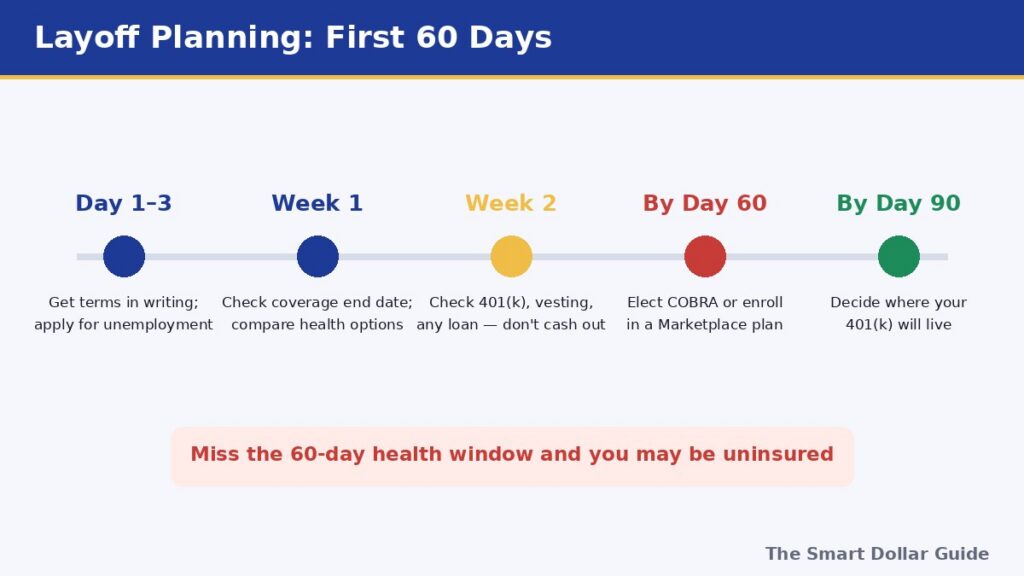
Layoff Planning: Your First 60 Days at a Glance
| When | What to do |
|---|---|
| Day 1–3 | Get your severance terms, final pay details and benefit end dates in writing. Apply for unemployment. |
| Week 1 | Find out exactly when your health coverage ends. Compare COBRA, ACA Marketplace, a spouse’s plan and Medicaid. |
| Week 2 | Check your 401(k) balance, vesting and any loan. Don’t cash out. |
| Within 60 days | Enroll in new health coverage (Marketplace special enrollment) or elect COBRA. |
| Within 90 days | Decide where your 401(k) will live: old plan, IRA or new employer’s plan. |
Step 1: Get Everything in Writing
Layoff planning starts with facts. Before you sign anything, ask HR for:
- Severance details: amount, payment schedule and any conditions, such as signing a release. Severance is taxable income.
- Your last day of health coverage. Some plans end on your last day of work; many run to the end of the month.
- Payout of unused vacation, which depends on your state’s law and company policy.
- Your 401(k) vesting status for any employer match.
Severance terms are sometimes negotiable, which is why layoff planning should start before you sign. Asking for a few extra months of paid health coverage can be worth more than a small cash increase.
Apply for unemployment benefits right away, even if you’re getting severance. Rules vary by state, and some states delay benefits while severance is paid. Unemployment benefits are taxable federal income, so consider having tax withheld.
Step 2: Choose Your Health Insurance
Health coverage is the most time-sensitive part of layoff planning. You usually have four options. Compare them on total cost, not just the monthly premium.
| Option | Typical cost | Best for | Deadline |
|---|---|---|---|
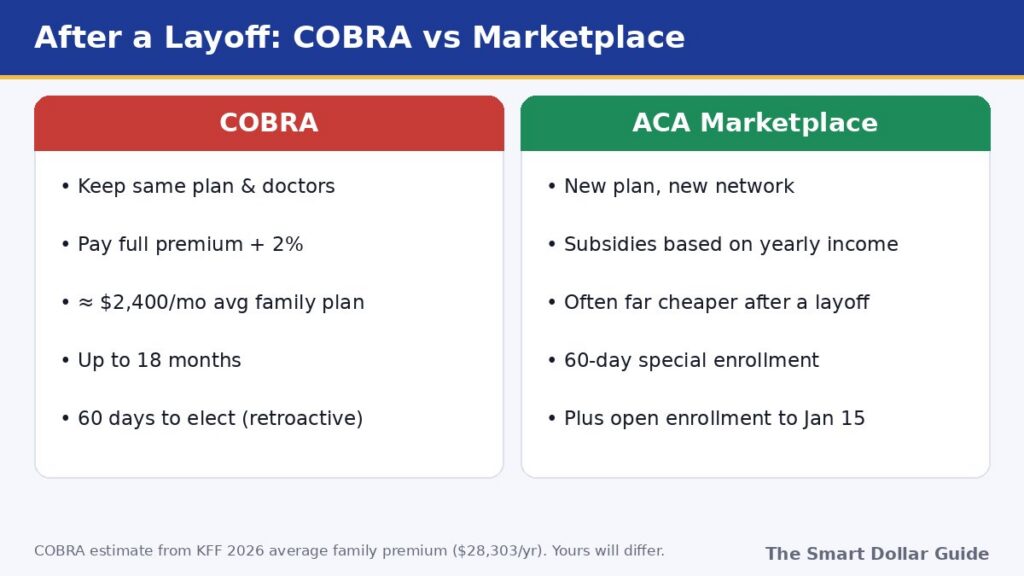
| COBRA (keep your work plan) | Full premium plus up to 2%; about $2,400/month for an average family plan | Mid-treatment, met your deductible, or must keep the same doctors | 60 days to elect |
| ACA Marketplace plan | Often much less if your income drops, thanks to premium tax credits | Most people with lower income for the year | 60 days after losing coverage |
| Spouse’s employer plan | Varies | Couples where one partner still has coverage | Usually 30 days |
| Medicaid | Little or nothing | Very low income (rules vary by state) | Any time |
How much COBRA really costs
With COBRA, you pay the share your employer used to cover. According to KFF’s 2026 employer survey, the average family plan costs $28,303 a year in total, while workers paid only about $7,471 of it. Under COBRA, that same family could pay about $2,400 a month. Single coverage often runs around $800 a month. These are national averages; your plan’s COBRA notice will list your exact cost.
COBRA usually lasts up to 18 months. You have 60 days to elect it after receiving the notice, and coverage is retroactive to the day your old plan ended. Read the U.S. Department of Labor’s COBRA guide for the details.
Why the Marketplace is often cheaper
Losing job-based coverage gives you a 60-day special enrollment period on HealthCare.gov or your state’s marketplace. Because subsidies are based on your expected income for the whole year, a layoff can make you eligible for much more help than you’d expect. The extra pandemic-era subsidies expired at the end of 2025, so savings are smaller than before, but they’re still significant for many households. If you’re laid off in November or December, open enrollment for 2027 coverage is also running through January 15. See our ACA open enrollment 2027 guide.
Tip: If you have a health savings account (HSA), you can use it tax-free to pay COBRA premiums, and to pay health insurance premiums while you’re receiving unemployment benefits.
Step 3: Protect Your 401(k)
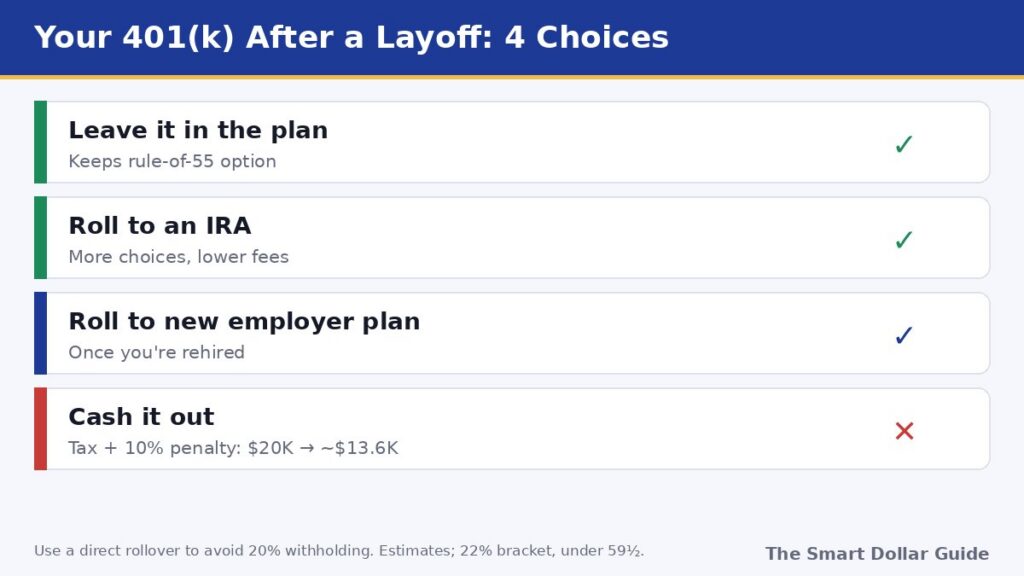
In layoff planning, your 401(k) is the asset most at risk from a rushed decision. It belongs to you, but what you do next decides how much of it you keep. Here are your four choices:
| Option | Pros | Cons |
|---|---|---|
| Leave it in your old plan | No action needed; keeps creditor protection; may allow penalty-free withdrawals under the rule of 55 | Fewer choices; balances under $7,000 may be moved out automatically |
| Roll it into an IRA | More investment choices, often lower fees, easy to manage | Lose the rule-of-55 option for that money |
| Roll it into a new employer’s plan | Keeps everything in one place | Only once you have a new job that accepts rollovers |
| Cash it out | Immediate cash | Income tax, plus a 10% penalty if under 59½, and lost growth |
The real cost of cashing out
Here’s why cashing out can wreck your layoff planning. Say you cash out $20,000 at age 40 and you’re in the 22% bracket. Federal income tax plus the 10% penalty takes about $6,400, before any state tax. The plan must also withhold 20% up front. Left invested, that $20,000 could grow to well over $100,000 by retirement. These are estimates; your tax depends on your total income.
Rules that can help
- Rule of 55: if you leave your job in or after the year you turn 55, you can withdraw from that employer’s 401(k) without the 10% penalty. Rolling the money to an IRA removes this option.
- Use a direct rollover. Have the plan send money straight to your IRA or new plan. A check made out to you triggers 20% withholding, and you’d have to replace that amount within 60 days to avoid tax.
- Outstanding 401(k) loan: if you leave with a loan, the unpaid balance is usually treated as a distribution. You generally have until your tax filing deadline, including extensions, for that year to roll over the amount and avoid tax.
For more on how withdrawals are taxed, read our 401(k) withdrawal strategy guide.
Step 4: Build a Bare-Bones Budget
Strong layoff planning includes a short-term budget. Add up your severance, unemployment benefits and savings, then list only essential expenses: housing, utilities, food, insurance, transportation and minimum debt payments. Divide your total cash by your monthly essentials to see how many months you have.
- Keep your emergency fund in a high-yield account. See the best online banks for 2026.
- Call lenders early. Many card issuers and mortgage servicers offer hardship programs if you ask before you miss a payment.
- Avoid running up credit cards to cover expenses. If balances are already high, read our guide on whether to consolidate credit card debt.
- Pause extra retirement contributions during your layoff planning period, but don’t withdraw from retirement accounts unless you’ve used every other option.
Layoff Planning Mistakes to Avoid
Even careful people make these layoff planning errors under stress:
- Letting health coverage lapse while you “figure it out.” Missing the 60-day window can leave you uninsured until the next open enrollment.
- Cashing out your 401(k) for short-term breathing room.
- Rolling over a 401(k) you might need at 55 to 59½, losing the penalty-free option.
- Forgetting that severance and unemployment are taxable.
- Signing a severance agreement without reading what rights you’re giving up.
Final Thoughts
Good layoff planning comes down to a few clear moves: get the details in writing, apply for unemployment, choose health coverage within 60 days based on total cost, and leave your 401(k) invested by keeping it in the plan or doing a direct rollover. Avoid cashing out, protect your emergency fund, and talk to your lenders early. For more practical guides, visit our Personal Finance section.
Disclaimer: This article is for general information only and is not financial, tax, legal or insurance advice. Costs are national averages or estimates as of November 2026. Check your plan documents and your state’s rules, or speak with a professional.
Frequently Asked Questions
What should I do with my 401(k) if I get laid off?
Usually leave it in the plan or do a direct rollover to an IRA or a new employer’s plan. Avoid cashing out, which triggers income tax and usually a 10% penalty if you’re under 59½.
How much does COBRA cost?
You pay the full premium plus up to 2%. Based on KFF’s 2026 average family premium of $28,303 a year, that’s about $2,400 a month for a family. Your COBRA notice lists your exact cost.
How long do I have to get new health insurance after a layoff?
You generally have 60 days to elect COBRA and 60 days after losing coverage to enroll in an ACA Marketplace plan through a special enrollment period.
Is the Marketplace cheaper than COBRA?
Often, yes. Marketplace subsidies are based on your income for the year, so a layoff can make you eligible for significant help. COBRA may still make sense if you’ve met your deductible or are mid-treatment.
What is the rule of 55?
If you leave your job in or after the year you turn 55, you can withdraw from that employer’s 401(k) without the 10% early withdrawal penalty. Income tax still applies.
What happens to my 401(k) loan if I lose my job?
The unpaid balance is usually treated as a distribution, but you generally have until your tax filing deadline, including extensions, to roll over that amount and avoid tax.