

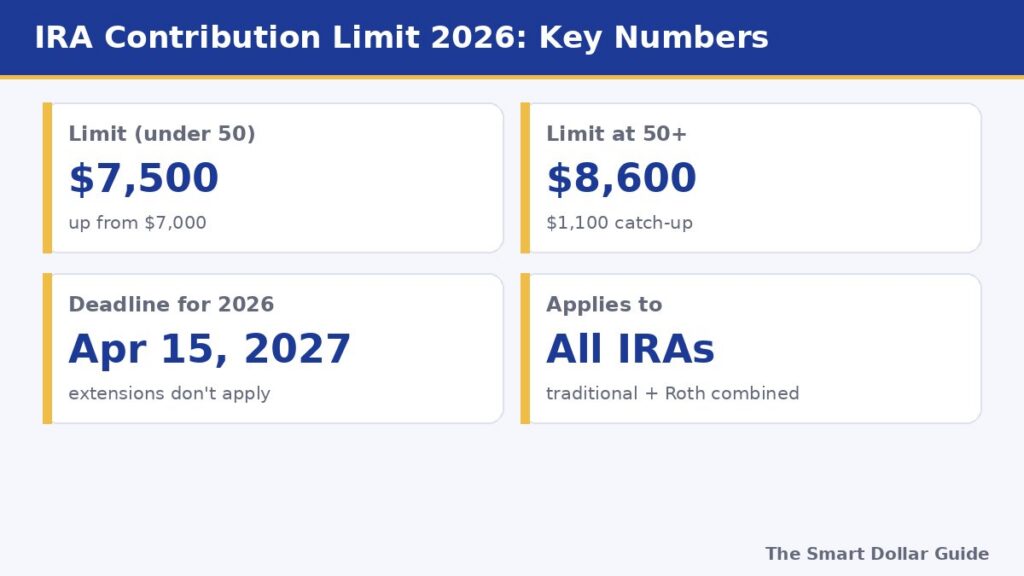
The IRA contribution limit for 2026 is $7,500, or $8,600 if you’re 50 or older. That’s up from $7,000 and $8,000 in 2025, according to the IRS. Good news if you’re behind: you have until April 15, 2027 to make your 2026 contribution. But “max it out” isn’t the right goal for everyone. This guide shows when maxing your IRA makes sense, which type of IRA to pick, how much tax it can save you, and a simple monthly plan to reach the limit before Tax Day.
IRA Contribution Limit 2026: The Key Numbers
| Item | 2025 | 2026 |
|---|---|---|
| IRA contribution limit (under 50) | $7,000 | $7,500 |
| Catch-up contribution (50+) | $1,000 | $1,100 |
| Total limit at 50+ | $8,000 | $8,600 |
| Deadline to contribute for the year | April 15, 2026 | April 15, 2027 |
The limit applies to all your IRAs combined, traditional and Roth. If you put $3,000 in a Roth IRA, you can add only $4,500 to a traditional IRA for 2026. You also can’t contribute more than your taxable earned income for the year, though a working spouse can fund a spousal IRA for a spouse with little or no income.
What about 2027? The IRS usually announces next year’s limits in November. As of early November 2026, the 2027 IRA limit had not been announced, so treat any figure you see online as a forecast.
Who Can Contribute Up to the IRA Contribution Limit?
You need taxable earned income, such as wages or self-employment income, to contribute. Investment income, Social Security and pension payments don’t count. Your contribution can’t be more than you earned, so a student who earned $3,000 from a summer job can put in up to $3,000, not the full IRA contribution limit.
- No upper age limit. Since 2020 you can keep contributing to a traditional IRA at any age, as long as you have earned income.
- Spousal IRA. A married couple filing jointly can contribute up to the IRA contribution limit for each spouse, even if only one works, as long as their combined earned income covers both contributions. That’s up to $15,000 for a couple under 50, or $17,200 if both are 50 or older.
- Kids with jobs. A parent can open a custodial Roth IRA for a child who earns money, which gives decades of tax-free growth.
Should You Max Out Your IRA? Check These First
An IRA is a great tool, but it isn’t always the first place your next dollar should go. Most people should follow this order:
- Pay off high-interest debt. Clearing a credit card at 22% is a guaranteed return no investment can match.
- Keep an emergency fund. Three to six months of expenses in a high-yield savings account, so a surprise bill doesn’t force you to pull money from your IRA. See our list of the best online banks in the USA for 2026.
- Get your full 401(k) match. Free employer money beats any IRA benefit.
- Then fill your IRA up to the IRA contribution limit. IRAs often have more fund choices and lower fees than workplace plans.
If you can’t reach $7,500, don’t worry. Contributing $100 a month still adds up over time, and every dollar gets the same tax benefits.
Roth or Traditional IRA: Which One Fits You?
The same IRA contribution limit covers both types, but they’re taxed in opposite ways.
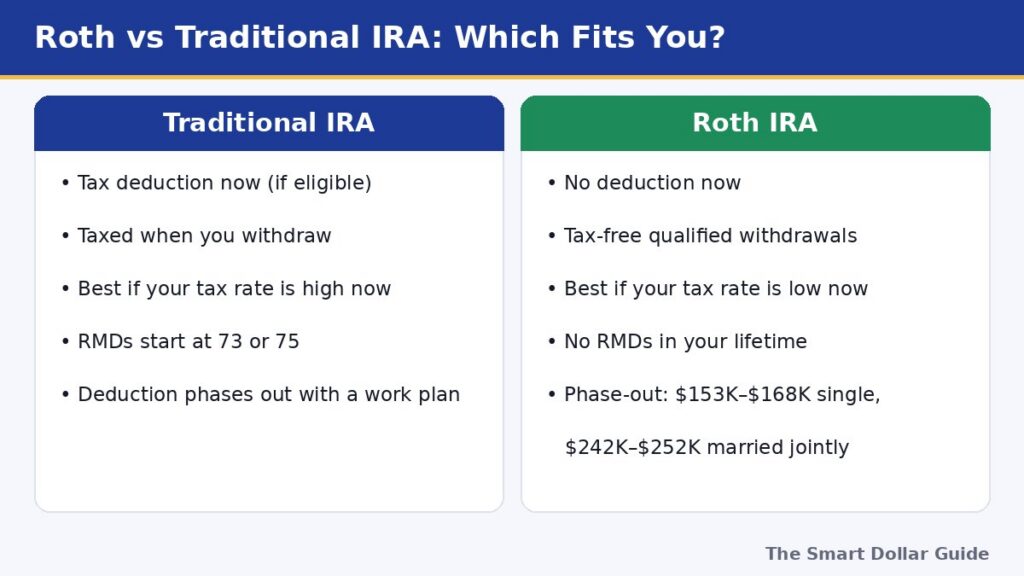
| Traditional IRA | Roth IRA | |
|---|---|---|
| Tax break | Deduction now (if eligible) | Tax-free withdrawals later |
| Best if | Your tax rate is higher now than in retirement | Your tax rate is lower now or you’re early in your career |
| 2026 income limits | None to contribute; deduction limits apply if you have a workplace plan | Phase-out from $153,000 to $168,000 (single) and $242,000 to $252,000 (married filing jointly) |
| Required withdrawals | Yes, starting at 73 or 75 | None during your lifetime |
Can you deduct a traditional IRA contribution?
If neither you nor your spouse has a retirement plan at work, your traditional IRA contribution is fully deductible at any income. If you do have a workplace plan, the deduction phases out in 2026 at these incomes:
- Single, covered by a workplace plan: $81,000 to $91,000
- Married filing jointly, you’re covered: $129,000 to $149,000
- Married filing jointly, only your spouse is covered: $242,000 to $252,000
Above these ranges you can still contribute, but the money isn’t deductible. In that case a Roth IRA is usually better, if your income allows it. For a deeper comparison, read our guide 401(k) vs Roth IRA, or start with Roth IRA for beginners.
How Much Tax Can Maxing Your IRA Save?
For a deductible traditional IRA, the federal tax savings equal your contribution times your tax bracket. These are estimates and don’t include state tax:
| Contribution | 12% bracket | 22% bracket | 24% bracket |
|---|---|---|---|
| $7,500 (under 50) | $900 | $1,650 | $1,800 |
| $8,600 (50+) | $1,032 | $1,892 | $2,064 |
A Roth IRA gives no deduction today, but all qualified withdrawals are tax-free. Investing $7,500 every year for 30 years at an assumed 7% average return would grow to roughly $708,000, all of it tax-free in a Roth. Returns are not guaranteed; this is an illustration only.
Bonus: the Saver’s Credit
If your income is modest, you may also get the Saver’s Credit, worth up to $1,000 per person ($2,000 for couples). For 2026, it’s available if your adjusted gross income is up to $40,250 (single), $60,375 (head of household) or $80,500 (married filing jointly). It’s on top of any IRA deduction, which makes an IRA one of the best deals for lower-income savers.
A Simple Plan to Hit the IRA Contribution Limit by April 15
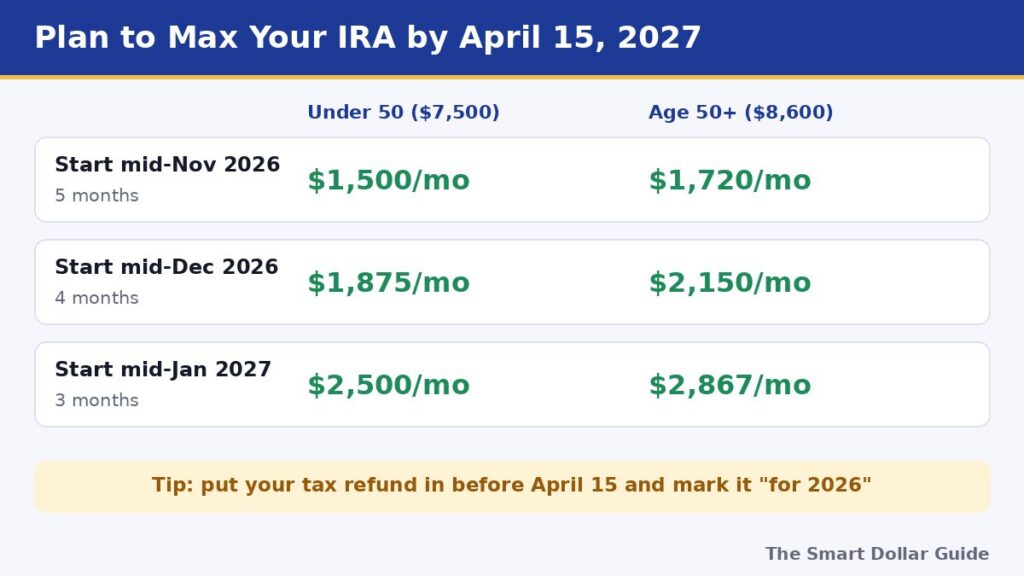
If you haven’t started your 2026 contribution, here’s how to spread it out between now and Tax Day:
| Start date | Months to April 15 | Monthly amount ($7,500) | Monthly amount ($8,600) |
|---|---|---|---|
| Mid-November 2026 | 5 | $1,500 | $1,720 |
| Mid-December 2026 | 4 | $1,875 | $2,150 |
| Mid-January 2027 | 3 | $2,500 | $2,867 |
A tax refund can help. Many people file early, get their refund in February or March, and put it straight into their IRA before April 15.
Common Mistakes to Avoid
- Picking the wrong tax year. Between January 1 and April 15, 2027, tell your broker the deposit is for 2026. Otherwise it counts toward 2027.
- Counting on a filing extension. A tax extension does not extend the IRA deadline. April 15 is the last day for 2026 contributions.
- Going over the IRA contribution limit. Excess contributions face a 6% tax every year until you fix them. Watch your total across all IRAs.
- Leaving the money in cash. Contributing isn’t investing. After the money lands, choose your investments, such as a low-cost index fund or target-date fund.
- Contributing to a Roth above the income limit. If your income is too high, ask a tax professional about a “backdoor” Roth (a nondeductible traditional IRA contribution converted to a Roth).
Should You Max It Out Before Tax Day? The Short Answer
Max out your IRA if you’ve handled high-interest debt, have an emergency fund, are getting your full 401(k) match and can afford it without strain. If not, contribute what you can; the deadline will come again next year. Either way, use the extra time until April 15 to decide between Roth and traditional, and to claim any deduction or Saver’s Credit you qualify for. Planning other moves before December 31? See our year-end tax moves checklist.
You can check the official numbers on the IRS IRA contribution limits page. For more guides, visit our Personal Finance section.
Disclaimer: This article is for general information only and is not tax or investment advice. Figures are IRS limits for the 2026 tax year as of November 2026. Examples are estimates. Consult a tax professional about your situation.
Frequently Asked Questions
What is the IRA contribution limit for 2026?
$7,500, or $8,600 if you’re 50 or older thanks to a $1,100 catch-up contribution. The limit applies to all of your traditional and Roth IRAs combined.
What is the deadline to contribute to an IRA for 2026?
April 15, 2027. A tax filing extension does not extend this deadline. When contributing between January 1 and April 15, tell your provider the money is for 2026.
What are the 2026 Roth IRA income limits?
Direct Roth IRA contributions phase out between $153,000 and $168,000 of modified AGI for single filers and between $242,000 and $252,000 for married couples filing jointly.
Can I deduct my traditional IRA contribution if I have a 401(k)?
It depends on income. In 2026 the deduction phases out between $81,000 and $91,000 for single filers covered by a workplace plan, and $129,000 to $149,000 for married couples filing jointly when the contributing spouse is covered.
Can I contribute to an IRA for my spouse who doesn't work?
Yes. Married couples filing jointly can each contribute up to the limit through a spousal IRA, as long as their combined earned income covers both contributions.
Has the IRS announced the 2027 IRA limit?
Not as of early November 2026. The IRS usually announces next year’s limits in November, so check IRS.gov for the official 2027 figure.