Table of Contents
- Year-End Tax Moves at a Glance
- Year-End Tax Moves to Make Before December 31
- 1. Boost your 401(k) before the last paycheck
- 2. Take your RMD, or give it away
- 3. Consider a Roth conversion
- 4. Harvest investment losses, or gains
- 5. Use the new charity deduction, even if you don’t itemize
- 6. Spend your FSA money
- 7. Check your withholding
- 8. Save records for the new deductions
- 9. Make gifts and 529 contributions
- Year-End Tax Moves That Can Wait Until April 15, 2027
- Year-End Tax Moves That No Longer Work in 2026
- Which Year-End Tax Moves Fit You?
- Final Thoughts
- Frequently Asked Questions
- Sources
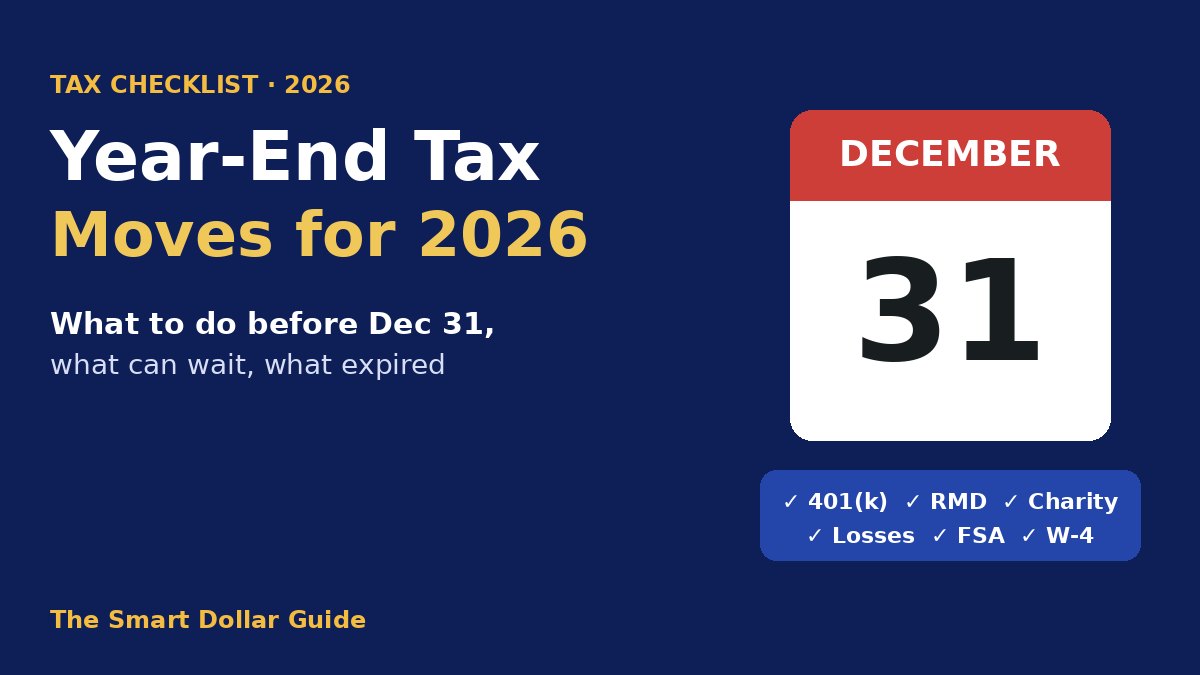
The best year-end tax moves for 2026 aren’t the same as last year’s. The 2025 tax law added new deductions, changed how charitable gifts work and ended popular home energy credits, so some advice you may have saved is out of date. This simple checklist sorts every move into three groups: what must be done by December 31, 2026, what can wait until April 15, 2027, and what no longer works. All figures are for the 2026 tax year, the return you’ll file next spring.
Year-End Tax Moves at a Glance
| Move | Deadline | Who it helps |
|---|---|---|
| Max out your 401(k) ($24,500) | Last paycheck of 2026 | Anyone with a workplace plan |
| Take your required minimum distribution | December 31 | Most people 73 and older |
| Give from an IRA (QCD, up to $111,000) | December 31 | Age 70½ and older |
| Harvest losses or gains | Trade by December 31 | Taxable investment accounts |
| Roth conversion | December 31 | Lower-income years, early retirees |
| Cash gifts to charity | December 31 | Everyone, including non-itemizers (new) |
| Spend your FSA | Plan deadline, often December 31 | FSA holders |
| IRA and HSA contributions | April 15, 2027 | Eligible savers |
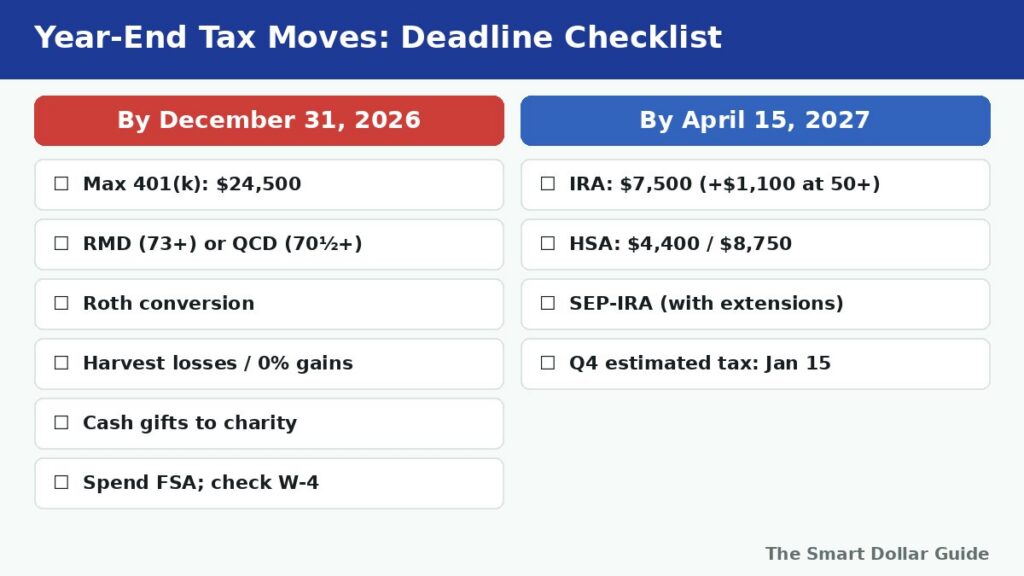
Year-End Tax Moves to Make Before December 31
1. Boost your 401(k) before the last paycheck
Retirement savings are among the most valuable year-end tax moves. The 2026 401(k) limit is $24,500, plus $8,000 if you’re 50 or older, or $11,250 if you’re 60 to 63. Contributions must come out of 2026 paychecks, so ask HR or update your plan online now. Each extra $1,000 in a traditional 401(k) saves $220 in federal tax if you’re in the 22% bracket.
2. Take your RMD, or give it away
If you’re 73 or older, take your required minimum distribution by December 31 to avoid a 25% penalty. If you’re 70½ or older and give to charity, a qualified charitable distribution (QCD) sends up to $111,000 directly from your IRA to a charity. It counts toward your RMD and stays out of your taxable income. Our 401(k) withdrawal strategy guide explains how RMDs fit into a bigger plan.
3. Consider a Roth conversion
If your income is low this year, for example because you retired or had a gap between jobs, converting some traditional IRA money to a Roth IRA lets you pay tax now at a low rate. Conversions must be finished by December 31. A married couple stays in the 12% bracket up to $100,800 of taxable income in 2026 ($50,400 for single filers).
4. Harvest investment losses, or gains
For investors, tax-loss harvesting is one of the classic year-end tax moves. Sell investments that are down to offset gains elsewhere. Losses beyond your gains can reduce ordinary income by up to $3,000 a year, and the rest carries forward. Avoid buying the same or a “substantially identical” investment within 30 days, or the wash-sale rule cancels the loss.
In a low-income year, the opposite can work. Long-term gains are taxed at 0% if your taxable income stays below $98,900 (married filing jointly) or $49,450 (single). Selling and rebuying a winner can reset your cost basis tax-free.
5. Use the new charity deduction, even if you don’t itemize
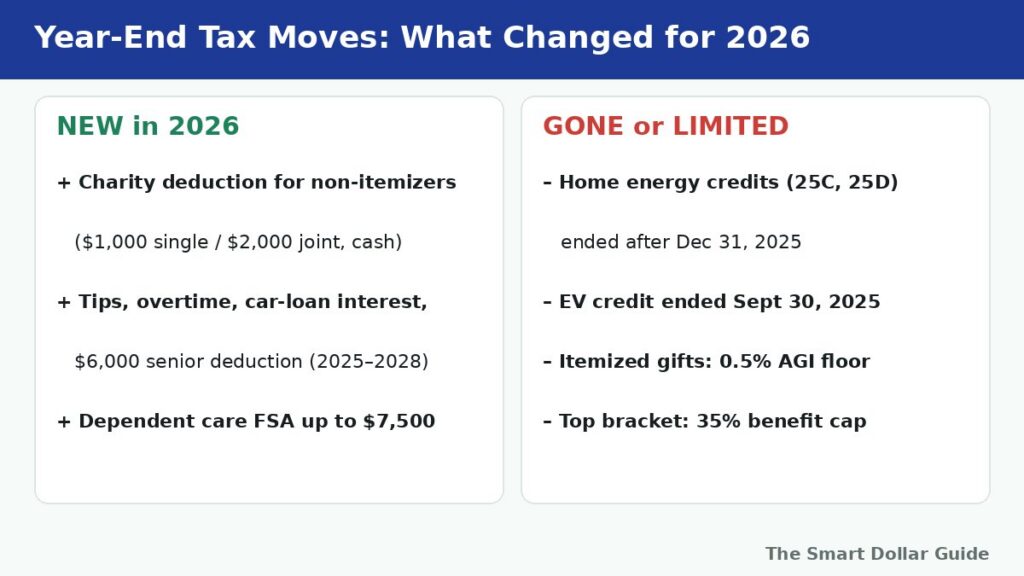
This is one of the biggest changes to year-end tax moves for 2026. For the first time since 2021, people who take the standard deduction can deduct cash gifts to charity: up to $1,000 for single filers or $2,000 for married couples. The gift must be cash (including check or card) to a qualified public charity; donor-advised funds don’t count. Keep a receipt, and get a written acknowledgment for any gift of $250 or more.
If you itemize, two new limits apply in 2026. Only giving above 0.5% of your adjusted gross income is deductible, and top-bracket taxpayers get a benefit worth at most 35%. Bunching several years of gifts into one year can help you clear the floor.
6. Spend your FSA money
Many health flexible spending accounts are “use it or lose it.” Check whether your plan offers a grace period or lets you carry over a set amount. Glasses, contacts, prescriptions and many first-aid items qualify. The dependent care FSA limit rose to $7,500 in 2026, so update your election during open enrollment if you pay for child care.
7. Check your withholding
Withholding checks are easy year-end tax moves to forget. New deductions and life changes can leave you under- or over-withheld. Use the IRS Tax Withholding Estimator and adjust your W-4 for your final paychecks. If you’re self-employed or have investment income, the fourth estimated payment is due January 15, 2027. You generally avoid a penalty by paying at least 100% of last year’s tax (110% if your income was over $150,000).
8. Save records for the new deductions
For 2025 through 2028, you may deduct qualified tips (up to $25,000), qualified overtime pay (up to $12,500, or $25,000 if married filing jointly), interest on a loan for a new U.S.-assembled car (up to $10,000), and an extra $6,000 senior deduction if you’re 65 or older. Income limits apply. Before the year ends, save pay stubs and loan statements, and confirm what your employer will report.
9. Make gifts and 529 contributions
You can give up to $19,000 per person in 2026 without filing a gift tax return. Many states give a deduction for 529 college savings contributions only if you contribute by December 31, so check your state’s deadline.
Year-End Tax Moves That Can Wait Until April 15, 2027
- IRA contributions: up to $7,500, plus $1,100 if you’re 50 or older.
- HSA contributions: up to $4,400 for self-only coverage or $8,750 for family coverage, plus $1,000 if you’re 55 or older.
- SEP-IRA contributions for the self-employed, by your filing deadline including extensions.
These year-end tax moves still count for 2026 if you make them by the deadline, so you can wait until you know your final numbers.
Year-End Tax Moves That No Longer Work in 2026
- Home energy credits are gone. The Energy Efficient Home Improvement Credit and the 30% Residential Clean Energy Credit (solar panels, heat pump water heaters, batteries) ended for work done after December 31, 2025. Don’t rush a December project expecting a federal credit.
- The EV tax credit ended for vehicles acquired after September 30, 2025.
- Small itemized gifts may no longer pay off because of the new 0.5% floor.
The IRS explains the energy credit changes in its FAQs on the 2025 law.
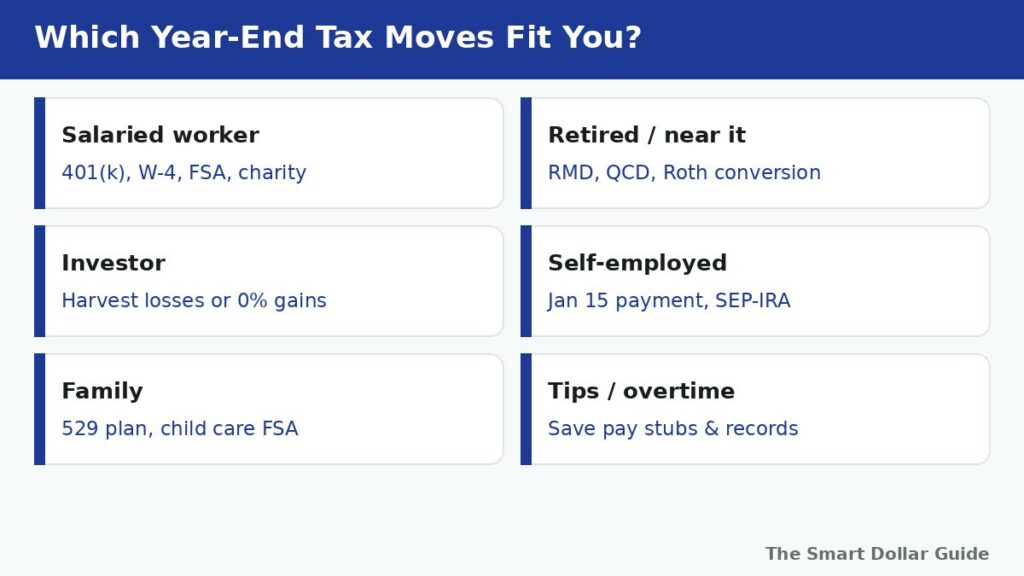
Which Year-End Tax Moves Fit You?
- Working and earning a salary: raise your 401(k), check withholding, spend your FSA, and make a cash gift to charity if you take the standard deduction.
- Retired or close to it: take your RMD, consider a QCD, and look at a Roth conversion if you’re in a low bracket. Our post on the Social Security tax cap for 2027 covers payroll taxes if you’re still working.
- Investor with a taxable account: harvest losses, or gains in a 0% year, and avoid wash sales.
- Self-employed: make your January 15 estimated payment and plan your SEP-IRA contribution.
- Family: fund a 529 plan and keep child care receipts for the dependent care credit or FSA.
Final Thoughts
The smartest year-end tax moves for 2026 are simple: put more into your 401(k), take care of RMDs, use the new charity deduction, harvest losses, and keep records for the new tips, overtime and senior deductions. Skip the expired energy credits, and leave IRA and HSA contributions until you know your final numbers in the spring. Holiday spending can derail these plans, so keep it in check with our holiday gift budget plan. For more tax guides, visit our Taxes section.
Disclaimer: This article is for general information only and is not tax advice. Figures are for the 2026 tax year as of November 2026. Rules have limits and income phase-outs; consult a tax professional about your situation.
Frequently Asked Questions
What tax moves must I make before December 31, 2026?
401(k) contributions through payroll, required minimum distributions, qualified charitable distributions, Roth conversions, tax-loss or gain harvesting, charitable gifts and many 529 contributions for state deductions must be done by December 31.
Can I deduct charity if I take the standard deduction in 2026?
Yes. Starting in 2026, non-itemizers can deduct up to $1,000 ($2,000 for married couples filing jointly) in cash gifts to qualified public charities. Gifts to donor-advised funds don’t qualify.
Can I still get a tax credit for solar panels or a heat pump in 2026?
No. The federal Residential Clean Energy Credit and Energy Efficient Home Improvement Credit ended for property placed in service after December 31, 2025.
What is the 401(k) limit for 2026?
$24,500, plus an $8,000 catch-up if you’re 50 or older, or $11,250 if you’re 60 to 63. Contributions must come from 2026 paychecks.
What can wait until April 15, 2027?
IRA contributions (up to $7,500, plus $1,100 at 50+), HSA contributions (up to $4,400 self-only or $8,750 family) and SEP-IRA contributions (by your filing deadline including extensions) can still count for 2026.
What is the QCD limit for 2026?
People 70½ or older can give up to $111,000 directly from an IRA to charity in 2026 as a qualified charitable distribution. It can count toward your RMD and isn’t included in taxable income.
Sources
- PG Calc – Indexed tax tables for 2026 (brackets, standard deduction, QCD, gift exclusion, capital gains)
- Kiplinger – 2026 tax law: 3 big ways your charitable deduction has changed
- Kiplinger – 5 Trump tax bill changes homeowners need to know (SALT, energy credits)
- IRS – FAQs on modification of sections 25C, 25D, 30D and more under the 2025 law
- IRS – 401(k) limit increases to $24,500 for 2026, IRA limit increases to $7,500
- IRS – Tax Withholding Estimator