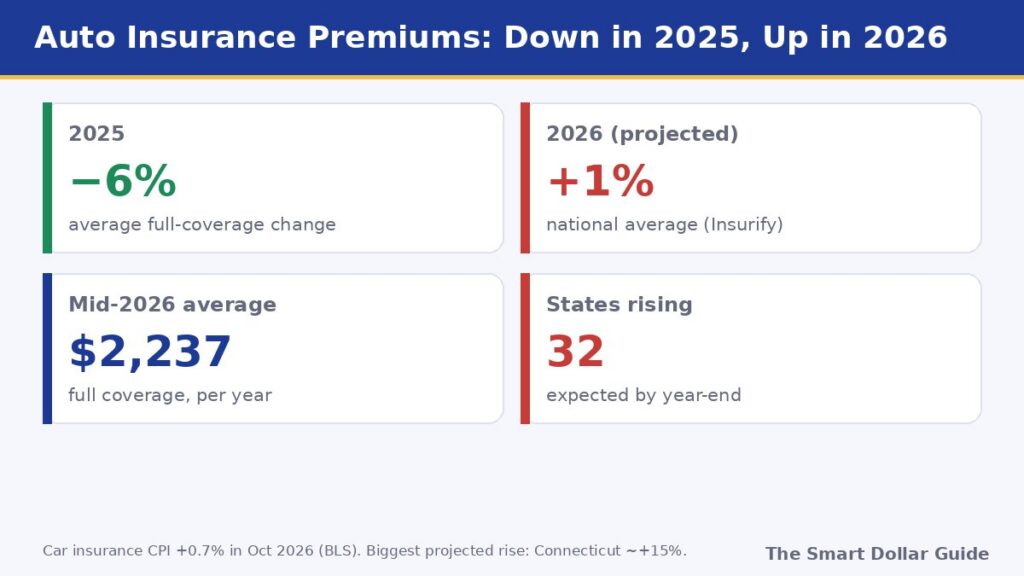
Auto insurance premiums are climbing again, but not the way they did a few years ago. After falling about 6% in 2025, the average full-coverage policy rose to $2,237 a year by mid-2026, according to Insurify, and drivers in 32 states are expected to see increases by year-end. Car insurance prices in the Consumer Price Index rose another 0.7% in October 2026. The national average is only up modestly, but some states are seeing double-digit jumps. This guide shows seven ways to cut your bill, ranked by how much they usually save, plus the coverage you should never cut to save money.
Auto Insurance Premiums in 2026: What’s Happening
| Measure | Latest figure |
|---|---|
| Average full-coverage premium (June 2026) | $2,237 a year (Insurify) |
| Change in 2025 | About −6% |
| Projected change for all of 2026 | About +1% nationally |
| States expected to rise by year-end | 32 |
| Biggest projected increase | Connecticut, about +15% |
| Car insurance CPI, October 2026 | +0.7% in one month (BLS) |
Different trackers measure auto insurance premiums in slightly different ways. The Zebra puts the 2026 average at $2,256, up 3%. Either way, the trend has turned upward again, and your own renewal could be much higher or lower than average.
Why auto insurance premiums are going up
- Repair costs: vehicle maintenance and repair prices are up about 45% over five years, roughly double overall inflation. Modern cars with sensors and cameras cost more to fix, and tariffs on auto parts add to the bill.
- More severe claims: bodily injury and collision claim costs rose sharply from 2020 to 2024.
- Severe weather: hail, floods and storms are causing more comprehensive claims.
- Catch-up pricing: after cutting rates in 2025, insurers are raising them again in states where claims are growing.
First, Protect the Coverage That Matters
Cutting your bill shouldn’t leave you exposed to a lawsuit or a total loss. Before changing anything, keep these protections:
- Liability limits well above your state minimum. Many state minimums are far too low to cover a serious accident. If you have savings or a home, consider at least 100/300/100 ($100,000 per person, $300,000 per accident for injuries, $100,000 for property damage).
- Uninsured and underinsured motorist coverage. It protects you when the other driver can’t pay.
- Collision and comprehensive on any car you can’t afford to replace, or that has a loan or lease, since lenders require them.
With those locked in, here’s how to lower your auto insurance premiums.
7 Ways to Cut Your Auto Insurance Bill
These steps are listed roughly in order of how much they tend to lower auto insurance premiums. Most take less than an hour.
1. Shop around at every renewal
This is usually the biggest saver. Insurify found that full-coverage quotes for drivers with similar profiles can differ by $100 to $200 a month between insurers. Compare at least three quotes for the same coverage, deductible and limits once or twice a year, and always when your renewal notice shows an increase. Insurers price risk differently, so the cheapest company for your neighbor may not be cheapest for you.
When to shop
The best time to compare is 30 to 45 days before your policy renews. Your renewal notice shows the new price, and switching at renewal avoids cancellation fees. Also compare after a big life change, such as moving, marrying, adding a teen driver or buying a car, because each one changes how insurers price you.
2. Bundle with home or renters insurance
Buying auto and home or renters insurance from the same company can cut auto insurance premiums by up to 25%, according to Insurify. Renters insurance often costs little, so the bundle discount alone can pay for it. Still compare the bundle total against separate policies.
3. Raise your deductible, if you have savings
Going from a $500 to a $1,000 deductible on collision and comprehensive often lowers that part of your premium noticeably. Only do this if you could pay the higher deductible tomorrow. Keep that amount in a high-yield savings account; see the best online banks for 2026.
4. Try usage-based insurance
Telematics programs track how, when and how much you drive through an app or plug-in device. Safe, low-mileage drivers can save significantly. Hard braking, speeding or late-night driving can reduce the discount, and some insurers can raise your rate. Ask how the data is used before you sign up.
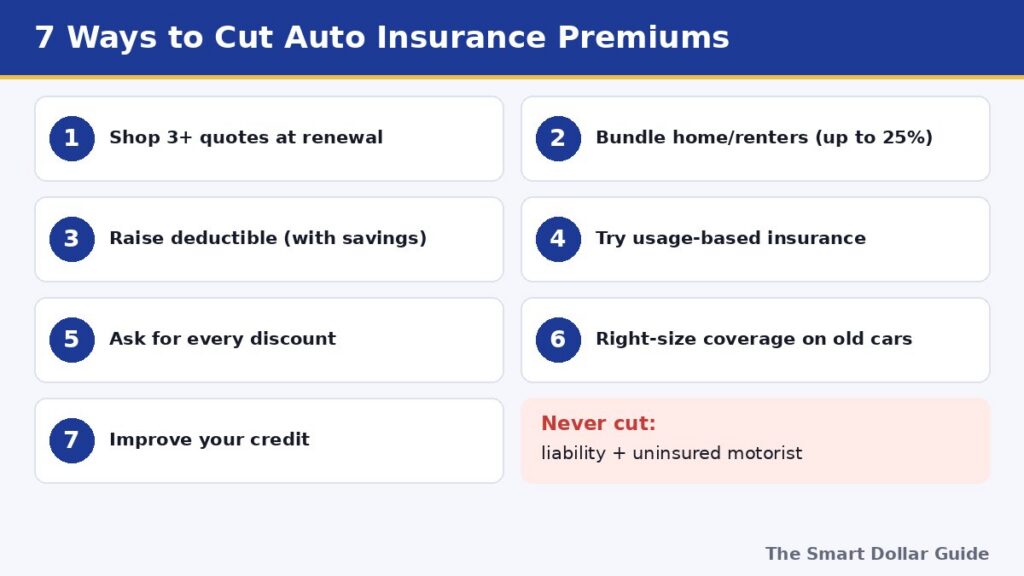
5. Ask for every discount
Many drivers never ask, yet discounts are one of the easiest ways to lower auto insurance premiums. Common discounts include:
- Paying the full policy up front, autopay and paperless billing
- Good driver, good student and multi-car
- Defensive driving course (required discounts for older drivers in some states)
- Low mileage, if you work from home or drive less because of higher gas prices
- Anti-theft devices and safety features
- Membership, employer or military affiliations
6. Right-size coverage on an older car
Collision and comprehensive pay up to your car’s current value, minus the deductible. On an older car worth only a few thousand dollars, they may cost more than they’re worth. A common rule of thumb: if these coverages cost more than about 10% of the car’s value per year, consider dropping them, but only if you could replace the car without hardship. Keep your liability and uninsured motorist coverage either way.
7. Improve your credit-based insurance score
In most states, insurers use a credit-based insurance score to set rates, and drivers with poor credit can pay far more than those with excellent credit. A few states, including California, Hawaii, Massachusetts and Michigan, ban or limit this. Paying bills on time and lowering card balances can help at your next renewal. See our post on credit score changes in 2026.
How Much Could You Save on Auto Insurance Premiums?
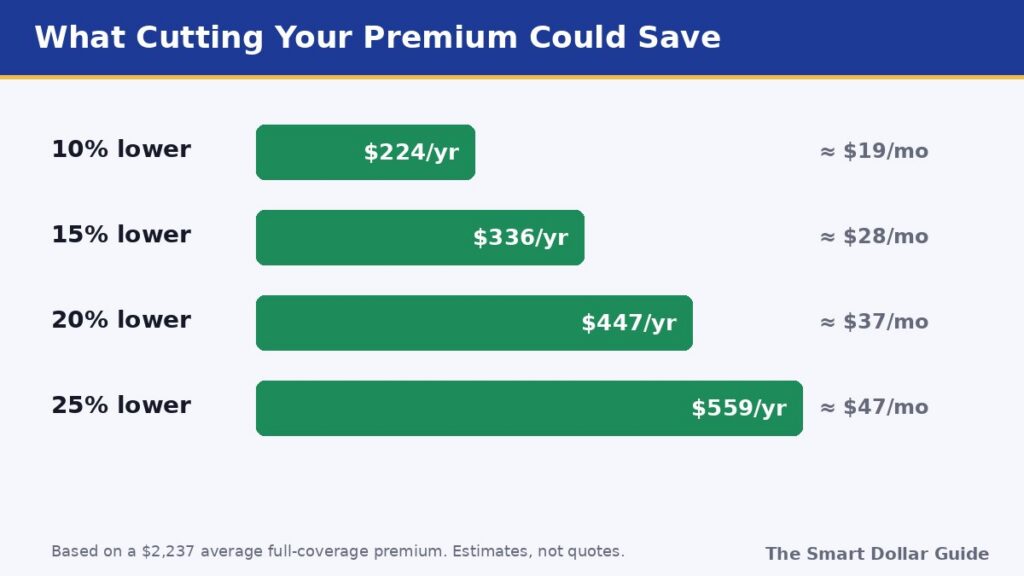
Savings depend on your state, driving record and insurer. As a rough illustration on the $2,237 average full-coverage premium:
| If you cut your premium by… | Yearly savings | Monthly savings |
|---|---|---|
| 10% | about $224 | about $19 |
| 15% | about $336 | about $28 |
| 20% | about $447 | about $37 |
| 25% | about $559 | about $47 |
Combining two or three steps, such as shopping around, bundling and adding discounts, is often how drivers reach the higher end. These figures are estimates, not quotes.
Mistakes That Raise Auto Insurance Premiums Later
- Dropping to state-minimum liability. One serious accident could exceed your limits and put your savings at risk.
- Letting coverage lapse between policies. A gap can raise your rates for years.
- Filing small claims. A $700 claim can raise your premium by more than that over three years. Pay small repairs yourself if you can.
- Not updating your insurer after a move, a new job with a shorter commute, or a teen driver leaving for college without a car.
- Choosing a deductible you can’t afford. The savings disappear if a claim forces you onto a credit card.
You can track how auto insurance premiums are changing nationwide in the monthly Consumer Price Index report from the Bureau of Labor Statistics, which lists “motor vehicle insurance” as its own category.
Final Thoughts
Auto insurance premiums are rising again in most states, but you don’t have to accept your renewal price. Shop around every year, bundle, raise your deductible if you have savings, ask for every discount and keep your credit healthy, all while keeping strong liability and uninsured motorist coverage. For more ways to stretch your budget, read our guide to protecting your budget from inflation, or visit our Personal Finance section.
Disclaimer: This article is for general information only and is not insurance advice. Premium figures are national averages from Insurify, The Zebra and the BLS as of 2026 and vary widely by state and driver. Savings are estimates.
Frequently Asked Questions
Why are auto insurance premiums going up in 2026?
Mainly higher repair costs, more severe accident claims and severe weather. After cutting rates in 2025, insurers are raising them again in states where claims are growing.
How much is car insurance in 2026?
The average full-coverage policy was about $2,237 a year in mid-2026, according to Insurify. The Zebra puts the 2026 average at about $2,256. Costs vary widely by state and driver.
What is the fastest way to lower my car insurance?
Shopping around at renewal is usually the biggest saver: quotes for similar drivers can differ by $100 to $200 a month. Bundling and asking for discounts also help quickly.
Should I raise my deductible?
Raising your deductible lowers your premium, but only do it if you could pay the higher deductible from savings right away.
When should I drop collision coverage?
Consider it on an older car if collision and comprehensive cost more than about 10% of the car’s value per year and you could replace the car without hardship. Keep liability and uninsured motorist coverage.
Does my credit score affect car insurance rates?
In most states, yes. Insurers use a credit-based insurance score. California, Hawaii, Massachusetts and Michigan ban or limit this practice.