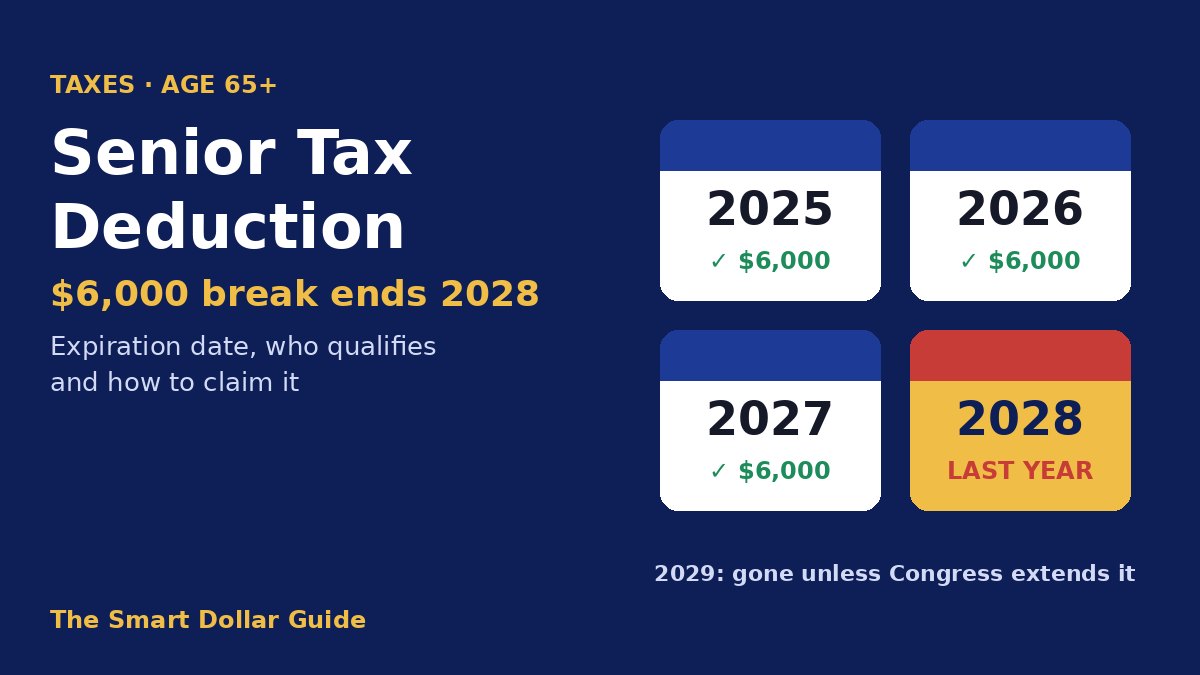
The new $6,000 senior tax deduction has an expiration date: it covers only tax years 2025 through 2028. Unless Congress extends it, your 2028 tax return, filed in early 2029, is the last one that can claim it. That leaves at most four years, and fewer if you turn 65 after 2025. This guide shows exactly how many years you’ll get, how much the break is really worth, and how to keep your income in range so you don’t lose part of it.
Senior Tax Deduction Expiration Date at a Glance
| Item | Details |
|---|---|
| Amount | Up to $6,000 per person age 65 or older ($12,000 if both spouses qualify) |
| Years | Tax years 2025, 2026, 2027 and 2028 |
| Last return to claim it | 2028 return, filed in 2029 |
| Phase-out starts | $75,000 modified AGI (single), $150,000 (married filing jointly) |
| Fully gone at | $175,000 (single), $250,000 (joint) |
| Itemize or standard? | Either; you can claim it both ways |
| Not eligible | Married filing separately; no valid Social Security number |
The break was created by the One Big Beautiful Bill Act in 2025. It’s often called the “senior bonus.” It does not eliminate tax on Social Security, despite what many headlines suggested. It’s simply an extra deduction that lowers your taxable income, whatever the source.
Will the Senior Tax Deduction Be Extended?
Maybe, but don’t plan on it yet. A bill introduced in Congress in February 2026 would make the $6,000 senior tax deduction permanent, and senior advocates support it. As of November 2026 it hasn’t passed. Tax breaks with an end date are often extended at the last minute, but some do expire. Plan as if 2028 is the final year, and treat any extension as a bonus.
How Many Years Will You Get?
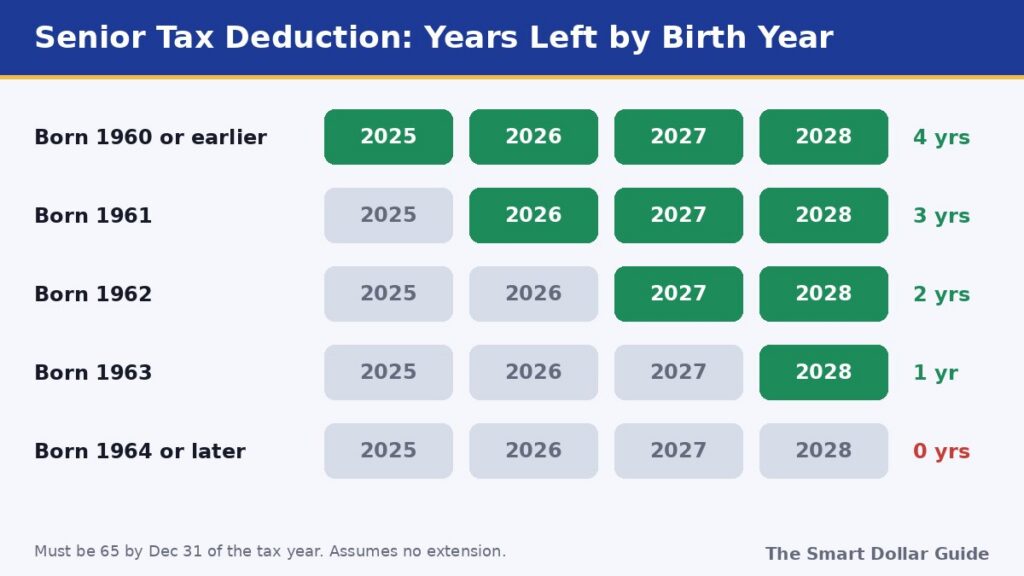
You must be 65 or older by December 31 of the tax year. That means your birth year decides how many times you can claim the senior tax deduction before it expires:
| Born in | Turn 65 in | Years you can claim | Number of years |
|---|---|---|---|
| 1960 or earlier | 2025 or earlier | 2025–2028 | 4 |
| 1961 | 2026 | 2026–2028 | 3 |
| 1962 | 2027 | 2027–2028 | 2 |
| 1963 | 2028 | 2028 only | 1 |
| 1964 or later | 2029 or later | None (unless extended) | 0 |
One quirk: the IRS treats you as reaching 65 on the day before your birthday. So someone born on January 1 counts as 65 a year early. A person born January 1, 1964, for example, is treated as 65 on December 31, 2028, and can claim one year.
What the $6,000 Senior Tax Deduction Is Really Worth
A deduction lowers taxable income, not your tax bill dollar for dollar. Your savings depend on your tax bracket:
| Your federal bracket | Single (one $6,000 deduction) | Couple, both 65+ ($12,000) |
|---|---|---|
| 10% | $600 | $1,200 |
| 12% | $720 | $1,440 |
| 22% | $1,320 | $2,640 |
| 24% | $1,440 | $2,880 |
These are estimates of federal savings with the full deduction. Over four years, a married couple in the 12% bracket could save about $5,760. Many retirees with low taxable income already pay little or no federal tax, so their gain may be smaller.
It adds to deductions you already get. For 2026, a single filer age 65 or older gets the $16,100 standard deduction, plus the $2,050 extra standard deduction for age 65, plus up to $6,000 from the new break. That’s up to $24,150 of income with no federal tax. A married couple, both 65 or older, can deduct up to $32,200 + $3,300 + $12,000 = $47,500.
How the Phase-Out Works
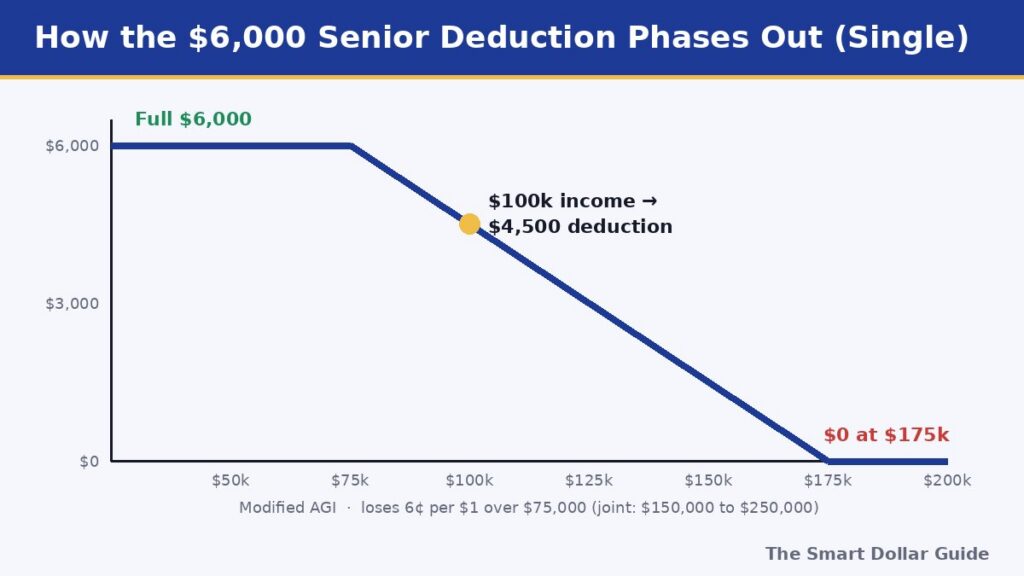
The senior tax deduction shrinks by 6 cents for every dollar of modified AGI above $75,000 (single) or $150,000 (joint). For most people, modified AGI is the same as adjusted gross income.
- Example: A single retiree with $100,000 of modified AGI is $25,000 over the limit. 6% of $25,000 is $1,500, so the deduction drops to $4,500.
- Hidden cost: inside the phase-out range, each extra $1,000 of income also cuts your deduction by $60. In the 22% bracket, that adds about $13 of tax per $1,000, raising your effective rate on that income to roughly 23.3%.
6 Ways to Get the Most Before It Expires
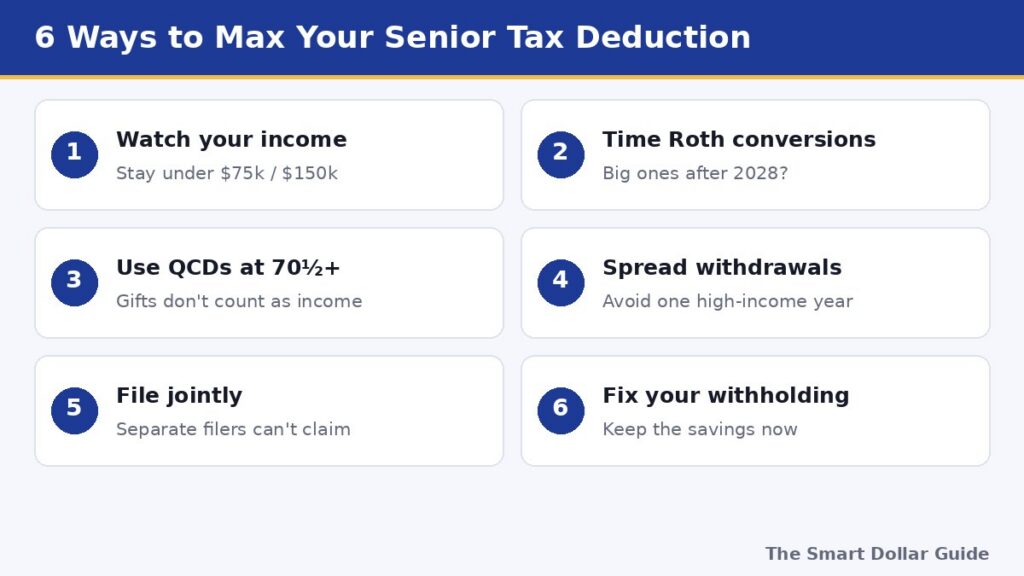
1. Watch your income near the threshold
If your income is close to $75,000 or $150,000, small choices matter. Selling investments with big gains, taking a large IRA withdrawal or cashing out a bond in the same year can push you into the phase-out and shrink your senior tax deduction.
2. Time Roth conversions carefully
Roth conversions raise your income for the year. If you’re well below the threshold, a conversion that keeps you under it costs you nothing extra. If you’re already in the phase-out, compare the loss of the senior tax deduction against the long-term benefit, or plan larger conversions for years after 2028.
3. Use qualified charitable distributions
If you’re 70½ or older and give to charity, a qualified charitable distribution (QCD) sends money straight from your IRA to the charity. It isn’t counted in your income, so it can keep you below the phase-out while also counting toward required minimum distributions.
4. Plan your withdrawals
Spread large IRA or 401(k) withdrawals over several years instead of one, or use cash savings or Roth money in a high-income year. Our guide to 401(k) withdrawal strategy explains how timing affects your taxes.
5. File jointly if you’re married
Married couples who file separately can’t claim the senior tax deduction at all. If you normally file separately, run the numbers both ways.
6. Update your withholding
If you have tax withheld from pensions, IRA withdrawals or Social Security, the extra deduction may mean you’re over-withholding. Adjusting it puts the money in your pocket during the year instead of waiting for a refund.
How to Claim the Senior Tax Deduction
You claim it on Schedule 1-A, filed with your Form 1040 or 1040-SR. Tax software asks for your birth date and fills it in automatically. You’ll need a valid Social Security number, and married couples must file jointly. The deduction lowers taxable income but isn’t subtracted in figuring AGI, so it doesn’t change how much of your Social Security is taxable or your Medicare IRMAA surcharges. The IRS explains the rules on its enhanced deduction for seniors page.
If you missed it on your 2025 return, you can file an amended return, generally within three years of the original filing date.
What Changes After 2028
If the senior tax deduction expires on schedule, a couple who are both 65 or older could see taxable income rise by up to $12,000 in 2029, with no change in their actual income. The regular standard deduction and the extra $1,650–$2,050 for age 65 continue, since those are permanent. Use the next few years to plan, especially if you’re thinking about Roth conversions. Our year-end tax moves checklist can help with 2026, and our post on the 2027 Social Security COLA shows how your benefit is changing.
Final Thoughts
The $6,000 senior tax deduction is worth $720 to $1,440 a year for many retirees, but only through 2028. Check how many years your birth year gives you, keep your income below $75,000 (single) or $150,000 (joint) if you can, and make sure your tax software claims it on Schedule 1-A. If Congress extends it, great; if not, you’ll have made the most of it. For more tax guides, visit our Taxes section.
Disclaimer: This article is for general information only and is not tax advice. Savings figures are estimates based on federal tax brackets. Rules are as of November 2026 and may change if Congress acts. Consider speaking with a tax professional about your situation.
Frequently Asked Questions
When does the senior tax deduction expire?
The $6,000 senior deduction applies to tax years 2025 through 2028. Unless Congress extends it, the 2028 return filed in 2029 is the last one that can claim it.
Who qualifies for the $6,000 senior deduction?
People who are 65 or older by December 31 of the tax year and have a valid Social Security number. Married couples must file jointly. The deduction phases out above $75,000 of modified AGI for single filers and $150,000 for joint filers.
Do I need to itemize to get the senior tax deduction?
No. You can claim it whether you take the standard deduction or itemize. It’s claimed on Schedule 1-A with Form 1040 or 1040-SR.
Does the senior deduction mean no tax on Social Security?
No. It’s an extra deduction that lowers taxable income from any source. Social Security benefits can still be taxable depending on your income.
How much does the senior tax deduction save?
It depends on your bracket. A $6,000 deduction saves about $720 in the 12% bracket and $1,320 in the 22% bracket; a couple who both qualify can save twice that.
Will Congress make the senior deduction permanent?
A bill to make it permanent was introduced in February 2026, but it had not passed as of November 2026. Plan as if 2028 is the final year.