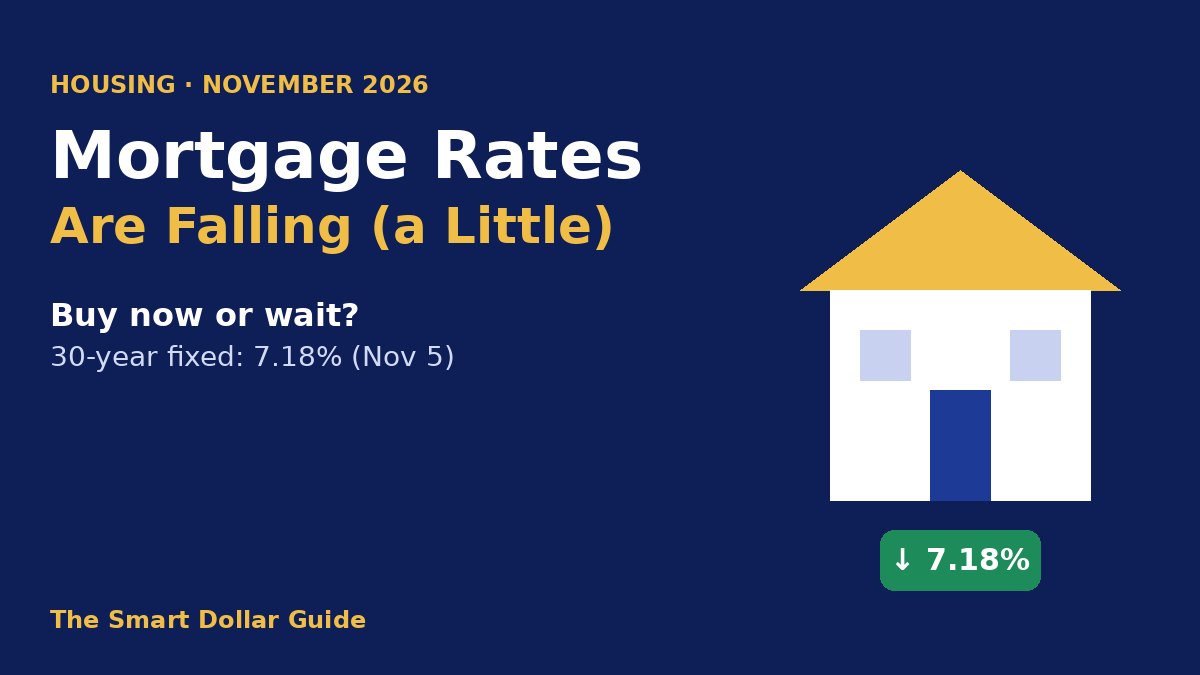
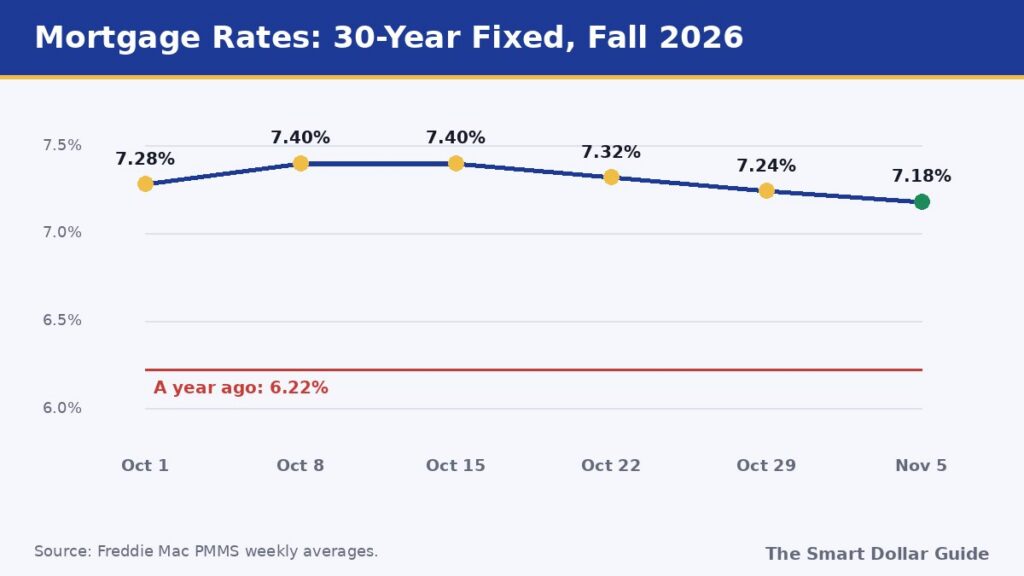
Yes, mortgage rates are falling in November 2026, but only a little. Freddie Mac’s 30-year fixed average dropped to 7.18% on November 5, its third weekly decline in a row, down from 7.40% in mid-October. That’s still about a full point higher than a year ago (6.22%), and near the highest level since 2023. So the real question isn’t “are rates falling?” It’s whether waiting for lower mortgage rates will actually save you money. This guide runs the numbers on buying now versus waiting, and shows how to get a better deal in today’s market either way.
Mortgage Rates in November 2026: Where Things Stand
| Week (Freddie Mac survey) | 30-year fixed | 15-year fixed |
|---|---|---|
| October 8, 2026 (recent high) | 7.40% | 6.73% |
| October 22, 2026 | 7.32% | 6.68% |
| October 29, 2026 | 7.24% | 6.60% |
| November 5, 2026 | 7.18% | 6.57% |
| A year earlier (Nov. 2025) | 6.22% | 5.50% |
| 2026 low (late February) | 5.98% | — |
Freddie Mac publishes a new average every Thursday on its Primary Mortgage Market Survey. Its rates assume excellent credit and a 20% down payment, so your quote may be higher.
Why did mortgage rates climb so much this year? Inflation rose to 3.6% as oil prices jumped, and the Federal Reserve has kept its benchmark rate at 3.75%–4.00% with talk of a December hike. Mortgage rates tend to follow the 10-year Treasury yield, which was near 4.9% in early November. Read more in our post Fed Interest Rates Aren’t Coming Down.
Will Mortgage Rates Keep Falling?
Nobody knows for sure, and the major forecasters don’t expect big relief soon. As of October, Fannie Mae projected the 30-year rate around 7.5% through the first three quarters of 2027, and the Mortgage Bankers Association around 7.2%. These forecasts change often, but neither points to a return to 6% next year.
The bottom line: a small dip is happening, but betting on a big drop is a gamble.
The Math: What a Rate Drop Is Really Worth
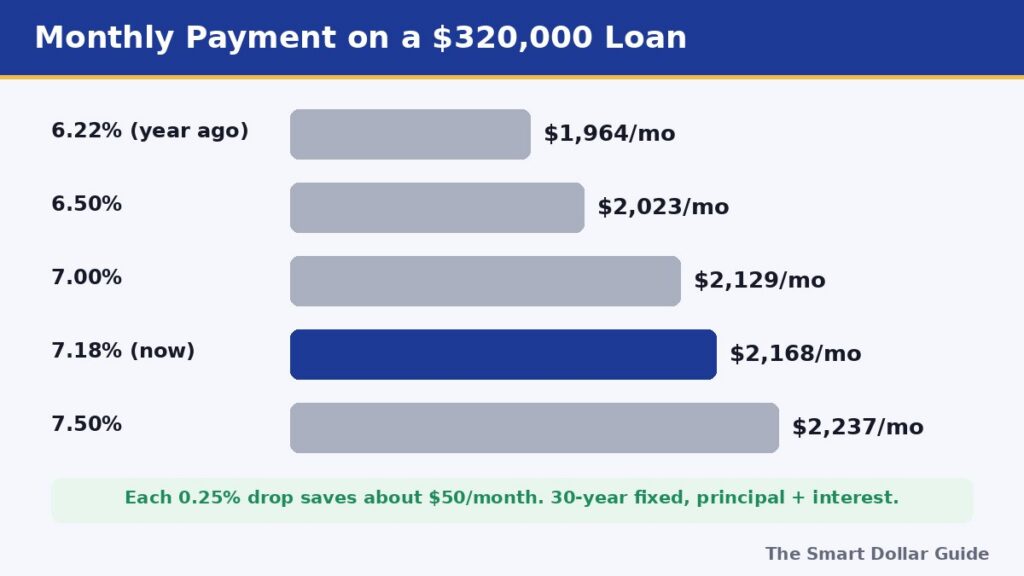
Here’s what different mortgage rates mean for a typical purchase. The example uses a $400,000 home with 20% down, so a $320,000, 30-year fixed loan. The national median existing-home price was $417,500 in September, according to the National Association of Realtors.
| Rate | Monthly principal and interest | Total interest over 30 years |
|---|---|---|
| 6.22% (a year ago) | $1,964 | about $387,000 |
| 6.50% | $2,023 | about $408,000 |
| 7.00% | $2,129 | about $446,000 |
| 7.18% (now) | $2,168 | about $460,000 |
| 7.50% | $2,237 | about $485,000 |
Taxes, insurance and any HOA fees come on top. These are estimates.
Each quarter-point drop saves roughly $50 a month on this loan. Falling from 7.18% to 6.50% would save about $145 a month. That’s real money, but it isn’t life-changing, and it can easily be wiped out if home prices rise while you wait.
Buy Now or Wait? The Case for Each
Reasons to buy now
- Buyers have more leverage. In September, 1.6 million homes were for sale, the most since 2019, and sales were slower than a year earlier. NAR’s chief economist said the market is “tilting in favor of buyers.” That means more room to negotiate price, repairs or closing costs.
- Prices are still rising slowly. The median price was up 1.3% from a year earlier. On a $400,000 home, that’s about $5,200 a year, which can cancel out a small rate drop.
- You can refinance later. If mortgage rates fall significantly, you can refinance. You can’t go back and buy at today’s price.
- You’ve found the right home and plan to stay at least five to seven years.
Reasons to wait
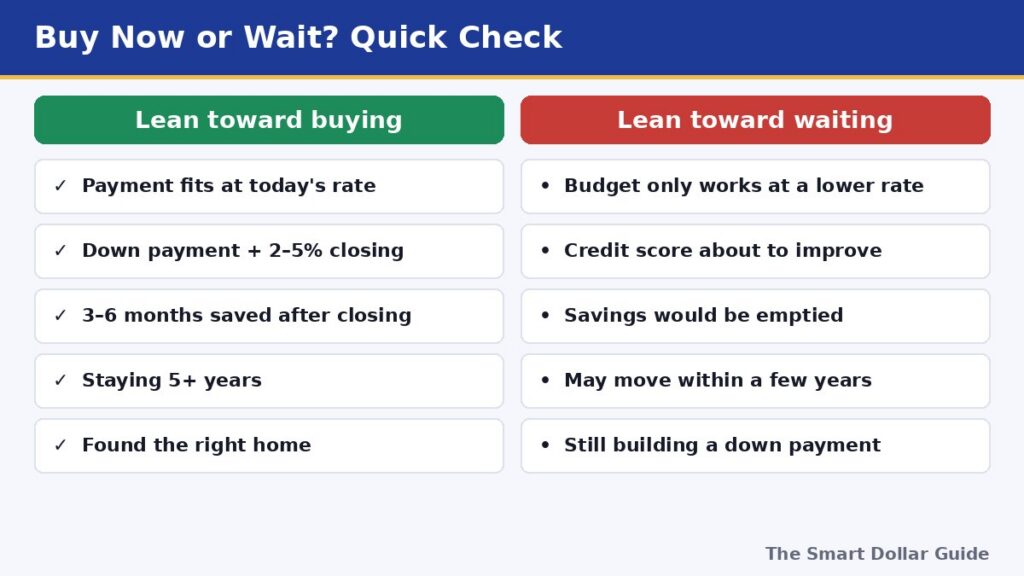
- Your budget only works at a lower rate. Don’t buy assuming you’ll refinance; there’s no guarantee rates will fall.
- Your credit score could improve soon. Moving from fair to good credit can cut your rate by more than a market dip. See our post on credit score changes in 2026.
- You don’t have a cushion. If your down payment would empty your savings, wait until you have closing costs plus three to six months of expenses set aside.
- You might move within a few years. Buying and selling costs often make short stays more expensive than renting.
Fixed Rate or Adjustable Rate?
When mortgage rates are high, adjustable-rate mortgages (ARMs) become more tempting. A 5/1 or 7/1 ARM usually starts with a lower rate for the first five or seven years, then adjusts once a year based on market rates.
- An ARM can make sense if you’re confident you’ll sell or refinance before the fixed period ends, or if you expect your income to rise.
- A fixed rate is safer if you plan to stay long-term or your budget is tight. Your payment never changes, even if mortgage rates climb further.
If you consider an ARM, check the caps: how much the rate can rise at the first adjustment, each year after that, and over the life of the loan. Then calculate the payment at the maximum rate and make sure you could still afford it.
The Refinance Reality Check
“Marry the house, date the rate” is popular advice, but refinancing isn’t free. Closing costs usually run about 2% to 5% of the loan, or $6,400 to $16,000 on a $320,000 mortgage. To see if it’s worth it, divide the cost by your monthly savings:
- $8,000 in costs ÷ $145 saved a month = about 55 months (4.6 years) to break even.
Refinancing generally makes sense only if mortgage rates fall enough and you’ll stay long enough to pass the break-even point.
6 Ways to Get a Lower Rate Without Waiting
- Shop at least three lenders on the same day. Quotes for the same borrower can differ by a quarter point or more. Compare the Loan Estimates, not just the advertised rate.
- Ask the seller for concessions. In a buyer’s market, sellers may pay for a rate buydown or closing costs.
- Consider buying points. One point costs 1% of the loan and often lowers the rate by around 0.25%, but only pays off if you keep the loan for several years.
- Look at a 15-year loan if you can afford the higher payment. It’s averaging about 0.6 points lower.
- Raise your credit score and lower your debt before applying. Paying down card balances helps quickly.
- Lock your rate once you have a contract, so a sudden jump doesn’t raise your payment before closing.
Quick Checklist: Are You Ready to Buy?
- Your total monthly debt, including the new mortgage, is about 36% of gross income or less
- You have the down payment plus 2% to 5% for closing costs
- You’ll still have three to six months of expenses saved after closing. A high-yield account helps; see the best online banks for 2026
- You plan to stay at least five years
- The payment works at today’s rate, not a hoped-for one
If you can tick every box, today’s mortgage rates are a reason to negotiate hard, not a reason to wait. If you can’t, waiting to build savings and credit is a smarter move than waiting for rates.
Final Thoughts
Mortgage rates are drifting lower in November 2026, but they’re still above 7% and forecasters don’t expect a big drop soon. Don’t try to time the bottom. Buy when your finances are ready, the payment fits today’s rate, and you’ve found a home you’ll keep, then use the buyer-friendly market to negotiate. For more money guides, visit our Personal Finance section.
Disclaimer: This article is for general information only and is not financial or mortgage advice. Rates are Freddie Mac averages as of November 5, 2026 and change weekly. Payment examples are estimates. Talk to a licensed lender about your situation.
Frequently Asked Questions
What is the average 30-year mortgage rate in November 2026?
Freddie Mac’s 30-year fixed average was 7.18% on November 5, 2026, down from 7.24% the week before and 7.40% in mid-October. It was 6.22% a year earlier.
Are mortgage rates going down?
They’ve fallen for three straight weeks, but only slightly. As of October, Fannie Mae forecast about 7.5% and the MBA about 7.2% through much of 2027, so a big drop isn’t expected.
How much does a 0.25% rate drop save?
On a $320,000, 30-year loan, each quarter-point drop saves roughly $50 a month in principal and interest.
Should I buy now and refinance later?
Only if the payment works at today’s rate. Refinancing costs about 2% to 5% of the loan, so you need a meaningful rate drop and enough time in the home to break even.
Is it a buyer's market right now?
It’s tilting that way. In September 2026, 1.6 million homes were for sale, the most since 2019, giving buyers more room to negotiate price, repairs or closing costs.
Is a 15-year mortgage cheaper?
It usually has a lower rate (6.57% vs 7.18% on November 5) and far less total interest, but a much higher monthly payment.
Sources
- Freddie Mac – Primary Mortgage Market Survey
- StockTitan – Mortgage rates decline for third consecutive week (Freddie Mac, Nov 5, 2026)
- Move With Momentum – 30-year mortgage rate falls to 7.18% (weekly history)
- The Mortgage Reports – Mortgage rates today, Nov 10, 2026 (forecasts, Treasury yield)
- AP via AJC – US home sales rose in September (NAR data, Oct 13, 2026)