If you’re planning to apply for a car loan, apartment or mortgage early next year, the next 30 days matter. You can’t fix a long credit history in a month, but you can boost your credit score quickly with a few moves that work on your next report: lowering the balances your card issuers report, fixing errors and adding positive history. The key is timing your moves to your card statement dates. This guide gives you five moves that can show up within one billing cycle, a day-by-day calendar to finish before the new year, and the “fixes” that won’t help in time.
How Fast Can You Boost Your Credit Score?
Your score is recalculated whenever a lender pulls it, using whatever is on your credit report that day. Most card issuers report to the credit bureaus once a month, usually on your statement closing date. So a change you make today can appear in your score within about 30 days, if it’s the kind of change scoring models react to quickly.
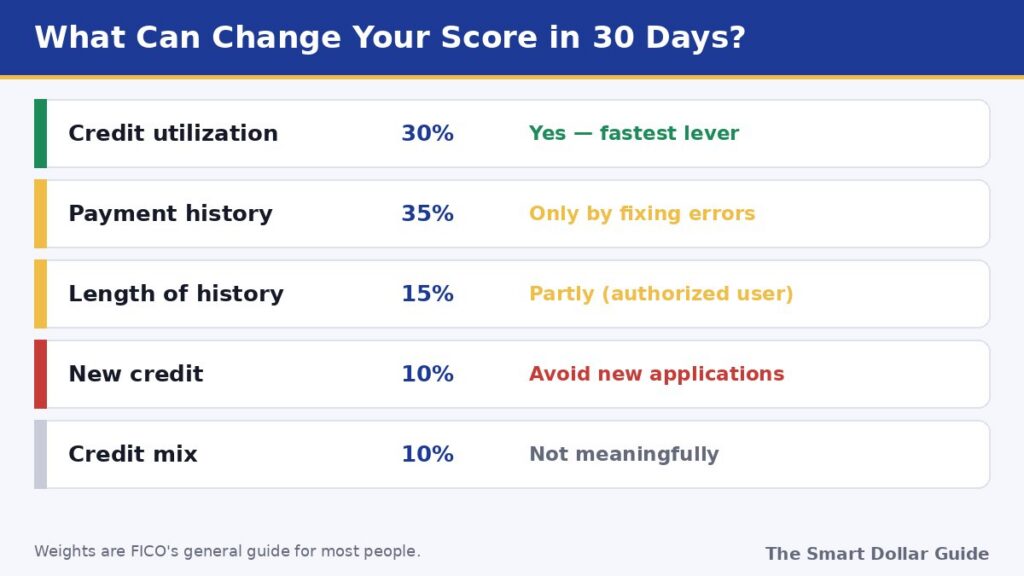
| Score factor (FICO) | Weight | Can it change in 30 days? |
|---|---|---|
| Payment history | 35% | Only by fixing errors; late payments stay for years |
| Amounts owed (credit utilization) | 30% | Yes, the fastest lever |
| Length of credit history | 15% | Partly, by becoming an authorized user |
| Credit mix | 10% | Not meaningfully |
| New credit | 10% | Avoid new applications |
For the details behind these weights, see our guide FICO Score explained.
5 Moves to Boost Your Credit Score in 30 Days
1. Pay down card balances before the statement closes
This is usually the fastest way to boost your credit score. Credit utilization is the share of your credit limits you’re using, and it’s based on the balance your issuer reports, which is normally your statement balance. Paying in full after the statement arrives doesn’t help your score if a high balance was already reported.
Example: You owe $3,000 across cards with $10,000 in total limits, so your utilization is 30%. Pay it down to $500 before your statement dates and your reported utilization drops to 5%. Many people with good payment histories see a meaningful jump from this alone (it often matters more than any other single step), though the exact number of points varies and nobody can promise it.
- Find each card’s statement closing date in your app (it’s different from the due date).
- Pay a few days before each closing date.
- Aim for under 10% overall, and avoid maxing out any single card.
- Leave a small balance reporting on one card instead of $0 on all of them; some scoring models score “all zero” slightly lower.
2. Check your reports and dispute errors now
Fixing mistakes is a free way to boost your credit score. A wrong late payment, an account that isn’t yours or a debt listed twice can drag your score down. You can get free reports from Equifax, Experian and TransUnion every week at AnnualCreditReport.com. File disputes online with each bureau that shows the error. Bureaus generally have 30 days to investigate, sometimes up to 45, so start in the first week.
Medical debt tip: a federal rule banning medical debt from credit reports was struck down in 2025, but the three bureaus still voluntarily leave off paid medical collections and medical collections under $500. If you see one of these, dispute it.
3. Ask for a credit limit increase
A higher limit with the same balance lowers your utilization, which can boost your credit score without paying down a dollar. Many issuers let you request an increase online, and some do it with only a soft credit check. Ask the issuer first whether the request will cause a hard inquiry; if it will, skip this move if you’re applying for a loan soon.
4. Become an authorized user on a strong account
Borrowing good history is another way to boost your credit score. If a family member has an old card with a low balance and a perfect payment record, being added as an authorized user can bring that history onto your report, often within one or two billing cycles. It helps most if your own history is short or thin. Only do it with someone you trust: their late payment or high balance can hurt you too, and some lenders discount authorized-user accounts.
5. Get credit for bills you already pay
Services like Experian Boost let you add on-time phone, utility, insurance and streaming payments to your Experian credit file. Some rent-reporting services do the same for rent. The effect is limited: it usually helps only scores based on that bureau’s data, and many mortgage lenders don’t count it. But it’s free or cheap and can give thin files a lift.
A 30-Day Calendar to Boost Your Credit Score Before the New Year
| When | What to do |
|---|---|
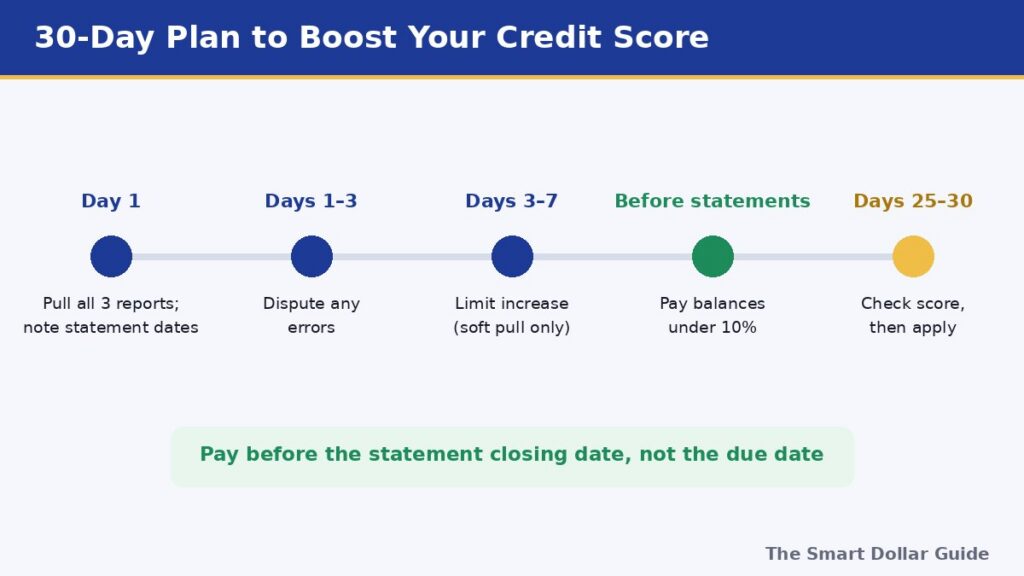
| Day 1 | Pull all three reports; note each card’s statement closing date and balance |
| Days 1–3 | File disputes for any errors |
| Days 3–7 | Request credit limit increases (soft pull only); ask about authorized-user status |
| Before each statement date | Pay balances down to under 10% of limits |
| Week 2 | Connect bill-payment data (optional) |
| Days 25–30 | Check your score and reports again; then apply |
If you need a higher score for a mortgage, ask your lender about a rapid rescore. Lenders can ask the bureaus to update your file within days once you’ve paid down balances or fixed errors, but only a lender can request one. Read our take on mortgage rates in November 2026 if you’re planning to buy.
What Won’t Boost Your Credit Score in 30 Days
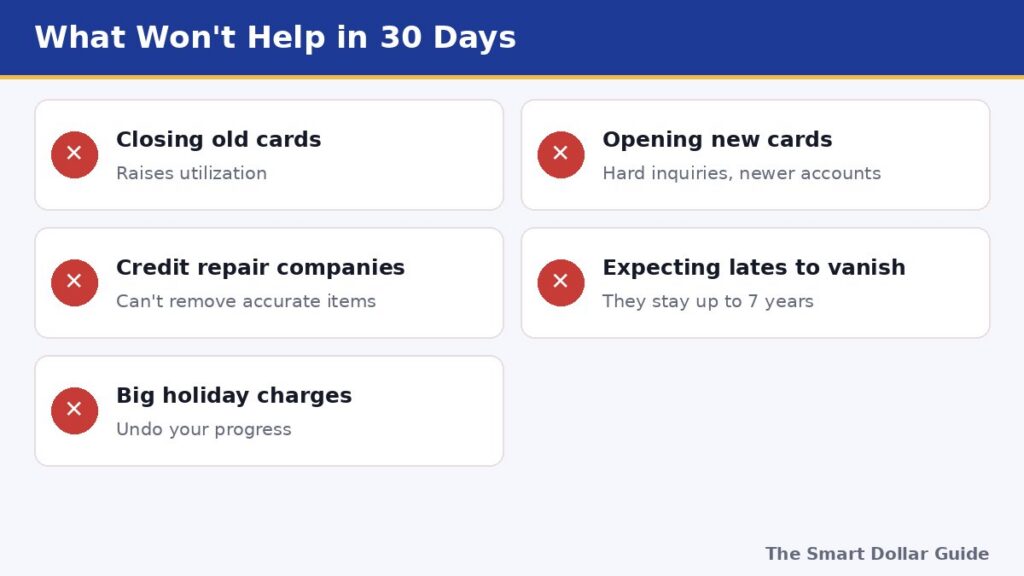
- Closing old cards. It cuts your available credit, which raises utilization, and can shorten your history.
- Opening several new cards. Each application can add a hard inquiry, and new accounts lower your average account age.
- Paying a credit repair company. They can’t remove accurate negative information, and everything they can legally do, you can do yourself for free.
- Expecting late payments to vanish. Accurate late payments stay on your report for up to seven years. A polite “goodwill” letter asking a lender to remove a one-time late payment sometimes works, but there’s no guarantee.
- Paying off an old collection the day before you apply. It’s good to pay, but some older scoring models still count paid collections, so the score may not rise right away.
Keep the Gains Through the Holidays
It takes work to boost your credit score, and all of it can be undone by one big holiday shopping trip that lands on a card right before your statement closes. Set a holiday budget, pay with cash or debit where possible, and make an extra card payment before statement dates in December. Our $500 holiday gift budget plan can help. If you’re carrying large balances you can’t pay down quickly, our guide on whether to consolidate credit card debt explains your options. And keep an eye on the rules themselves; our post on credit score changes in 2026 covers what’s new.
Final Thoughts
You can boost your credit score in 30 days by focusing on what changes fast: pay card balances down before statement dates, dispute errors right away, raise your limits without hard pulls, borrow a strong payment history as an authorized user and get credit for bills you already pay. Avoid new applications and closing old cards, then check your score before you apply. For more guides, visit our Credit section.
Disclaimer: This article is for general information only and is not financial or credit advice. Score changes vary by person and scoring model; no one can guarantee a specific increase. Rules are as of November 2026.
Frequently Asked Questions
Can you really boost your credit score in 30 days?
Often, yes. Most card issuers report balances once a month, so lowering your reported credit card balances or fixing an error can show up within one billing cycle. The number of points varies and no one can guarantee a specific increase.
What is the fastest way to raise my credit score?
Paying down credit card balances before each statement closing date, so a lower balance is reported. Credit utilization makes up about 30% of a FICO Score and has no long-term memory in most models.
What credit utilization should I aim for?
Under 30% is a common guideline, but under 10% overall tends to score best. Avoid maxing out any single card, and let a small balance report on one card instead of $0 on all of them.
How long does a credit report dispute take?
Credit bureaus generally have 30 days to investigate a dispute, and up to 45 days in some cases, such as when you send more information. File in the first week to finish within a month.
Does asking for a credit limit increase hurt my score?
Only if the issuer does a hard credit check. Many issuers use a soft pull, which doesn’t affect your score. Ask before you request one if you plan to apply for a loan soon.
Is a credit repair company worth it?
Usually not. Credit repair companies can’t legally remove accurate negative information, and you can dispute errors yourself for free.